HDFC Bank Ltd Stock (HDB) Moved Down by 3.34% on Mar 19: Facts Behind the Movement

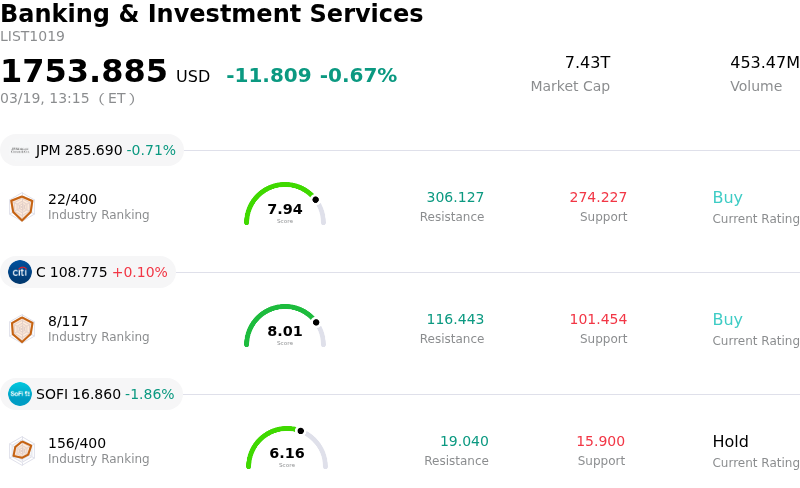
HDFC Bank Ltd (HDB) moved down by 3.34%. The Banking & Investment Services sector is down by 0.67%. The company underperformed the industry. Top 3 stocks by turnover in the sector: JPMorgan Chase & Co (JPM) down 0.71%; Citigroup Inc (C) up 0.10%; SoFi Technologies Inc (SOFI) down 1.86%.
What is driving HDFC Bank Ltd (HDB)’s stock price down today?
HDFC Bank (HDB) experienced a notable decline in its share price today, largely driven by significant governance concerns stemming from the sudden resignation of its Part-time Chairman and Independent Director, Atanu Chakraborty, on March 18, 2026. His resignation cited personal ethical concerns regarding certain practices within the bank, leading to immediate investor apprehension.
The unexpected leadership change triggered substantial intraday volatility and a sharp sell-off, impacting investor sentiment both domestically and in global markets where the bank's American Depositary Receipts are traded. This event has introduced a "governance discount" in the market, as investors await further clarity on the specifics of the ethical concerns mentioned.
Despite the market's reaction, the Reserve Bank of India (RBI) quickly issued a statement approving the transition arrangement and affirming that HDFC Bank remains well-capitalized, financially sound, and without material concerns regarding its conduct or governance based on the regulator's assessments. Additionally, interim chairman Keki Mistry, who was promptly appointed, held a conference call to reassure shareholders that there were no operational or material governance issues behind the resignation, emphasizing the board's cohesion.
While the bank's underlying fundamentals, including its financial performance and asset quality, are broadly considered strong, the lack of detailed disclosures regarding the former chairman's departure continues to weigh on market sentiment in the short term. Analysts anticipate continued volatility until greater transparency emerges, despite many maintaining a positive long-term outlook on the stock's prospects.
Technical Analysis of HDFC Bank Ltd (HDB)
Technically, HDFC Bank Ltd (HDB) shows a MACD (12,26,9) value of [-1.09], indicating a sell signal. The RSI at 20.61 suggests sell condition and the Williams %R at -96.24 suggests oversold condition. Please monitor closely.
Fundamental Analysis of HDFC Bank Ltd (HDB)
HDFC Bank Ltd (HDB) is in the Banking & Investment Services industry. Its latest annual revenue is $33.77B, ranking 13 in the industry. The net profit is $8.38B, ranking 11 in the industry. Company Profile
Over the past month, multiple analysts have rated the company as Buy, with an average price target of $42.70, a high of $47.00, and a low of $35.30.
More details about HDFC Bank Ltd (HDB)
Company Specific Risks:
- The abrupt resignation of the part-time chairman, Atanu Chakraborty, on March 18, 2026, citing "happenings and practices" misaligned with his ethics, has triggered significant governance concerns and investor uncertainty, leading to a substantial market capitalization erosion.
- The bank is currently facing broader sector-wide risk-off pressure on Indian financial institutions due to global market volatility, heightened geopolitical concerns, and potential regulatory tightening regarding the distribution of insurance products, amplifying downside risk for HDFC Bank's ADR.
- Concerns over "leadership risk" and potential boardroom friction have emerged following the chairman's departure, posing an execution risk to the ongoing "HDFC 2.0" strategy and the final stages of merger integration.
- Aggressive competition for deposits to manage the Loan-to-Deposit Ratio (LDR) could sustain a high "cost of funds," thus limiting the expansion of Net Interest Margins (NIMs) which have already compressed post-merger due to inherited borrowings and a higher mix of mortgage loans.