


Who Will Benefit After Jensen Huang Resigns? AMD, Broadcom and TSMC Vie for Nvidia AI Chip Share



AI Podcast


Jensen Huang’s resignation as Nvidia CEO has triggered semiconductor sector capital reallocation, causing Nvidia shares to fall approximately 11% while AMD, Broadcom, and TSMC surged. Investors are seeking alternatives to avoid management risk, benefiting AMD through potential accelerator market share gains and Broadcom via custom ASIC demand. TSMC remains resilient, capturing manufacturing orders regardless of which designer prevails. While Nvidia retains a mature CUDA ecosystem and strong R&D, concerns persist regarding supply chain coordination and long-term competitiveness during this leadership transition, as rivals and cloud giants seek to expand their market footprint.

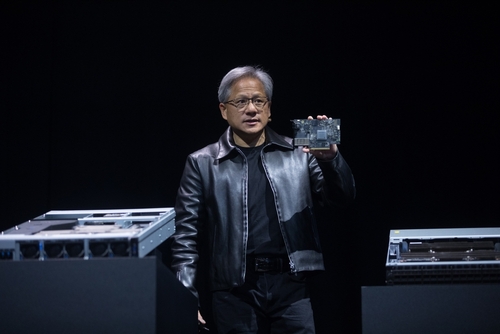
TradingKey - Leadership changes at Nvidia (NVDA) are driving a new round of capital reallocation across the semiconductor sector. Following Jensen Huang's resignation as chief executive officer and board director, investors began searching for alternatives that can benefit from artificial intelligence capital expenditures without directly bearing Nvidia's management risk. AMD (AMD), Broadcom (AVGO), and TSMC (TSM) have therefore become the focus of market attention.
So far this week, Nvidia shares have fallen about 11%, while AMD and Broadcom have surged approximately 30% and 24%, respectively. As the primary manufacturer of Nvidia's advanced chips, TSMC has also gained about 11% over the same period.
Nvidia has appointed Chief Financial Officer Colette Kress as interim CEO and initiated a search for internal and external candidates. The board of directors also appointed Harvey C. Jones as the company's first chairman, aiming to stabilize expectations among customers, employees, and shareholders by strengthening board leadership. The company emphasized that its existing product roadmap, customer commitments, and daily operations will continue to move forward.
However, Jensen Huang's influence does not stem solely from his role as CEO. Over the past thirty-plus years, he has been deeply involved in chip architecture, supply chain configuration, customer partnerships, and industry investments, serving as the key figure connecting Nvidia with TSMC, memory manufacturers, cloud computing providers, and AI laboratories. The market is concerned that while a successor has yet to be named, rivals could exploit this window to compete for customers and manufacturing resources.
Why AMD and Broadcom Are the Most Direct Alternatives?
AMD is the most readily understood beneficiary in the market following Nvidia's leadership adjustments. Both companies sell AI accelerators to data center customers, and AMD is also continuously improving its chip, networking, and software platforms, aiming to provide Microsoft, Meta, Oracle, and AI startups with a second option beyond Nvidia.
Major cloud service providers had already been increasing their procurement of AMD accelerators to reduce reliance on a single vendor. If Nvidia experiences delays in succession, product decisions, or customer communication, cloud computing companies could further raise AMD's share in their procurement plans. Even if AMD cannot fully replace Nvidia for now, merely securing more incremental orders could drive its data center revenue and market share higher.
Broadcom's path to benefiting differs from AMD's. Rather than directly challenging Nvidia with general-purpose GPUs, the company assists tech giants such as Google in developing custom AI chips and provides high-speed networking and connectivity products. As cloud computing companies seek to lower computing costs, the importance of in-house ASICs could rise further.
If customers worry that Nvidia's management changes will affect long-term supply or product roadmaps, they may accelerate internal chip projects. Broadcom can generate revenue across multiple stages, including chip design, network switching, and data center connectivity.
TSMC May Be Relatively Resilient Winner in Supply Chain Realignment
Compared with AMD and Broadcom, TSMC's advantage is that it does not need to bet on which chip designer will ultimately prevail.
Nvidia's most advanced AI processors are primarily manufactured by TSMC, AMD's high-end CPUs and GPUs likewise rely on its advanced processes, and most of Broadcom's outsourced wafers also come from TSMC. JPMorgan Asset Management previously estimated that nearly all advanced chips from Nvidia and AMD are foundry-manufactured by TSMC, and approximately 95% of Broadcom's outsourced wafers also depend on the company.
If order growth from Nvidia slows while demand rises for chips from AMD, Broadcom, or major cloud service providers developing in-house silicon, some advanced process and packaging capacity could be reallocated among different customers. As long as overall investment in AI computing power does not drop significantly, TSMC still stands to benefit from shifts in chip demand.
Compared to a single chip designer, TSMC can simultaneously serve customers across GPUs, custom accelerators, CPUs, and high-speed networking chips. Whether the ultimate market share goes to Nvidia, AMD, or in-house chips from Google and Amazon, many orders are still likely to flow back to TSMC's manufacturing platform.
Jensen Huang has long maintained close ties with TSMC and other suppliers, helping Nvidia secure priority access to resources during periods of tight capacity in CoWoS advanced packaging, HBM support, and advanced process nodes. If a new management team fails to maintain the same level of supply chain coordination, AMD and hyperscale cloud providers could capture more of the newly added capacity.
Will Competitors Catch Up to Nvidia's Lead?
Jensen Huang's value to Nvidia is reflected not only in its technology roadmap and product strategy, but also in the supply chain relationships he has established over the long term.
Advanced manufacturing capacity in the semiconductor industry is extremely limited. From wafer fabrication to advanced packaging, high-bandwidth memory, and high-speed networking components, the production of AI chips requires tight coordination across multiple stages. A key reason Nvidia has been able to establish a leading position amid fierce competition is that the company partnered early with critical suppliers and secured scarce manufacturing and packaging resources through long-term planning.
Dylan Patel, CEO of SemiAnalysis, believes that Jensen Huang personally participated in building Nvidia's relationships with manufacturers and component suppliers, enabling the company to secure critical capacity early on. In his view, if Huang were to leave, Nvidia might face tests regarding changes in its supply chain coordination capabilities, while hyperscale cloud providers with proprietary chip programs, such as Google and Amazon, could seize the opportunity to further expand their own supply chain footprints.
This has potential implications for the competitive landscape of the AI chip industry. Google and Amazon have been developing their own AI chips, partly to reduce their reliance on Nvidia GPUs. If Nvidia's future management needs to devote more energy to corporate governance and strategic succession, competitors could gain more time to advance their in-house chip initiatives and build closer partnerships with wafer foundries, packaging providers, and memory makers.
Patel also noted that Nvidia's technological edge and supply chain control are interconnected. If its supply chain coordination capability is compromised, the company will need to rely more heavily on chip performance and its software ecosystem to stay ahead in the competition. Considering that the technological gap between Nvidia and some of its major competitors is not insurmountable, a management transition could amplify market concerns over its long-term competitiveness.
However, Nvidia possesses a massive R&D team, a mature CUDA ecosystem, and long-standing customer relationships, and its supply chain network is not sustained by a single executive alone. Were Huang to leave, it would not mean existing capacity contracts and supply relationships would become invalid immediately. What truly warrants observation is whether the new management team can sustain the existing product roadmap and supply chain coordination capabilities, and whether major customers and suppliers will adjust their long-term cooperation arrangements as a result.
This content was translated using AI and reviewed for clarity. It is for informational purposes only.
Recommended Articles








Comments (0)
Click the $ button, enter the symbol, and select to link a stock, ETF, or other ticker.