


Nvidia Falls Over 7% Premarket, AMD and Broadcom Buck Trend to Gain Over 2%: Jensen Huang’s Future May Drive Customers to Diversify Chip Purchases



AI Podcast


Nvidia’s board is discussing CEO Jensen Huang’s future amid an ongoing independent investigation and a shareholder class-action lawsuit, causing premarket shares to drop over 7% on November 12 ET. While potential management changes threaten strategic execution, competitors like AMD and Broadcom rallied over 2% on expectations of capturing AI chip orders. Despite leadership uncertainty, Nvidia’s entrenched CUDA ecosystem and proprietary infrastructure insulate its near-term market position. Investors should monitor upcoming CEO succession developments, subsequent Q3 fiscal 2027 earnings on November 17, and customer procurement shifts toward alternative platforms including Google TPUs.
TradingKey - Nvidia (NVDA) CEO Jensen Huang's future continues to hang in the balance, with the board reportedly discussing whether to remove him from his post.
As of press time on November 12 ET, Nvidia shares fell more than 7% in premarket trading, while AMD (AMD) and Broadcom (AVGO) bucked the trend, rising over 2%. The market is concerned that management changes could impact Nvidia's customer relationships and strategic execution, while watching whether AMD, Broadcom, and Google parent Alphabet (GOOGL) can capitalize on this to win more AI chip orders.
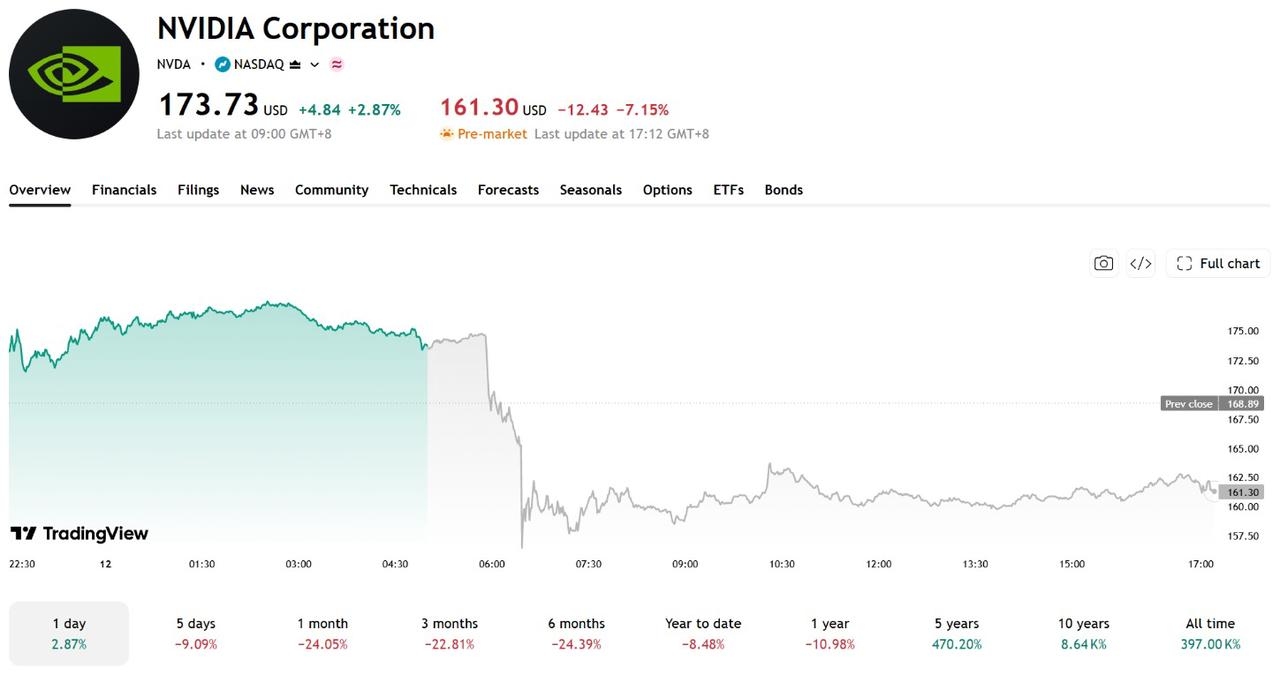
[Source: TradingView]
Nvidia Board Discusses Jensen Huang's Future as Succession Questions Heat Up
On November 11, The Wall Street Journal reported, citing people familiar with the matter, that Nvidia's board of directors is preparing to remove Jensen Huang as CEO and plans to hold a meeting to discuss his future.
Reuters subsequently reported that the board met that evening to discuss whether to remove Huang. Bloomberg, meanwhile, reported that the board is working with an external firm to search for potential successors and considering appointing an interim CEO.
The turmoil stems from controversy surrounding Jensen Huang's extramarital affair and reports that he may have been targeted by foreign intelligence operations. On November 8, Nvidia's board announced the launch of an independent investigation and retained independent external legal counsel to assist in reviewing the situation.
At the time, the board expressed support for Huang and his management team, stating that there was currently no reason to believe U.S. national security or Nvidia's trade secrets had been compromised.
Meanwhile, Nvidia is also facing a shareholder class action. On November 9, investor Mark Kistenmacher filed a proposed securities class-action lawsuit in the U.S. District Court for the Northern District of California, naming Nvidia and Huang as defendants.
Huang co-founded Nvidia in 1993 and has long led the company's product development and business strategy. Reuters noted that Huang has not explicitly designated a successor, and the company has no obvious candidate to take over.
Dan Niles, founder of Niles Investment Management, expects that Huang could leave Nvidia. In a post on November 11, he stated that Huang could announce his departure as early as the following morning, and that he expected current CFO Colette Kress to serve as interim CEO.
Niles also believes that the incoming interim CEO may set a lower bar for future performance expectations. Nvidia's stock currently trades at roughly 11 times forward 2026 earnings, a valuation he believes could fall further into the single digits.
If Huang departs, the market may reevaluate Nvidia's management stability, technology roadmap, and customer relationships. However, as of publication, the board has not officially announced whether it will remove Huang from his post.
AMD, Broadcom and Other Rivals See Opportunity
As Nvidia's share price comes under pressure, AMD and Broadcom have drawn market attention, though their competitive directions differ.
AMD is Nvidia's direct competitor in the AI accelerator space, with its Instinct series GPUs primarily used for AI training and inference. If major cloud service providers wish to reduce their reliance on Nvidia, AMD is poised to win more orders. However, switching GPU platforms involves software adaptation, system deployment, and supply capacity, and it will take time for customers to shift procurement.
Broadcom, meanwhile, primarily benefits from demand for custom AI chips (ASICs) and data center networking equipment. With tech giants like Google and Amazon continuing to develop proprietary AI chips, Broadcom is expected to capture more business by participating in chip design and providing networking solutions.
Google TPUs may also gain more attention as a result. Primarily designed for specific AI workloads, TPUs differ from Nvidia GPUs in their general-purpose computing capabilities and scope of applications, making a full replacement of GPUs difficult in the short term.
However, the rise in AMD and Broadcom shares does not mean that Nvidia customers have already shifted orders. There is currently no sufficient evidence to indicate that this management turmoil has altered customers' actual procurement plans.
Can Nvidia Sustain Its Competitive Advantage?
Nvidia's competitive edge stems not only from GPU performance, but also from its CUDA software ecosystem, developer tools, and comprehensive data center product suite. A large number of enterprises have already built their AI development and infrastructure around Nvidia GPUs, and switching to alternative platforms would incur additional software adaptation and deployment costs. Therefore, even if Jensen Huang departs, Nvidia will not immediately lose its market position.
Going forward, investors will need to monitor the board's CEO selection and whether the successor can maintain the existing product roadmap and customer partnerships.
Meanwhile, AMD's AI chip orders, Broadcom's custom chip business, and the deployment progress of Google's TPUs are also worth watching.
Nvidia is scheduled to report its third-quarter fiscal 2027 financial results on November 17. Data center revenue, GPU shipments, gross margins, and next-quarter revenue guidance will help investors assess whether the management turmoil has affected the company's fundamentals.
This content was translated using AI and reviewed for clarity. It is for informational purposes only.
Recommended Articles









Comments (0)
Click the $ button, enter the symbol, and select to link a stock, ETF, or other ticker.