


Jensen Huang Abruptly Steps Down, Nvidia Pares 14% Intraday Plunge, Stock Seen Rebounding Toward $190



AI Podcast


On November 12, Eastern Time, Nvidia shares fell 4.34% to close at $166.19 amid heavy trading volume after co-founder Jensen Huang abruptly resigned as CEO. CFO Colette Kress assumed the interim role. The sudden departure introduces management and strategic uncertainty, triggering early panic selling that drove the stock to an intraday low of $148.80. Heavy retail dip-buying provided crucial support near the $150 level. Technically, the RSI entered oversold territory at 26.14, signaling limited near-term downside. Investors now await upcoming quarterly earnings and clarity on product roadmap continuity. Key resistance stands at $170 and $190, with downside support at $150 and $130.

TradingKey - On November 12, Eastern Time, Nvidia (NVDA) shares experienced sharp volatility following the sudden resignation of CEO Jensen Huang. NVDA gapped down sharply at the open and touched an intraday low of $148.80, down roughly 14% from the prior session at one point, before staging a marked rebound to ultimately close at $166.19, down 4.34%. Full-day trading volume reached approximately 748 million shares, expanding significantly from recent average levels.
Jensen Huang Departure Adds Management Uncertainty as Initial Panic Selling Partially Absorbed
On November 12, Nvidia officially announced that co-founder Jensen Huang resigned as president, CEO, and director, effective immediately. The company's current CFO, Colette Kress, has been named interim CEO, and the board has initiated a search process for a permanent CEO. Huang led Nvidia for over 30 years and spearheaded its transformation from a graphics chipmaker into a core global supplier of AI computing. Consequently, the impact of his sudden departure is primarily centered on management stability, product strategy continuity, and key customer relationships, rather than any sudden shift in current demand for Nvidia's AI chip business.
Judging from the stock price reaction, the initial wave of panic selling has clearly been absorbed, though it is not yet possible to determine whether the selling pressure has completely ended. NVDA dropped to as low as $148.80 at the open before rebounding over 11% from its low, ultimately narrowing its full-day decline to 4.34%. Meanwhile, Reuters, citing data from Vanda Research, reported that retail investors net-bought approximately $111 million worth of Nvidia shares in the first half-hour of trading—a record level—while buy orders on the Fidelity platform were nearly five times sell orders by midday. This indicates that notable buying support emerged around $148 to $150.
However, the unusually heavy trading volume of 748 million shares also indicates that the market is still readjusting the risk premium following Huang's departure. Nvidia has yet to name a permanent CEO, and the company is also scheduled to report quarterly earnings next week. The market will need further confirmation on whether continuity will be maintained across the Blackwell and subsequent product roadmaps, data center demand, and the new management team's strategy.
Nvidia Stock Price Technical Analysis
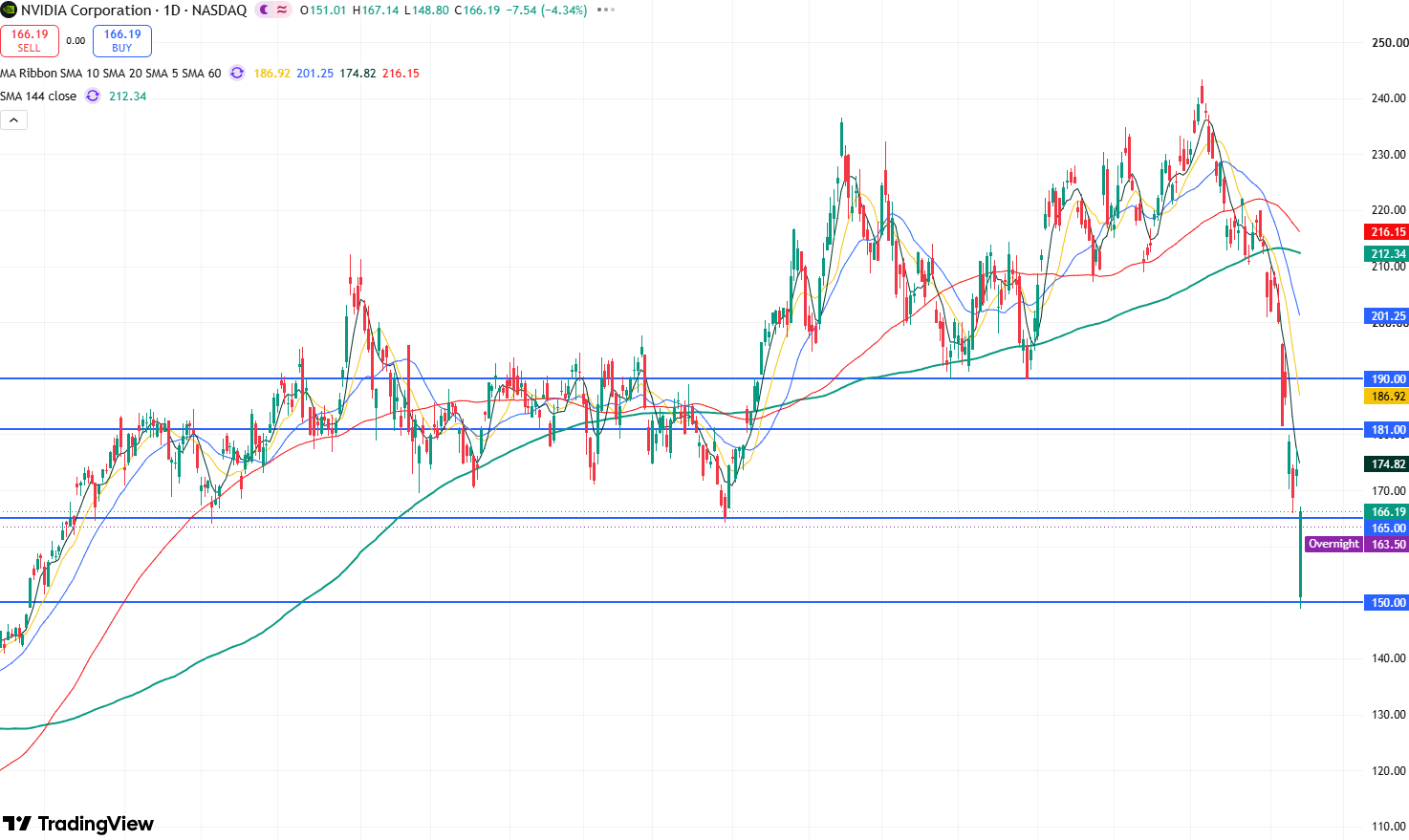
Nvidia stock daily chart, Source: TradingView
Looking at Nvidia's daily chart, the stock opened sharply lower at $151.01 on Thursday under pressure from the negative news of Jensen Huang's resignation, briefly falling below key support at $150 intraday. However, it quickly rebounded to recover most of its losses, indicating that market selling pressure has been somewhat absorbed, thereby supporting a stock rebound.
In terms of technical indicators, the Relative Strength Index (RSI) stands at 26.14, having entered oversold territory, which suggests that near-term downside room for the stock may be limited and that the probability of a rebound has significantly increased.
Currently, the stock has found support at the key $150 level and halted its decline, and it may see a short-term technical recovery rally. The primary upside target to watch is the $170 resistance level; a breakout above this level could drive a further advance toward key resistance at $190, and breaking and holding above $190 would likely restore its medium-term upward structure.
On the downside, the key support level to watch is $150. If this level is lost, the stock could slide further toward the support level near $130.
This content was translated using AI and reviewed for clarity. It is for informational purposes only.
Recommended Articles









Comments (0)
Click the $ button, enter the symbol, and select to link a stock, ETF, or other ticker.