


Philadelphia Semiconductor Index Jumps 6%, Reclaims 10,000: Morgan Stanley Says Long-Term AI Investment Logic Has Not Fundamentally Changed, Prefers Nvidia and Broadcom



AI Podcast


On November 9, ET, the Philadelphia Semiconductor Index surged over 6% as markets reassessed AI supply chain impacts. Morgan Stanley noted that prior selloffs overreacted to potential U.S. data center project delays, clarifying that long-term AI investment demand remains intact. While about 20% of 2028 U.S. projects may face delays, total capex forecasts for major tech firms remain stable at $1.6 trillion in 2027 and $1.8 trillion in 2028. Morgan Stanley favors well-capitalized leaders like Nvidia, Broadcom, and TSMC for dip-buying, while highlighting that slowing construction may ease supply chain imbalances and benefit software deployment.
TradingKey - On November 9, ET, the Philadelphia Semiconductor Index surged more than 6% intraday to reclaim the 10,000-point mark, as the market reassessed the impact of slowing data center construction on the AI supply chain.
Earlier, concerns over tightening approvals sparked by the U.S. midterm elections drove a sharp correction in AI-related stocks. Morgan Stanley noted in a weekend research report that the market had overreacted, pointing out that policy changes primarily affect project timelines, while long-term investment demand for AI remains fundamentally unchanged.
Simply put, if customers merely delay construction, chip orders and revenue may only be deferred, whereas the prior selloff had already priced in more pessimistic expectations regarding the sustainability of investment.
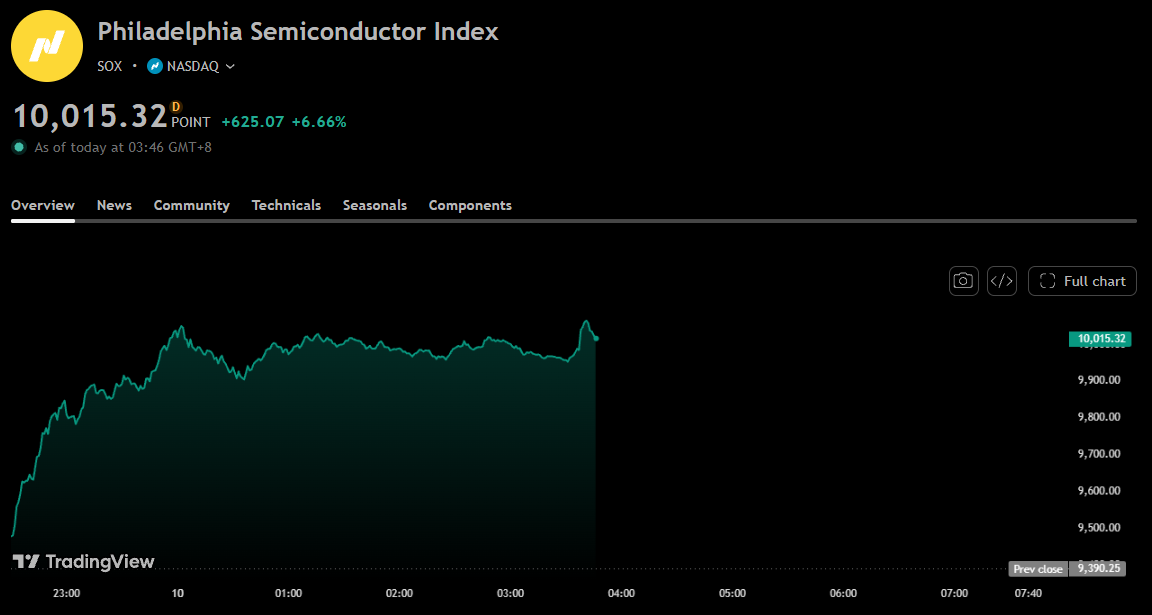
Philadelphia Semiconductor Index, Source: TradingView
Morgan Stanley Maintains AI Capex Forecast as Data Center Projects May Face Delays
Morgan Stanley estimates that approximately 20% of U.S. data center projects originally scheduled for 2028 could be delayed to 2029, involving about 5 gigawatts of IT load capacity, equivalent to roughly 10% of relevant global projects. Projects that have already entered the construction phase are not expected to be significantly affected.
According to the bank's estimates, new U.S. data center capacity additions will decline by about 4% year-over-year in 2028, before rebounding by approximately 38% in 2029. This suggests that construction pressures may alter the timing of revenue realization, but they are not yet sufficient to prove that the broader investment cycle is turning into a contraction.
Therefore, Morgan Stanley still maintains its forecasts for total capital expenditures of major cloud computing and tech companies at approximately $1.6 trillion in 2027 and $1.8 trillion in 2028, respectively. The rationale is that scaling large models and AI applications to billions of users will continue to require ongoing increases in computing resources.
A slower construction pace could also provide some buffer. The bank believes this will help ease supply chain imbalances, improve financing conditions, and support compute leasing prices. However, if approval delays widen further, the 2028 capex forecast could still be revised downward.
Nvidia, Broadcom Favored as Semiconductor Dip-Buying Focuses on Profitability
For semiconductor companies, capital expenditure expectations remain stable, providing demand support for future orders. However, during project delays, some suppliers may still face slowing deliveries, rising inventories, and shrinking margins; therefore, rebound opportunities must be assessed based on each company's specific situation.
Morgan Stanley favors larger, well-capitalized leaders, including Nvidia (NVDA), Broadcom (AVGO), and TSMC (TSM). The firm set a price target of $505 for Broadcom, implying roughly 72% upside from the reference share price in the report.
In the hardware sector, where valuations have pulled back significantly, the firm is also watching Seagate Technology (STX), Western Digital (WDC), as well as Lumentum (LITE), Coherent (COHR), and Arista Networks (ANET). The screening focuses on whether companies can sustain profitability during periods of order volatility and withstand financial pressures from delayed revenue realization.
Meanwhile, Morgan Stanley believes that AI investment opportunities will gradually broaden to software and applications. As enterprises begin deploying AI into practical business operations, it is expected to generate revenue for companies beyond infrastructure while providing a commercial justification for sustained investments in computing power.
This content was translated using AI and reviewed for clarity. It is for informational purposes only.
Recommended Articles








Comments (0)
Click the $ button, enter the symbol, and select to link a stock, ETF, or other ticker.