


Alphabet Plans to Launch Two New TPUs, May Push Stock Back to $300 Mark



AI Podcast


Alphabet is accelerating its proprietary TPU chip development to challenge Nvidia’s market dominance, planning to launch two new products next year targeting confidential computing and large-scale AI applications. Offering a 30% price advantage over Nvidia GPUs, Google has already attracted major clients like Apple, Meta, and Oracle, with external chip sales projected to exceed $135 billion by 2028. While supply shortages remain a constraint, partnerships like the one with Marvell aim to expand capacity. Technically, Google's stock remains in a medium-term downward trend, currently consolidating with the 10-day exponential moving average acting as a key short-term pivot.

TradingKey - Google parent Alphabet (GOOGL) plans to launch two TPU chip products targeting confidential computing and AI applications that require processing large amounts of information, respectively, with availability expected next year. As its proprietary chips begin to be sold to customers beyond its cloud business, Google is expanding its product choices to compete for the Nvidia (NVDA)-dominated AI computing market.
The newly launched TPU 8tx and 8i Max feature adjusted configurations based on existing designs. The 8tx is paired with AMD (AMD) processors to protect data at the chip level, targeting government and strictly regulated industries; meanwhile, the 8i Max packages two TPUs together to increase computing power and memory, supporting tasks that require processing long-form information, such as coding and drug discovery.
These configurations allow Google to offer products tailored to customer requirements for security and performance, helping expand the application scope of TPUs. Previously, Google launched a new generation of AI processors roughly every two years, but this year it has already rolled out two models simultaneously. Adding further variants now reflects that it is accelerating product development to meet demand.
Industry research forecasts show that Google's sales of TPUs and related hardware and software will exceed $135 billion by 2028, significantly higher than the $12 billion estimated for this year. This means that external chip sales are poised to become an important revenue stream for Google beyond its cloud services.
In addition, Google's TPUs are priced about 30% lower than Nvidia GPUs, while their data processing capabilities remain competitive. Apple (AAPL), Meta (META), and Oracle (ORCL) have already become customers, and specialized configurations are expected to further enhance product appeal.
Growing demand has also brought delivery pressure. In its earnings report last month, Google stated that all currently available TPUs had been contracted, but shortages in memory and manufacturing capacity constrained supply. The company recently reached a partnership with Marvell Technology (MRVL) involving part of its TPU work, creating room to expand its supply sources.
For Google, the opportunity to expand its chip business centers on two points: winning customers through specialized products, and then delivering sales growth through supply expansion.
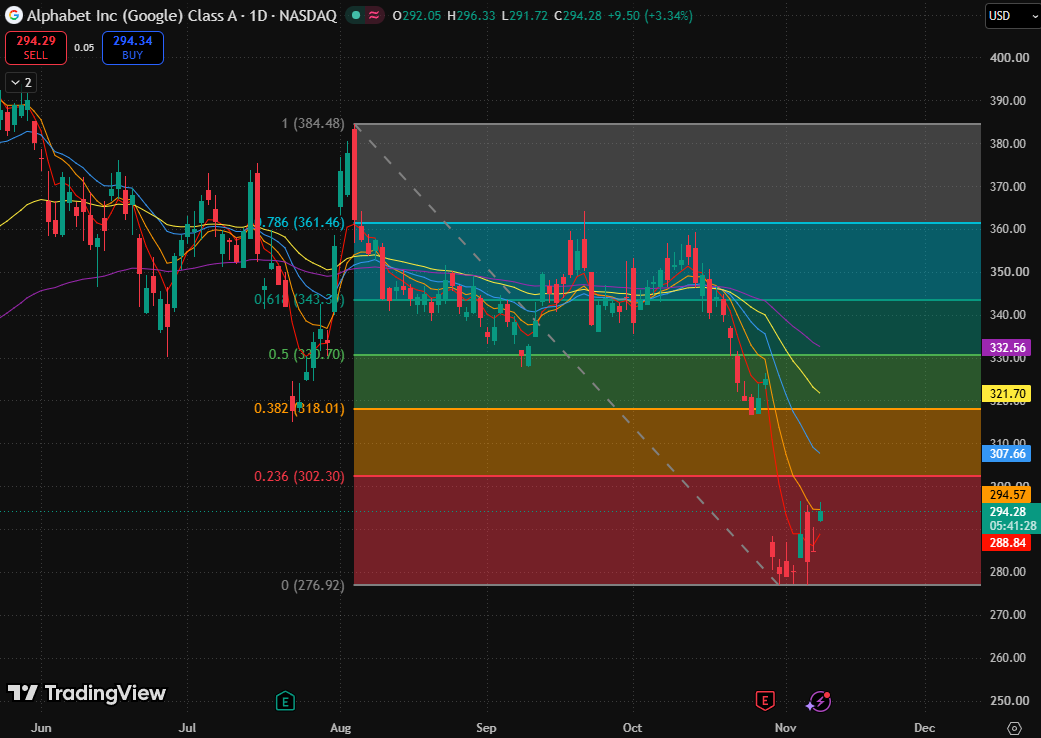
Google Stock Price Chart, Source: TradingView
Google's stock price is currently in a low-level consolidation and recovery phase following a sharp decline. Buying support has emerged multiple times near $276.92, and the price has also climbed back above the 5-day exponential moving average, but it has yet to firmly hold above the 10-day exponential moving average ($294.57), leaving the medium-term downward structure unchanged.
The current pivot is the 10-day exponential moving average. Although the price crossed above it intraday, it has now fallen back below it, indicating that it is still attempting a short-term breakout and has yet to achieve a firm footing and retest confirmation after reclaiming the level. In terms of moving averages, the five moving averages remain in a complete bearish alignment, with the upward turn of the shortest moving average not yet altering the medium-term direction, and the price currently having reclaimed only the shortest-term line.
Looking ahead, if the daily chart firmly holds above the 10-day exponential moving average, breaks above the rebound high near $296-$297, and holds support on a retest, the recovery can be expected to continue; the more significant resistance band is the $302.30-$307.66 zone formed by the 0.236 Fibonacci retracement level and the 20-day exponential moving average. If the price falls below the 5-day exponential moving average and fails to reclaim it on a bounce, the short-term outlook will weaken again.
This content was translated using AI and reviewed for clarity. It is for informational purposes only.
Recommended Articles








Comments (0)
Click the $ button, enter the symbol, and select to link a stock, ETF, or other ticker.