


Nvidia Stock Retreats 25% From High: FY2028 P/E Nears About 11x, Is Now the Time to Buy?



AI Podcast


Nvidia shares experienced a significant pullback driven by mounting investor concerns over AI capital expenditure returns, financing costs, data center construction delays, and executive management scrutiny. Despite the stock price decline, market earnings forecasts remain stable, resulting in lower forward price-to-earnings multiples. While current valuations offer a buffer against moderate growth deceleration, market divergence persists regarding potential risks to customer procurement and order fulfillment. Future investment returns will depend heavily on upcoming order deliveries, revenue guidance, and margin trajectories to confirm whether the valuation discount provides an attractive entry point.
TradingKey - From its peak on October 6 to November 5, Nvidia (NVDA) shares experienced a cumulative pullback of about 25%. Over the span of a month, investor focus shifted from computing power demand growth to whether customers can afford the costs of sustained expansion. Subsequently, Jensen Huang admitted to an extramarital affair, sending the stock price down further to around $175.
A series of negative news has pressured valuations, but market earnings forecasts have yet to fall in tandem. This disconnect has also made whether Nvidia is already cheap enough a new focal point of debate.
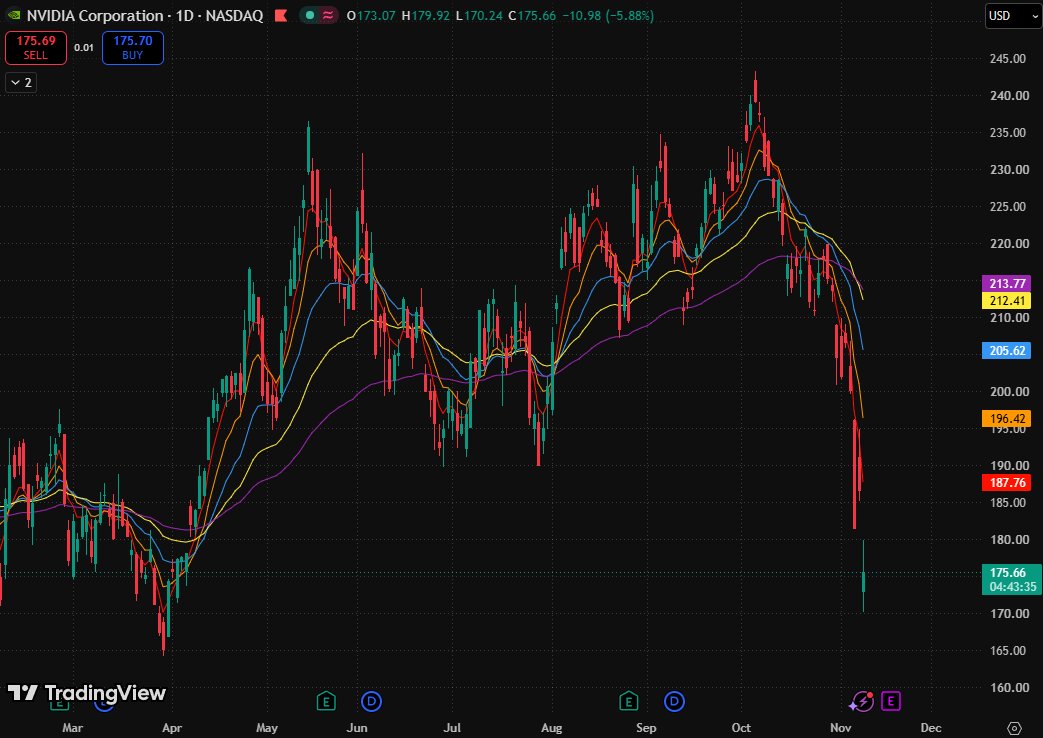
Nvidia stock chart, Source: TradingView
Nvidia Slide Timeline: AI Investment Doubts, Buildout Headwinds and Jensen Huang Turmoil
The first shift occurred in market sentiment toward AI capital expenditures. In late October, Big Tech companies continued to raise their investment plans, yet failed to dispel investor doubts over returns. A Reuters report noted that concerns over rising financing costs and the slow payback on AI investments have spread from equity markets to credit markets.
Customer capital expenditures were originally the growth driver for Nvidia. However, if customers must use more expensive capital to purchase computing power while revenue realization lags behind, procurements could be delayed. Consequently, the market began to lose confidence in the sustained rapid growth of future orders.
In early November, data center construction faced policy-related uncertainties. The Democrats' victories in key gubernatorial races during the midterm elections sparked market concerns over tighter approvals and a construction slowdown. On November 5, Nvidia fell 9.3% in a single day.
This extended the risks from financing to delivery: even if customers are willing to invest, delays in data centers, power availability, and approvals could postpone equipment procurement and revenue realization. While Nvidia's long-term demand may not disappear, the timeline for growth realization could be pushed back.
On November 8, Jensen Huang publicly admitted to marital infidelity. Concurrently, the board announced an independent investigation into related national security reports, while expressing continued confidence in Huang and the management team.
Family asset arrangements have also drawn scrutiny as a result. Company disclosures show that as of March 23, a single family trust co-trusteed by Huang and his wife held approximately 529 million shares. Currently, there is no credible report of an announced divorce. If a future divorce involves cash payments or concentrated share sales following equity division, it could create additional selling pressure.
Nvidia FY2028 Forward P/E Around 11x: Is Now the Time to Buy?
While the stock price continues to pull back, market earnings forecasts remain relatively stable. According to data compiled by Tenet Investing as of November 9, Nvidia's fiscal 2027 and 2028 EPS estimates stand at $9.29 and $15.81, respectively, edging up 0.1% and 0.2% over the past 30 days.
Based on a price of $175, the corresponding P/E multiples are approximately 18.8x and 11.1x, respectively. The latter is based on expectations of roughly 70% EPS growth in fiscal 2028. If that growth materializes, investors are effectively paying about 11x earnings to hold a company whose profits are still expanding rapidly.
However, pressures surrounding data center construction and customer financing could also affect these growth expectations. Comparing valuations under downwardly revised earnings forecasts provides a clearer picture of how much buffer the current price offers.
Earnings Scenario | EPS | Corresponding P/E |
Fiscal 2027 Market Estimate | $9.29 | 18.8x |
Fiscal 2028 Market Estimate | $15.81 | 11.1x |
Fiscal 2028 Estimate Cut by 20% | $12.65 | 13.8x |
Fiscal 2028 Estimate Cut by 40% | $9.49 | 18.4x |
Note: The latter two are stress tests, both calculated using a fixed share price of $175.
Assuming the fiscal 2028 EPS estimate is lowered by 20% to approximately $12.65, the P/E multiple would rise to 13.8x, yet EPS would still grow by roughly 36% compared with the fiscal 2027 estimate. This indicates that the current price can absorb a degree of growth deceleration, and valuation appeal would not immediately evaporate with downward earnings revisions.
If the estimate is reduced by 40%, the picture changes significantly. EPS would drop to around $9.49, representing growth of only about 2% over the fiscal 2027 estimate, while the P/E multiple would rebound to 18.4x. At that point, earnings growth would near stagnation, weakening the original buy case supported by rapid expansion.
This is precisely where market opinions diverge. Bulls believe that falling share prices and stable earnings forecasts mean they can buy similar expected returns at a lower price. In contrast, cautious investors worry that analysts have not fully factored in financing and construction pressures, meaning the low P/E multiple may hinge on overly optimistic projections.
Determining which view carries more weight depends on order fulfillment. If the slowdown in construction stems primarily from regulatory approvals, power grid hookups, or construction delays while customers maintain procurement plans, the impact would mainly manifest as deferred revenue. However, if customers slash purchases due to capital constraints or subpar returns, the pressure could further transmit to revenue, pricing, and margins.
A price of $175 already leaves room for some growth slowdown. In subsequent earnings reports, order deliveries, revenue guidance, and margin trajectories will determine whether this valuation discount can translate into investment returns.
This content was translated using AI and reviewed for clarity. It is for informational purposes only.
Recommended Articles











Comments (0)
Click the $ button, enter the symbol, and select to link a stock, ETF, or other ticker.