


Crude Oil Price Forecast: Oil Falls 4% as US, Iran Signal Talks, Technicals Point to Brent Testing $88



AI Podcast


On Monday, November 9, Eastern Time, international oil prices declined significantly, with Brent and WTI crude futures dropping 4.3% and 3.5%, respectively. This downturn was primarily driven by receding geopolitical risk premiums, as potential U.S.-Iran negotiations and easing supply disruption concerns diminished conflict fears. Technically, Brent crude’s short-term upward momentum is disrupted, with prices falling below key moving averages. Stabilization depends on reclaiming and holding $93.80 per barrel, while resistance clusters near $98.35–$99.45. A break below the $92.80 intraday low risks further downside toward the $88.21 Fibonacci support level.
TradingKey - On Monday, November 9, Eastern Time, international oil prices fell again. As of press time, Brent crude futures (UKOIL) fell 4.3% to $93.7 per barrel; U.S. WTI crude futures (USOIL) fell 3.5% to $87.76 per barrel. Intraday, Brent crude's decline briefly exceeded 5%.
Signals of negotiations between the U.S. and Iran, coupled with unconfirmed reports of Iranian concessions regarding the Strait of Hormuz, eased market concerns over escalating conflict and energy supply disruptions, driving down the geopolitical risk premium in oil prices.
According to media reports including Iran's Tasnim News Agency and Qatar's Al Jazeera, Iranian President Masoud Pezeshkian stated on the 9th that the Supreme Leader had ordered an end to the 'neither war nor peace' state. Iran is willing to resolve issues through negotiations on the premise of safeguarding its dignity, but will not bow to coercion or bullying.
Trump said over the weekend that the likelihood of the U.S. launching a large-scale military strike against Iran was 'extremely low.' However, in a subsequent interview, he emphasized that this depends on whether Iran is willing to sign a 'very tough deal,' showing that the risk of military action remains tied to the outcome of negotiations.
Short-term diplomatic signals can depress the risk premium, but whether shipping security can achieve sustained improvement still depends on the terms and enforcement of negotiations. Moving forward, the key focus for the market is whether concession rumors can be officially confirmed and whether diplomatic engagements can translate into a substantive agreement.
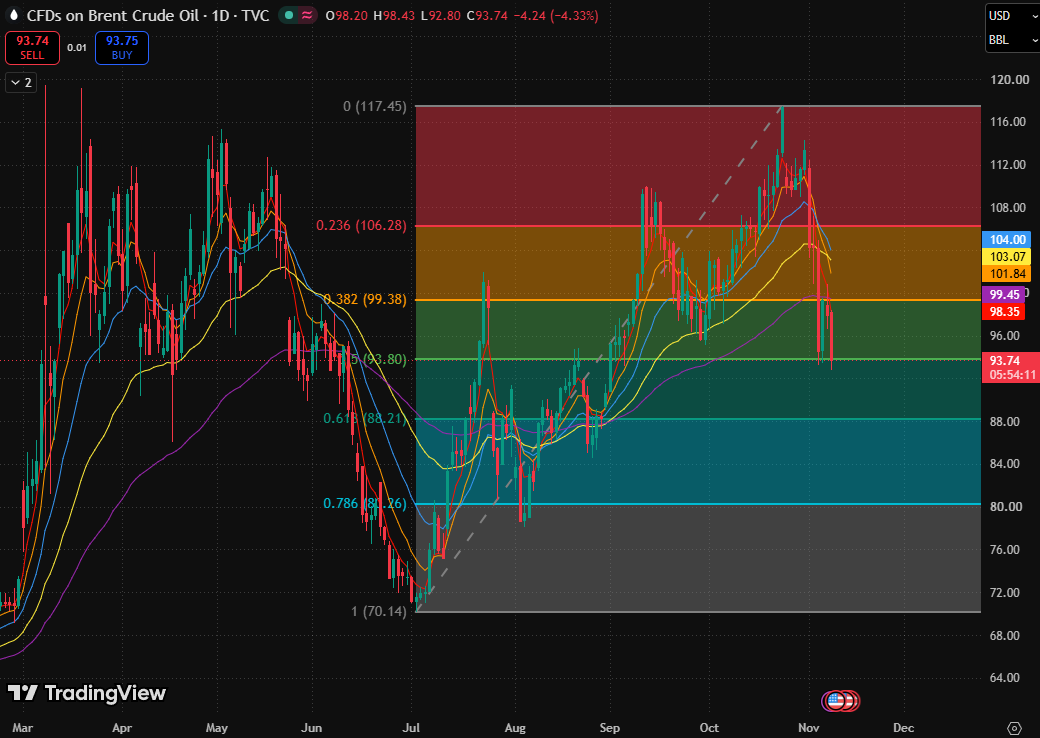
Brent crude daily price chart, Source: TradingView
From a technical perspective, Brent crude's short-term upward momentum has been disrupted, and it currently needs to be confirmed first whether the pullback can stabilize near the halfway mark. Regarding moving averages, although the price is below all five moving averages, the three medium-term moving averages still retain their original bullish sequence; thus, it cannot yet be characterized as a complete bearish alignment across all five moving averages.
Going forward, only if the daily close reclaims $93.80 per barrel and holds it during a subsequent retest will the pullback meet the preliminary conditions for stabilization. Immediate resistance above lies in the $98.35–$99.45 per barrel area formed by the 5-day exponential moving average, the 0.382 Fibonacci retracement level, and the 160-day exponential moving average; the more significant resistance zone is between $101.84 and $104.00 per barrel, where the 10-day, 80-day, and 20-day exponential moving averages reside.
If the price pulls back further and breaks below the intraday low ($92.80 per barrel), and fails to reclaim it on a rebound, buying support will weaken and the risk of a further pullback will rise, potentially dropping toward the 0.618 Fibonacci retracement level ($88.21 per barrel) to seek support.
This content was translated using AI and reviewed for clarity. It is for informational purposes only.
Recommended Articles











Comments (0)
Click the $ button, enter the symbol, and select to link a stock, ETF, or other ticker.