


Nvidia Stock Price Forecast: Jensen Huang Personally Responds to Market Doubts, Can Nvidia Stock Price Still Rise in the Second Half of 2026?



AI Podcast


As of July 16, Eastern Time, Nvidia shares reflect resilience following a June correction, gaining 3.65% in July. Management’s recent roadshow mitigated investor concerns regarding product delays for the Rubin Ultra architecture, competition from custom ASICs, and potential growth saturation. By emphasizing its CUDA ecosystem and diversifying into sovereign AI and industrial markets, Nvidia maintains a strong competitive moat. With Q4 revenue up 85% year-on-year and a robust $80 billion buyback program, technical indicators suggest bullish momentum, with the stock eyeing a potential test of the $300 threshold while holding support at $190.

TradingKey - As of July 16, Eastern Time, Nvidia ( NVDA )'s latest share price stood at $207.4, down 2.4% on the day. Nvidia's share price has been in a continuous correction since June, but stopped its decline and rebounded after entering July, with a cumulative gain of 3.65% in July, indicating that the market still recognizes Nvidia's long-term AI growth thesis.
Jensen Huang Roadshow Crushes Market Concerns
The core driver behind the recent acceleration in Nvidia's stock price rebound is that Jensen Huang and the executive team personally participated in Morgan Stanley's closed-door roadshow, focusing on addressing the market's three major recent concerns about the company.
The first concern is product delays. The market had previously rumored that the next-generation Rubin Ultra architecture might be delayed to 2028 for delivery, raising investor worries about a gap in Nvidia's product iterations. However, Jensen Huang denied this rumor during the roadshow and emphasized that Rubin Ultra is still scheduled to ship on plan. For Nvidia, the stability of its product roadmap is critical, as AI customers' procurement plans, data center construction pacing, and capital expenditure budgets all revolve around Nvidia's GPU architecture iterations. If Rubin Ultra progresses as scheduled, it will help maintain Nvidia's leading edge in the AI training and inference markets.
The second concern is whether cloud service providers' self-developed ASICs will eat into Nvidia's market share. Amazon ( AMZN ), Google ( GOOGL ), Meta ( META) and other major cloud providers are all pushing forward with self-developed AI chips, sparking market worries that these custom chips will erode demand for Nvidia GPUs. However, according to information from Jensen Huang and Morgan Stanley's post-meeting notes, Nvidia believes that ASICs and GPUs do not have a zero-sum relationship. When major AI customers evaluate computing power procurement, the key is not just the price of a single chip, but the cost per token across the entire training and inference workflow. Leveraging its CUDA ecosystem, networking, software stack, system-level optimization, and rapid iteration capabilities, Nvidia can still maintain a comprehensive cost advantage in most commercial scenarios.
The third concern is growth peaking and customer concentration. Nvidia's management broke down three major growth engines: AI labs, traditional hyperscalers, as well as sovereign AI, emerging AI clouds, and the industrial enterprise market. Among them, Microsoft ( MSFT ), Meta, Amazon, and Google remain the core customer base, but sovereign AI and the industrial enterprise market are becoming new growth curves. From a market perspective, if Nvidia's demand relies solely on a few cloud providers, the market will worry about order cycles and capex volatility; however, if demand diffuses to national-level AI infrastructure, AI cloud platforms, and enterprise customers, the company's long-term growth visibility will be much higher.
Financial results show that Nvidia is still in a phase of hyper-growth. In its latest quarter, revenue reached $81.6 billion, up 85% year-on-year; data center revenue reached $75.2 billion, up 92% year-on-year. This indicates that demand for AI chips has not cooled down significantly, and the Blackwell product cycle is still ramping up rapidly. Meanwhile, the company's newly authorized $80 billion share buyback authorization and increased dividend also reinforce the signal management is sending to value investors: Nvidia is not just a growth stock, but also possesses the capability to deliver consistent cash returns.
Nvidia Stock Price Technical Analysis: Stock Price Poised to Reach $300
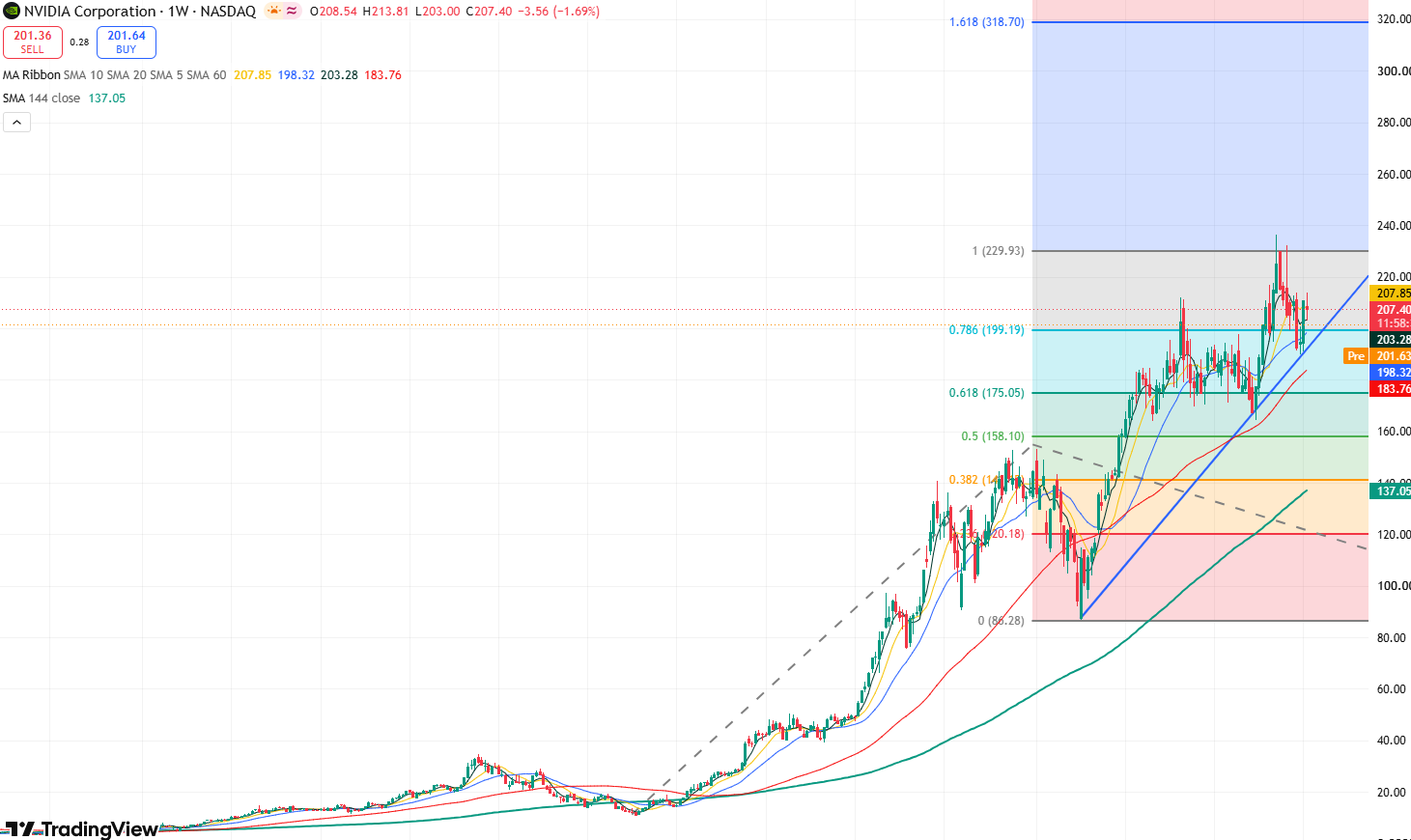
Nvidia stock price weekly chart, Source: TradingView
Looking at Nvidia's weekly stock chart, connecting the recent candlestick lows forms a clear upward trendline. Meanwhile, as the candlestick highs continue to move higher, it indicates that the overall trend of the stock price remains in a strong upward trajectory.
At present, although the stock price has recently experienced a pullback, it has not fallen below the upward trendline, and has even formed a long bullish candlestick on it. This indicates strong bullish momentum in the market, allowing the upward trend to continue. The stock price is expected to continue testing its historical high of $236.54. If it continues to rise and set new highs, it could further test the $300 threshold.
On the downside, the primary support level to watch is $190. If the stock price breaks below this level, it will open up room for a deeper correction, potentially testing the support near $164. Further down, the key support level at $150 will be crucial to watch.
This content was translated using AI and reviewed for clarity. It is for informational purposes only.
Recommended Articles









Comments (0)
Click the $ button, enter the symbol, and select to link a stock, ETF, or other ticker.