


Market Sentiment Turns Cautious Ahead of Netflix Earnings: Can NFLX Hold Key $70 Support?



AI Podcast


Netflix reports Q3 2026 earnings on October 20, with revenue projected at $12.87 billion and EPS at $0.82. Despite expected profit growth, investor sentiment is cautious amid slowing view-time growth, recent workforce reductions, and reduced engagement reporting. Trading around $70, the stock hovers near critical support at $69.11–$70.51. Meeting expectations may not drive a rebound; fourth-quarter guidance, advertising performance, and user engagement metrics will be pivotal for its short-term trajectory.
TradingKey - Netflix (NFLX) will report its third-quarter 2026 financial results after the U.S. market close on October 20. The company's stock price is currently hovering around $70, with investor sentiment turning noticeably cautious, making this earnings report a potentially critical turning point for its short-term trajectory.
The market expects Netflix's third-quarter revenue to be approximately $12.87 billion, up 12% year-over-year, with earnings per share projected at $0.82, up about 39% year-over-year. While these figures still reflect strong profit growth, revenue growth has gradually moderated from the high levels of previous years. For investors, merely meeting expectations may not be enough to drive a significant stock rebound; fourth-quarter guidance, advertising performance, and user engagement will be even more critical.
Third-Quarter Growth Remains, But Market Expectations Have Risen
Netflix reported second-quarter revenue of $12.56 billion, up 13% year-over-year, with earnings per share of $0.80. The company subsequently forecast third-quarter revenue of approximately $12.86 billion and EPS of $0.82. Judging from current market expectations, analysts have largely accepted management's projected growth trajectory.
The issue is that Netflix's current valuation already reflects multiple positive expectations, including ad revenue growth, price hikes, and margin improvements. If current-quarter results only modestly exceed market estimates while the fourth-quarter outlook remains relatively conservative, the stock could still face pressure.
Netflix is expanding its ad-supported subscription tier to build a new revenue stream as membership growth matures. However, the market is looking beyond just the size of ad revenue to monitor ad-supported user counts, watch time, and monetization efficiency. If user engagement slows down, it could limit the future growth space of the advertising business, even if subscription prices continue to rise.
Meanwhile, content spending, live sports, and other live programming will also impact profit margins. Netflix needs to prove that it can maintain stable free cash flow and operating margins while ramping up its content investments.
User Engagement and Cost Adjustments Spark Concerns
Wall Street's stance on Netflix has turned noticeably cautious recently. Huber Research downgraded the stock directly from "Buy" to "Sell," lowering its price target from $85 to $70. KeyBanc, Barclays, and Morgan Stanley also adjusted their price targets, with analyst concerns primarily centered on slowing view-time growth, declining returns on content investment, and intensifying competition in the streaming market.
Meanwhile, Netflix is reportedly cutting approximately 6% of its global workforce, affecting about 1,000 positions, which could mark the company's largest round of layoffs since 2022. The restructuring comes as revenue growth slows and user engagement faces pressure, leading the market to focus on whether the job cuts are intended to boost operational efficiency or reflect management's increased caution regarding future growth prospects.
Netflix also plans to reduce the release frequency of its user engagement reports starting in 2027. Although less frequent disclosures do not necessarily equate to weaker viewing demand, reduced transparency could further heighten investor concerns at a time when its advertising business is increasingly dependent on view time and user stickiness.
However, Netflix still boasts a low churn rate, a vast global subscriber base, and a mature content distribution system. Facing ongoing competition from YouTube, Disney+, and Amazon Prime Video, the company will need to demonstrate through data such as view time, ad revenue, and renewal rates that subscription price hikes have not significantly weakened user activity or the platform's appeal.
Netflix Stock Technical Analysis: $70 Is First Line of Defense Ahead of Earnings
Source: TradingView
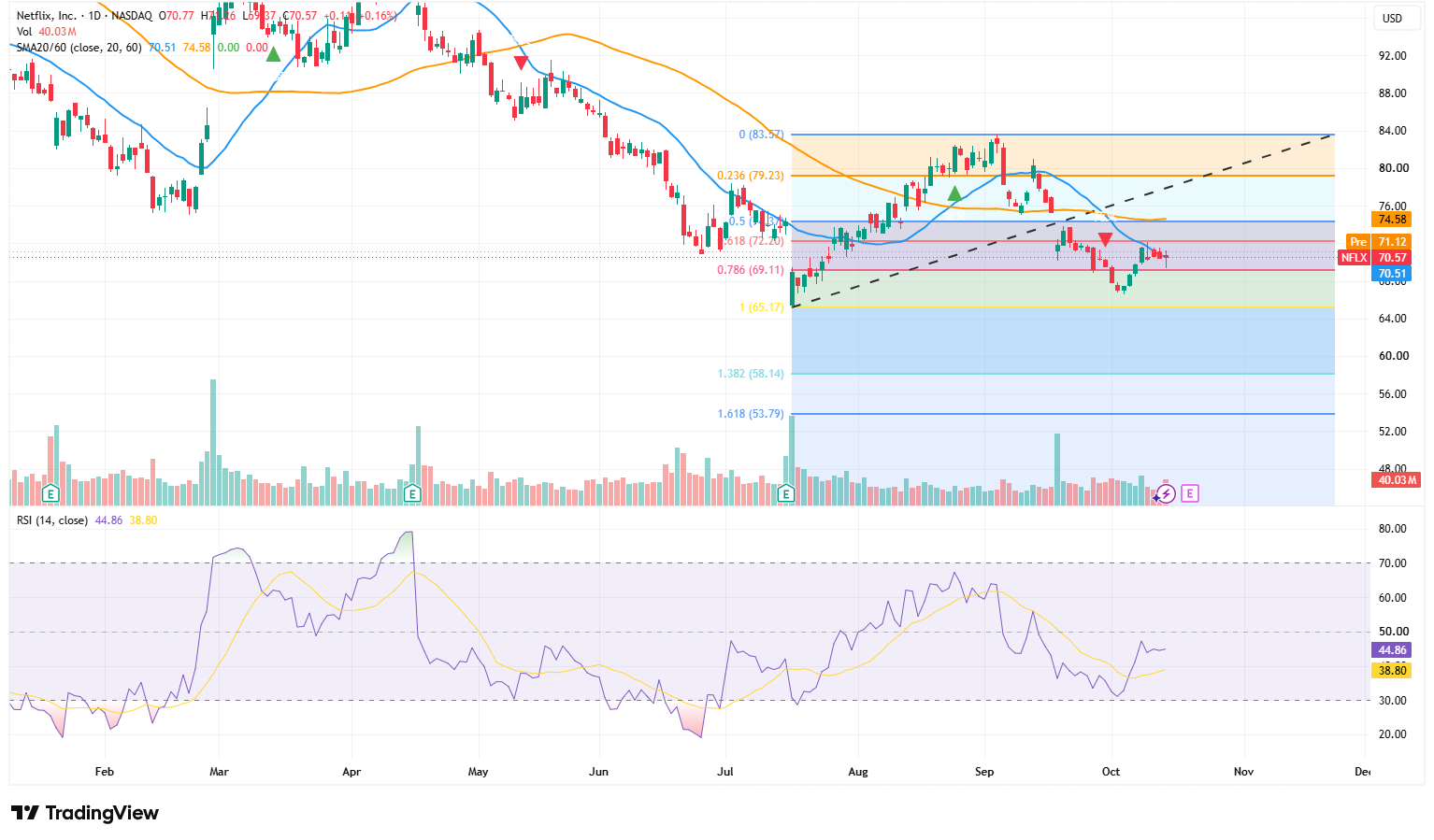
From the daily chart, Netflix closed at $70.57 on the 14th, largely holding the key round-number level of $70 while staying slightly above its 20-day moving average of $70.51. However, the stock price remains below the 60-day moving average of $74.58, and the previously established uptrend line has also been broken. Therefore, the current pattern resembles weak consolidation rather than a clear reversal.
$70 is not an isolated support point; attention should be focused on the $69.11–$70.51 support zone, where $69.11 corresponds to the 0.786 Fibonacci retracement level and $70.51 is the 20-day moving average. If the stock price closes below $69.11 on a daily basis after earnings, it could further retest $67–$68. If that area fails, the next key support lies at $65.17. Should earnings fall significantly short of expectations, the extended downside target could even drop to $58.14.
The first resistance level above is at $71–$72.10. Only a breakout above $72.10 could extend the rebound to the $74.35–$74.58 resistance confluence zone formed by the moving average and Fibonacci level. Once further establishing a firm footing above $74.58, attention can turn upward to $79.23, followed by the previous high near $83.
The RSI currently stands at 44.86, above the smoothed signal line of 38.80, indicating that short-term downside momentum is weakening. However, because the RSI remains below 50, bulls have not yet regained control. The small real bodies of recent candlesticks also reflect that investors are remaining on the sidelines ahead of earnings.
This content was translated using AI and reviewed for clarity. It is for informational purposes only.
Recommended Articles











Comments (0)
Click the $ button, enter the symbol, and select to link a stock, ETF, or other ticker.