


Circle Price Forecast: CRCL Crashes 17% as Rival Stablecoin Challenges USDC



AI Podcast


Circle Internet Group (CRCL) shares fell 17.55% to $63.85 on July 1 following the launch of a competing stablecoin by a Visa, Mastercard, and Stripe consortium. This development poses an existential threat, as 96% of Circle’s revenue relies on interest from USDC reserves rather than transaction fees. While USDC circulation reached $73.7 billion, the consortium’s control over payment rails bypasses typical regulatory barriers. Technically, CRCL has broken a triple bottom support level. Analysts identify further downside risk toward the $31.90 IPO price, with a short-selling strategy suggested below $50.00, while the long-term bull case hinges on diversifying revenue beyond reserve interest.
TradingKey - On July 1, Circle Internet Group (NYSE: CRCL) plummeted by 17.55% to trade at $63.85. The plunge follows the launch of a major stablecoin backed by a coalition of financial institutions, which has the potential to undercut USDC's competitive position. This marks the second competitive threat to materialize since June 3, when Circle sank 11% after CoinDesk reported Visa, Mastercard, and Stripe were poised to introduce a stablecoin platform. The news sent Circle lower again today, as the consortium's new stablecoin has been released rather than just planned.
As of now, USDC has grown to $73.7 billion in circulation, more than double the year-ago levels. However, nearly 96% of Circle's income comes from the interest generated on those reserves. Unlike network effects or switching costs that might keep USDC usage constant regardless of the competitive landscape, there's no obvious reason why USDC would stay the same if another stablecoin with a better-backed consortium were introduced. RSI at 35.81 suggests a neutral position before a deeper fall to the oversold zones.
The Competitive Threat That Has Been Building Since June 3
For better and for worse, this is Circle's unique position. Its main revenue generator is the yield Circle earns on the short-term U.S. Treasury bills and similar assets that back up the $73.7 billion USDC in circulation. While a steady high-quality revenue stream that grew 66% year-over-year to $740 million in Q3 FY2025, this has the unfortunate downside of Circle getting no revenue from USDC usage, developers integrating USDC into apps, or users using USDC on their wallets. With the majority of revenue from reserves, Circle's main business variable becomes the amount of USDC out there circulating, as well as the interest rate on U.S. Treasury bills, neither of which Circle has much control over.
For this reason, it's worth thinking about the Visa-Mastercard-Stripe group as an existential threat that no other stablecoin competitor has posed yet. The primary reason that Circle needs regulators is that it needs their approval to issue USDC, whereas Visa and Mastercard are already widely accepted on the payment rails that would be a natural home for an alternative to USDC. Together, Visa and Mastercard dominate the card market, and Stripe is the leading online payment service that processes payments for online merchants worldwide. With an alternative stablecoin underpinned by that group, that company wouldn't need years of regulatory lobbying to build momentum to overtake USDC.
Instead, they'd be able to lean on their connections with traditional finance institutions and merchants, and they'd take from Circle's pool of circulation revenue. That the consortium could have Coinbase attached is perhaps the most interesting detail of all. Circle and Coinbase co-founded the Centre Consortium that controls and issues USDC. The involvement of a founding partner in an alternative stablecoin is not the type of development you'd expect in a world where USDC dominates and Coinbase remains a founding and distribution partner.
What the Fundamentals Look Like Behind the Selloff
The market's reaction is a clear signal of two opposing realities that cannot both be favorable to Circle. First, the fundamental business is growing rapidly. Second, there is no real structural moat. Circle generated $740 million in revenue for the third quarter of fiscal year 2025, an increase of 66% from the year-ago period. In addition, USDC issuance rose to $73.7 billion in Q3, more than doubling its year-ago value. On-chain transaction volume jumped 580% in the period, reflecting a company that is growing its business quite effectively. That said, gross margins fell to 5.9% during the quarter, down from 10.5% a year prior, because distribution deals with crypto exchanges that are expensive and carry a high revenue sharing percentage compressed margins in the quarter even though the top line grew.
At approximately 37x EBITDA, the stock was appropriately priced for a premium valuation given its growth rate as the leading stablecoin, especially in an era when Circle had no viable competitors with payment network support. But with Visa-Mastercard-Stripe in the stablecoin game since July 1, sustaining the multiple is more challenging because the sole variable that supports it, Circle’s status as the best trusted and most regulated stablecoin, now has direct, well-funded competition. Shares of CRCL IPO’d in June 2025 at $31 per share. The stock rose to roughly $250 before falling back to $63.85, meaning the stock is now trading at just twice what it originally IPO’d at after peaking at eight times the IPO price. This reflects the impact of the increase in operating expense guidance, the June 3rd announcement of the Visa-Mastercard-Stripe competitor, and today’s competitor launch.
CRCL Technical Setup — Triple Bottom Breakdown at $63.85, RSI 35.81, Short Target $31.90
In this chart, CRCL is breaking down from the triple bottom near $90.75 with a red candle, and the major downtrend line, originating from the $156 plus highs, still stands to contain upside rallies. RSI, now at 35.81, is still in neutral territory, with further downside potential ahead of any oversold territory and no bearish divergence in place as yet.
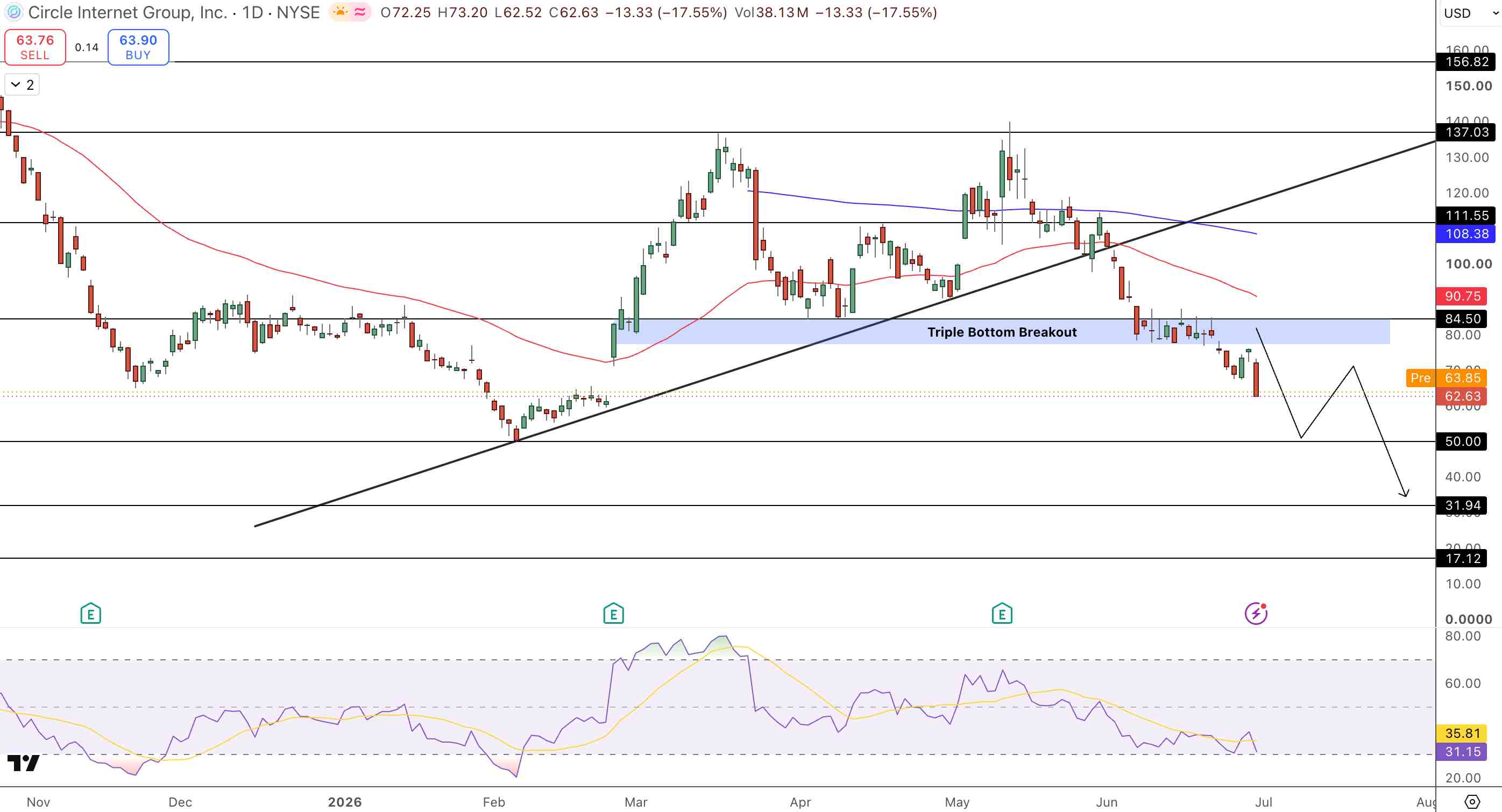
Circle Price Chart - Source: Tradingview
ext levels to watch is the cluster of horizontal support around $50 to $40. From here, the break of the triple bottom opens up further downside risk for a target of $31.94 to $17.12 in continuation. In other words, $31.94, which is near the IPO price, would effectively be an IPO-to-IPO round trip price. In the short, below $50.00, the target remains $31.90 and stop is above $90.75.
- Short entry: Below $50.00 — horizontal support cluster fails
- Target: $31.90 — triple bottom breakdown, near IPO price
- Stop Loss: Close above $90.75 — triple bottom pattern invalidated
- USDC circulation: $73.7B (+100%+ YoY) — growing, but now facing distribution-rail competition
- Revenue model: ~96% from reserve income on USDC-backed assets — no switching cost moat
- Competitor: Visa, Mastercard, Stripe consortium stablecoin — launched July 1
What Caused Circle’s 17.5% Crash on July 1?
Circle’s price slipped 17.55% to $63.85 on July 1, following an announcement that Visa, Mastercard, and Stripe had joined forces to launch a rival stablecoin with strong institutional support. This drop follows an 11% dip on June 3, when CoinDesk first broke the news that the companies were planning a competing stablecoin. A stablecoin backed by Visa, Mastercard, and Stripe threatens Circle because they own the distribution rails (card networks, merchant payment infra) that Circle needs to drive USDC adoption. They don’t need Circle’s regulatory legwork to get their own stablecoin moving at speed through their existing customer bases.
Does Circle Have Any Competitive Advantages Against Visa and Mastercard in Stablecoins?
Circle’s edge over Visa and Mastercard in the stablecoin market is two-fold: regulatory knowledge and the $73.7 billion already in circulation of USDC. The company has spent many years since 2018 building out regulatory compliance, reserve transparency, and institutional credibility. USDC is now integrated in thousands of DeFi protocols, centralized exchanges, and corporate treasuries.
However, about 96% of Circle’s revenue derives from interest on the USDC-backed reserves, not from switching costs, network effects, or user fees. Circle’s revenue would therefore drop if the circulation of USDC declined in favour of a Visa-Mastercard stablecoin, as there’s no other major source of revenue to make up for it at scale. The Arc platform and Circle Payments Network are growth platforms intended to shift that dynamic, but they have not reached material size yet.
Is CRCL a Short or a Contrarian Buy at $63.85?
The chart points toward further downside: there’s been a breakdown of the triple bottom on the daily chart. The RSI (35.81) shows no positive divergence yet. The descending trendline connecting the high of $156 is preventing a recovery. The bearish trade is short the stock below $50.00 with a target of $31.90 (near the stock’s IPO price of $31) and a stop above $90.75.
The bullish thesis is that Circle’s regulatory head start, combined with the presence of USDC in existing DeFi applications, along with new developments for Arc and the Circle Payments Network platforms, will allow the company to win out over Visa-Mastercard-Stripe. At current prices, the valuation at 37x EV/EBITDA means you’re arguing the contrarian case from a more reasonable place than at the prior peak, but 96% of the top line still comes from reserve income, meaning that the competition is an existential threat to revenue at the top line, not a loss in a few percentage points of market share.
Bottom Line
Circle shares declined 17.55% to $63.85 on July 1, as plans for a Visa-Mastercard-Stripe stablecoin transitioned to action, putting at risk the USDC circulation of $73.7 billion that generates about 96% of Circle’s revenues. The competitive dynamic is not the same as before, because Visa, Mastercard, and Stripe own the infrastructural distribution channels Circle depends on for adoption of USDC.
There’s no need for them to have Circle’s regulatory work done before they move at speed with their stablecoin through their existing customer base. On the daily time frame, there’s a breakdown of the triple bottom, RSI is flat (35.81), and there’s not yet a positive divergence. Short below $50.00 for a target at $31.90, and place a stop above $90.75.
The bull case relies on the Arc platform and Circle Payments Network creating revenue streams outside of reserve income, prior to distribution-rail competitors causing a material decline in USDC circulation.
Recommended Articles











Comments (0)
Click the $ button, enter the symbol, and select to link a stock, ETF, or other ticker.