


SpaceX Gains 10% in Overnight Trading, Market Cap Set to Overtake Amazon



AI Podcast


SpaceX's stock surged, nearing a $2.77 trillion valuation and potentially surpassing Amazon. This rally is driven by an extremely limited share float and high retail investor demand. Despite the enthusiasm, Wall Street analysts are divided, with ratings ranging from "Sell" to "Outperform," citing differing views on its long-term potential and current operational losses. Upcoming catalysts include options trading and "Quadruple Witching," expected to amplify volatility. The company's core businesses are its launch services and the profitable Starlink segment, with ambitious revenue projections for the future. Its inclusion in major indices is anticipated to provide further upward pressure.

TradingKey - On June 15 ET, SpaceX's post-listing upward momentum continued in overnight trading, SpaceX ( SPCX) saw its overnight gain expand to over 10%. If this gain holds through Tuesday's US market open, its market capitalization will rise to approximately $2.77 trillion, officially surpassing Amazon ( AMZN ), becoming the world's fifth-largest public company.
During Monday's regular trading session, SpaceX closed up 19.6% at $192.5, with its market capitalization reaching $2.52 trillion, surpassing TSMC ( TSM) to rank sixth globally, trailing only Microsoft ( MSFT ), Apple ( AAPL ), Alphabet ( GOOGL ), NVIDIA ( NVDA) and Amazon.
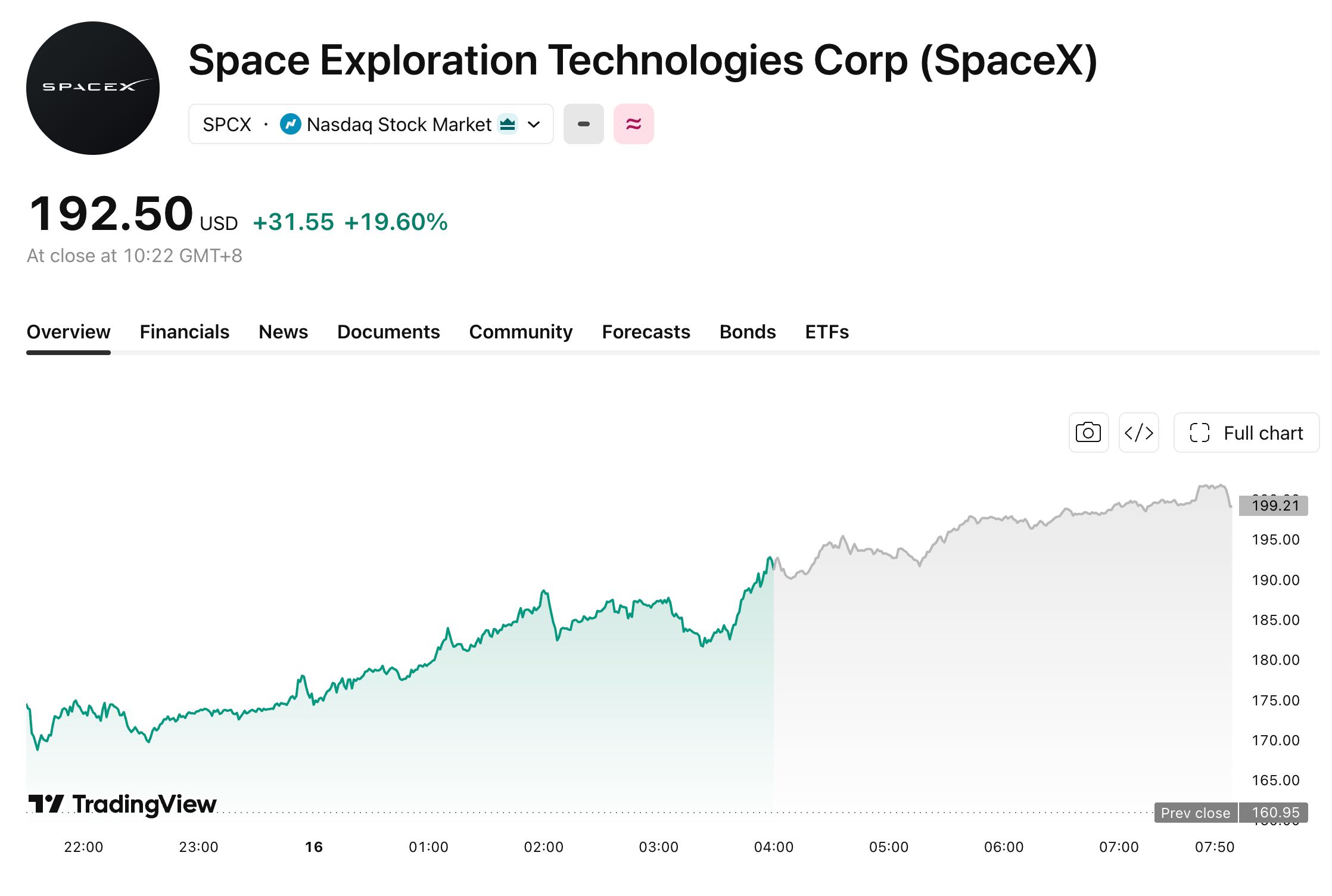
[Source: TradingView]
Scarcity of Shares Ignites SpaceX’s Short-Term Rally
SpaceX's IPO represented approximately 4.2% of its total shares outstanding, which increased to about 4.9% after the full exercise of the greenshoe option, resulting in extremely limited market float. On the first day of trading, retail investors' net purchases in the secondary market reached $117.6 million, accounting for 56% of total U.S. retail buy orders for the day. On Monday, the company announced the full exercise of the IPO greenshoe mechanism, with underwriters issuing an additional 83.3 million shares, bringing the total proceeds to $86.2 billion.
SpaceX faces two critical milestones this week. On Tuesday, Cboe Global Markets will launch SPCX option contracts; Thursday coincides with "Quadruple Witching" in the U.S. market, when stock index futures, stock index options, equity options, and single-stock futures expire simultaneously. The combined effect of the options listing and the massive contract expirations is expected to significantly amplify SPCX's intraday volatility.
SpaceX: Operating Losses and Valuation Divergence Coexist
Despite surging enthusiasm in the secondary market, Wall Street remains deeply divided over SpaceX’s valuation. CFRA issued a "Sell" rating on its IPO debut with a 12-month price target of $115. Based on its first-day closing price of $160.95, this target implies approximately 28.5% downside. Meanwhile, Oppenheimer assigned an "Outperform" rating and a $190 price target, citing expectations that space data centers and TeraFab wafer fabs will catalyze a $10 trillion long-term addressable market.
In terms of business structure, SpaceX currently relies on two main pillars. Its launch business, powered by Falcon 9 and Starship, accounts for approximately 83% of global orbital payloads. Starlink is the company's only profitable segment, projected to contribute $11.4 billion in revenue in 2025. Elon Musk stated publicly on Monday that he would be "surprised" if the company's annual revenue does not reach $1 trillion by 2031.
Effective June 26, SpaceX will be added to the FTSE Russell indices, with MSCI and the Nasdaq 100 expected to follow suit; passive demand from index funds is likely to provide further upward momentum for the stock. In the near term, investors should remain attentive to potential volatility driven by liquidity shocks from Thursday's "quadruple witching" and the tug-of-war between bulls and bears following the introduction of options trading.
This content was translated using AI and reviewed for clarity. It is for informational purposes only.
Recommended Articles








Comments (0)
Click the $ button, enter the symbol, and select to link a stock, ETF, or other ticker.