


Ethereum Price Prediction: Can ETH Reach $10,000 in the Next Five Years?



AI Podcast


Ethereum has experienced significant cyclical volatility over the past five years, peaking at $5,000 in 2025 before a 70% correction in 2026. Price performance remains highly sensitive to Federal Reserve monetary policy and institutional adoption. While current macroeconomic pressures risk further downside toward $1,000, long-term growth is supported by RWA tokenization and regulatory integration. Achieving a $10,000 valuation by 2030 requires a 45–50% CAGR, a target many institutional analysts deem plausible provided that ecosystem maturity and institutional capital inflows accelerate, potentially pushing valuations between $8,000 and $22,000 as the network scales globally.

A Review of Ethereum Price Trends Over the Past Five Years
TradingKey - In early 2021, Ethereum ( ETH) prices surged from $730, nearing $4,900 in November 2021 to set a record high. In 2022, the cryptocurrency market entered a bear market, and the price of ETH tumbled to a low of around $880, resulting in a maximum drawdown of 82%.
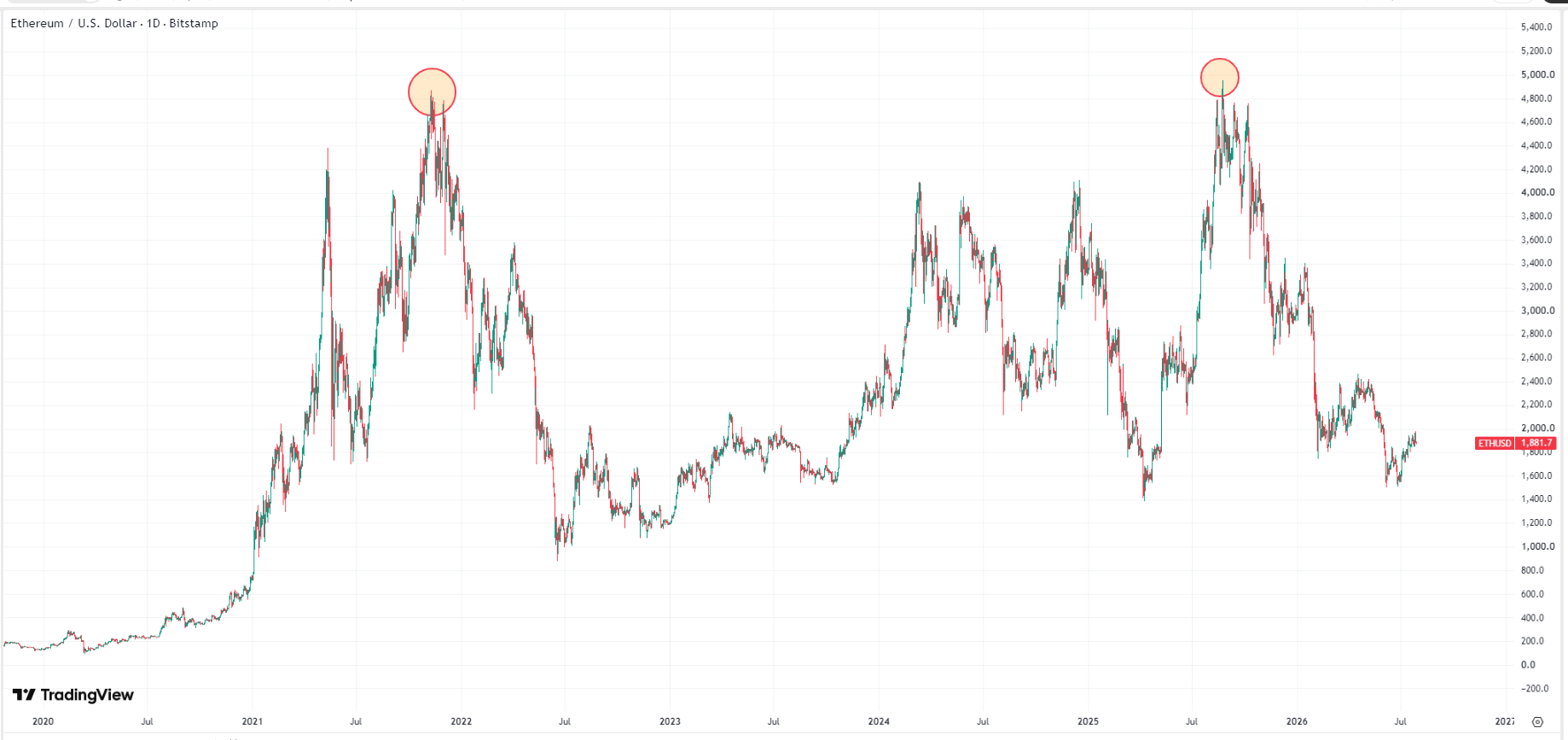 ETH price chart, Source: TradingView
In 2023, ETH prices fluctuated widely within the $1,000 – $2,000 range, showing a clear bottoming pattern; in 2024, ETH prices staged a strong recovery, breaking through $4,000 three times, accompanied by three major corrections; in 2025, Ethereum prices rallied again to recover lost ground from the previous year, while surging to near $5,000 in August to set a new all-time high. Entering 2026, the price of Ether continued to slide, falling to around $1,500 by June, representing a 70% drawdown from its peak.
What Factors Affect Ethereum Price Volatility?
Over the past five years, the price of Ethereum has experienced two distinct upward cycles. The first was in 2021, driven by the DeFi explosion, the NFT craze, and the launch of the EIP-1559 burning mechanism. The second spanned two years: in 2024, when the SEC approved spot Ethereum ETFs, and in 2025, as traditional financial giants like BlackRock and JPMorgan Chase advanced real-world asset (RWA) tokenization. In other words, regulatory tailwinds and ecosystem applications are conducive to driving up Ethereum's price.
In both 2022 and 2026, Ethereum's price experienced a clear downward trend. From an industry cycle perspective, the decline in Ethereum's price was due to the cryptocurrency market entering a bear market, during which extreme black swan events occurred, such as the cascading collapses of Luna and FTX in 2022. From a macroeconomic perspective, the Federal Reserve implemented aggressive rate hike policies, or showed signs of doing so, in both of these years.
Will Ethereum Price Continue to Fall?
Currently, the biggest factor suppressing the rise of Ethereum and the broader cryptocurrency market is Federal Reserve (Fed) policy uncertainty. If the U.S. Federal Reserve adopts a more hawkish stance in its interest rate decision, or if market concerns over liquidity tightening intensify, it will directly weigh on the valuation of overall risk assets (including ETH), triggering capital outflows.
Historical data suggests that Ethereum's price could hit new lows. During the 2022 bear market, Ethereum's maximum drawdown reached 82%, whereas the maximum drawdown in the current bear market is only around 70% so far. If history repeats itself, Ethereum's price could continue to decline, falling back toward the $1,000 mark. However, if the Fed releases dovish signals, global liquidity will improve and market risk appetite will rise, bolstering a rebound in Ethereum and the broader crypto market, with $1,500 potentially serving as the bottom for Ether in this bear market cycle.
Can Ethereum Reach $10,000 by 2030?
For the price of ETH to reach $10,000 by 2030, calculated from the current level of around $2,000, it would require a 400% increase, maintaining a compound annual growth rate (CAGR) of approximately 45%–50%. This is consistent with the high-beta characteristics of crypto assets during bull market expansion phases, making it logically achievable.
Based on past bull markets, for the price of Ethereum to reach a new peak, it requires positive catalysts such as regulatory clarity or an explosion of ecosystem applications. Currently, foreseeable tailwinds include the "Clarity Act" or the rapid tokenization of U.S. equities, both of which share the common feature of facilitating the compliant entry of institutional capital into the crypto market.
Currently, some Wall Street institutions are highly bullish on Ether by 2030, with target prices mostly set between $8,000 and $22,000. However, the underlying bullish logic of these institutions differs to some extent, as detailed below:
Institution | 2030 Target Price (USD) | Core Bull Case |
VanEck | 22,000 | Ethereum hosts 10% of global financial settlements and a high proportion of RWAs. |
ARK Invest | 20,000 | Web3 commercialization explodes globally, with Ethereum becoming the global decentralized operating system. |
Standard Chartered | 8,000 – 10,000 | Long-term capital inflows from compliant ETFs and staking yields attract allocations from pension funds and corporate treasuries; enterprise-grade applications and the Layer 2 ecosystem. |
Conclusion
After hitting a record high of $5,000 in 2025, ETH pulled back sharply in 2026 due to the Federal Reserve's hawkish policies and a bear market. If interest rate policy turns dovish and institutional capital continues to enter through legislation and RWAs, ETH is expected to achieve a 400% gain to break past $10,000 by 2030, with some institutions even targeting $22,000.
This content was translated using AI and reviewed for clarity. It is for informational purposes only.
Recommended Articles









Comments (1)
Click the $ button, enter the symbol, and select to link a stock, ETF, or other ticker.