


The Week That Proved AI Is Real: MSFT +16%, AMZN +10%, META -10%, AAPL -4% - Winners, Losers and Key Takeaways



AI Podcast


Between July 28 and 31, 2026, the tech sector saw a pivot toward AI monetization. Microsoft and Amazon outperformed by linking massive capital expenditure to validated demand, triggering historic rallies. Conversely, markets penalized Meta and Alphabet for aggressive spending without clear revenue narratives, while Apple dipped despite record earnings. The KOSPI’s record 17.91% surge reflects continued optimism for semiconductor demand through 2028. Investors have shifted to a strict "proof-of-demand" standard for AI investments, prioritizing tangible backlog and cash flow over narrative-driven spending. The AI bull market remains intact but increasingly focused on demonstrable, profitable execution.
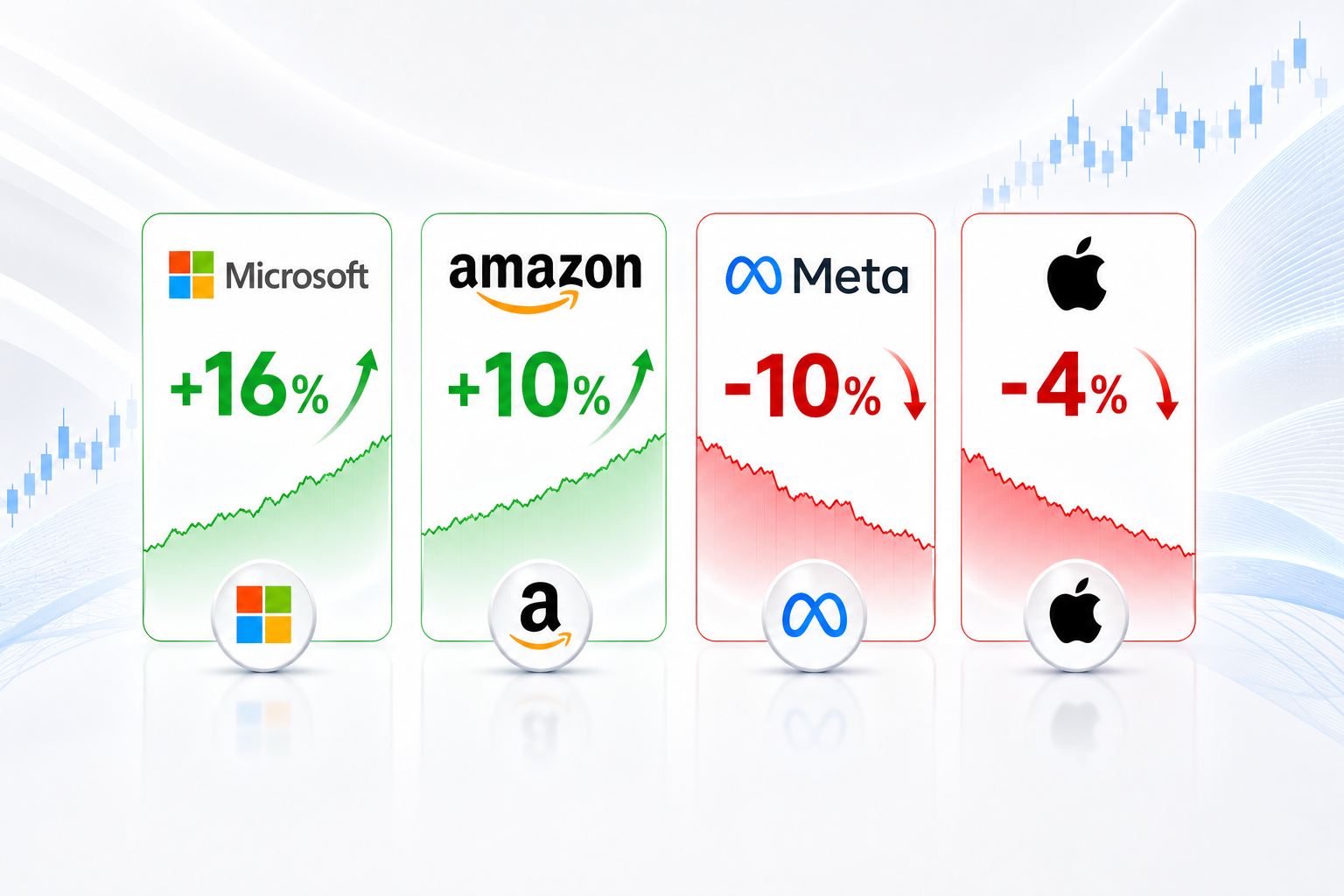
TradingKey - From July 28 to 31, 2026, we saw a conclusive market response to AI that we had anticipated for a year prior. The five largest tech firms released earnings reports and the S&P 500 IT experienced a nearly 5% rally. This was Microsoft(MSFT)’s biggest rally ever, adding roughly $450 billion to Microsoft’s market capitalization. Microsoft’s rally was the most significant single-day market capitalization increase in stock market history.
Amazon (AMZN)’s after-hours, post-earnings report rally, was 10% and marked a 37% increase in AWS, which is Amazon’s fastest growth since 2021. Meta’s earnings report miss was a 14% decline in earnings per share, and free cash flow decreased to $784 million, resulting in a 9.64% decline in Meta stock.
Apple’s stock decreased by 3% to 4%, despite Apple reporting record earning for the month June. Finally, the KOSPI had its largest one-day increase ever, with a total increase of 17.91%. The following is a recount of the events, the underlying mechanisms, and their effect on the future.
Monday and Tuesday: The Last Gasp of the Chip Selloff
Semiconductor stock selloffs continued this week due to the CXMT IPO and Apple’s use of Chinese memory suppliers. In the morning of July 28, the PHLX Semiconductor Index fell 4.3% and the VanEck Semiconductors ETF lost 2% or more. The XLK tech ETF decreased by 0.9%. The S&P 500 ended the day flat at 7,413.18.
The Nasdaq had a down 0.18% day. The equal weighted S&P 500 closed at all time highs. The healthcare sector was up 2.4%, consumer staples were up 2% and materials were up 1.7%. A rotation away from tech stocks and into old economy stocks continued to increase through July.
Tuesday July 29 was the last day Apple shares traded below $340. Apple shares closed the day at an all time high of $342.89 and Apple became the first company to hit a $5 trillion market cap after surpassing Nvidia which fell 5% or more.
The Nasdaq fell 0.22% as the semiconductor selloff continued. The SMH ETF was down more than 3% for the fourth consecutive day. The SOX index was down more than 20% from the June 22 high. Despite the market, Microsoft increased 2.6% and was the only large-cap tech stock to have positive momentum ahead of the earnings release gauntlet.
Wednesday: Microsoft Changes Everything
July 30 was the hinge of the week, with strong Microsoft Q4 FY2026 earnings after the close on July 29. Wednesday brought a 16% stock spike, with an incredible $450 billion in new market capitalization in a single day. This triggered a stampede on the broad market, with the S&P 500 up 1.7% to 7437.64, the Nasdaq up 2.8% to 25122.18, an 8% gain in the iShares Semiconductor ETF, and a nearly 5% gain in XLK, the tech sector ETF, with the largest single day gain since the middle of 2025.
Microsoft was rewarded where Meta and Alphabet were punished, with a clear and strong capex narrative. Azure was up 43% (beating the 39-40% guidance), commercial RPO was up 84% at $678 billion, and Copilot had 30 million paid seats. Management suggested Azure was capex constrained with demand surpassing supply, and framed FY2027 capex guidance of $255-$260 billion as fulfillment of demand.
This clear and strong demand contrasted with Meta, which increased capex to $130-$145 billion with a 14% miss on EPS and only $784 million of FCF, and Alphabet which increased capex to $195-$205 billion with no demand narrative. Microsoft's $678 billion RPO backlog encapsulated the market's weekly narrative.
Thursday and Friday: Amazon Confirms, Apple Disappoints, KOSPI Makes History
Amazon became the first company in history to surpass quarterly revenue of $200 billion when they reported $200.61 billion for Q2 2026, representing an increase of 19.6%, and a $200 billion Amazon Web Services segment grew by 37%. Amazon stock gained 10% after the report, bringing the stock price to $255, and net income of $62 billion. An Anthropic revaluation helped the numbers. Amazon CEO Andy Jassy stated that the yearly Amazon capital expenditure of $220 billion is needed to address the customer demand, and promised growth of the company until 2028.
Apple reported record revenue of $109.42 billion for the Apple Inc. Q3 and $2.02 in EPS, both representing increases of 16% and 29% respectively, after $54.25 billion in iPhone revenue. Apple stock lost 3 to 4% for the price of $319 after reporting a revenue miss on Apple services ($30.74 billion reported, $31.22 billion forecast) and revenue from the Greater China region of $18.8 billion ($19.6 billion forecast) as well. Mac's and iPad's were subject to price increases, but no price increases were made to iPhones.
The KOSPI, South Korea's stock market, saw a record increase of 17.91% and closed on the day of 6595.45 with SK Hynix gaining 30% and Samsung gaining 27% with 7 trillion won in foreign purchases on the day. Local buying interest came on the news of Amazon's confidence in AI semiconductor sales to them for the year 2027 and on the news of a 199.5% increase in June export data reaching $44.8 billion. A previous 22.4% decline over the month of July
Key Takeaways for the Week Ahead
There are five important things traders should know.
To begin, the capex standard has permanently changed. Microsoft and Amazon showed that companies can win by demonstrating demand before spending. Meta and Alphabet showed the opposite case. Future hyperscaler calls will follow this pattern.
Second, the Anthropic markup represents a known, recurring concern. Amazon’s net income was bolstered by $53.4 billion, and Alphabet’s EPS was bolstered by a non-cash revaluation of approximately $6 to $7. Analysts will forecast these things to help decrease the surprise premium.
Third, Apple’s Services miss ($30.74B v. $31.22B expected) is significant because it indicates the first slowing of growth in Apple’s high-multiple segment. Considering the slowdown and the issues in China, Apple’s Services miss ($30.74B v. $31.22B expected) growth in the high-multiple segment, pre-earnings priced Apple at $333 with a P/E of 44x. Post-earnings that drops to $319. Fourth, the KOSPI’s 17.91% surge coupled with Amazon’s visibility to 2028 affirm the AI boom is not over, the market just lost patience for unsubstantiated capex.
Fifth, Microsoft adding $450 billion (+16%) in one day signals long-term AI portfolio positioning and proves the premium is placed on the true monetization of AI vs. the narratives.
The Week in Numbers
- Microsoft: +16% on July 30. Azure +43%. Added $450B - most in a single day in any stock in history.
- Amazon: +10% after hours. AWS +37%, fastest growth since 2021. Revenue exceeded $200B for the first time.
- Apple: -3-4% after hours. Revenue reached a record $109.4B. Services and China underperformed. Flagged a Memory Crunch.
- Meta: -9.64% after hours. Revenue beat expectations but EPS 14% missed. FCF $784M. Capex was raised again
- Alphabet: Already -15% prior week. Recovering to $335. P/E at 17.7x.
- S&P 500: Up 1.7% Thursday. XLK +5% Thursday - largest IT sector day since mid-2025.
- KOSPI: +17.91% July 31 - largest single-day gain in its history.
- Fed: Held rates. 10-year yield steady at ~4.63%. VIX falling from 18.67 peak.
Bottom Line
Beginning July 28, 2026, we can begin tracking one of the first historical precedents in AI Stocks. Infrastructure requests for AI Stocks indicate structurally persistent demand for these stocks through 2028, backed by Microsoft’s $678 billion backlog, Amazon’s demand and capacity problems, and South Korea’s record exports of semiconductors. The AI Stocks market will not accept AI related spending based on good faith.
Positive movements in the AI market will require Capex to be validated with actual demand, and the market will disregard non-cash gains. Microsoft signed a contract for the right to the largest one-day market capitalization increase with the greatest level of unprecedented certainty in history. The AI-bull market is in position, but the burden of proof is now greater.
Recommended Articles




Comments (0)
Click the $ button, enter the symbol, and select to link a stock, ETF, or other ticker.