


The Tech Titan’s Next Leap: Why Amazon’s Massive AI Gamble is Already Paying Off for Stock Investors



AI Podcast


Amazon's Q1 2026 results show strong performance with $181.5 billion in net sales, up 17% year-on-year, and record operating income of 13.1%. AWS sales grew 28%, reaching $37.6 billion, while North American retail and advertising also showed robust growth. The company is investing $200 billion in AI, developing custom chips like Trainium3 to reduce customer costs and boost AWS AI services. Despite geopolitical risks and competition, Amazon's diversified business model and technological advantages provide a strong moat. Technical analysis indicates a healthy stock correction with potential for a breakout. Wall Street remains bullish with average price targets around $305-$310.

TradingKey - By 2026, the saga of Amazon.com Inc. ($AMZN$) isn’t about e-tailing supremacy or getting products to customers overnight. It is the story of an IT colossus re-purposing its sprawling IT capacity to be first mover in the generative AI boom. Through the first six months of 2026, Amazon has been one of the strongest performers in the Big Tech sector. Driven by a massive rebound in growth of Amazon Web Services (AWS) and the strength of its retail unit, money is coming in from institutions. While the markets are focused on global trade wars and the scale of Capex, the fundamentals of Amazon are stronger than ever.
Q1 2026: The Financial Story
The $181.5 billion total net sales (plus 17 percent year on year) delivered in the company’s March 31, 2026 period Q1 earnings report surprised even Wall Street. The company’s $181.5 billion total net sales were up 17 percent year on year, shrugging off foreign exchange headwinds that would have otherwise dampened lesser companies. But the highlight was the level of profitability Amazon produced ($23.9 billion, or 13.1 percent operating income, a record high). AWS is the shining star of this quarter. AWS generated $37.6 billion in sales for the quarter, a 28 percent annual growth, the best performance in 15 quarters and an annualized run rate of near $150 billion.
Amazon’s home market is stable as well. North American retail revenue grew to $104.1 billion, plus 12 percent, with 9.0 percent operating margin driven by better domestic logistics. Amazon’s third leg of the stool is its advertising business that is now a $70 billion trailing twelve-month run rate.
Spending $200 Billion on AI and Turning it into Profit
The question on everyone’s mind is how much money will be needed from the tech giants in AI hardware to keep the market from getting hot. Amazon is upping its 2026 capital expenditure to a record $200 billion. The company spent 76 percent more on infrastructure in the last quarter, and free cash flow dipped to $1.2 billion for the trailing twelve months. Unlike some of its peers, Amazon has maintained its margins even as it ramped up infrastructure, showing it has a huge advantage for operating efficiency.
Jassy has called 2026 a “prove-it” year for AI. The company is answering the call by releasing its own chips. AWS Graviton CPU and Amazon Trainium AI chip annualized sales are above $20 billion. The Trainium3 chip, launched by the tech giant in Spring 2026, with 3nm advanced chip design, has effectively severed Amazon's complete dependence on expensive third-party graphics cards, and will save customers as much as 50 per cent off AI training costs.
With Amazon and its partner Anthropic, whose Claude 4.7, Claude Mythos generative AI models all run natively on AWS, Amazon is now running $15 billion annualized generative AI.
Crossing Tariffs: Geopolitics versus Moats in Amazon
No corporate storybook has without its antagonists. For Amazon, the antagonism lies in the macro environment. The long negotiations by the US for better trade terms and the threat of higher tariffs have resulted in the disruption of supply chains in a number of countries, leading to a class of consumers suing the company for the passing of the tariff costs. On the technology front, the cloud providers such as the Microsoft Azure platform and Google Cloud Platform are also engaging in a struggle for business.
However, in a case like this, where the supply of the company is diversified and multi-layered, the impact of any adverse effect will be mitigated by the other side. In other words, if tariffs have an impact on the supply chain of goods, then the revenue generated from Prime services and advertising campaigns with high margins will come in to counteract that. Amazon has a strong moat in this regard, and it has also been able to deliver more than one billion same-day/next-day orders in the first half of 2026 alone.
The Technical Story: The Wedge Is a Healthy Reset
Looking at the price action of 1-hour $AMZN$ on NASDAQ, the technical picture is actually quite healthy for the stock, which is currently at $264.91, having gained a minor 0.32% today. As one can clearly see, in recent weeks, the stock has been in a typical falling wedge pattern as a correction following a local top that was made at $278.51. In other words, this is still within the same market structure for the long-term bulls, and the technical correction is not yet over.
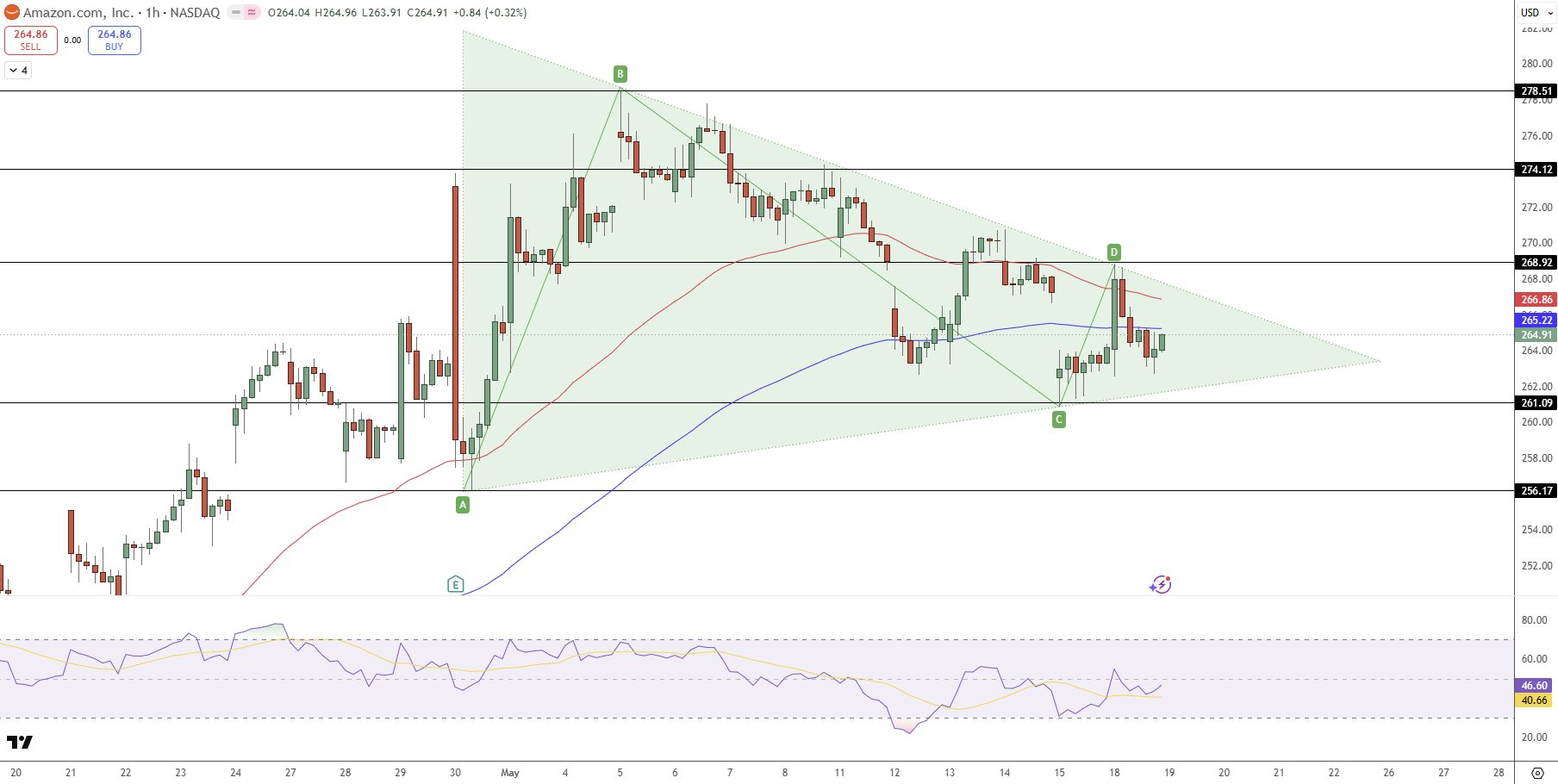
AMZN Price Chart - Source: Tradingview
After making the recent top, the stock formed a large bullish hammer right on the lower descending support line of the wedge pattern that can be seen, which means that it did respect the technical levels. It has remained above the blue moving average cluster of support (in the $261.00-$263.00 range).
As a result, this correction respected the golden Fibonacci zone, and the move was caused by selling rather than by any major institutions dumping their shares; and the price action is now above the major moving averages. Now, as a final observation for technical analysts, the baseline momentum oscillator, which indicates that selling pressure is near exhausted as it rests in the neutral zone 45-55 and makes a positive divergence. There is an opportunity for a powerful breakout to be made.
Wall Street’s Verdict and an Actionable Trading Blueprint
Wall Street is overwhelmingly bullish. The average 12-month price target among large banks is $305 to $310, and some institutions see AWS’s 28% growth rate as proof that Amazon’s shares could jump past $350 by year end. With shares trading at 28 to 30 times next year’s expected earnings, Amazon’s stock is not overvalued relative to its technology peers, especially considering the company’s growth both in online retail and its cloud computing division.
For day traders, there is a clear opportunity to go long right now. The breakout signal to follow: a close on the hourly chart above $265.50 will signal a breakout above the wedge’s down-sloping resistance trendline. Take profits at $268.92, where the down trend line and the Red moving average are capping prices. The next price target to eye is $274.12, where historical liquidity rests. Place a stop loss below $261.00. An hourly close below this level would invalidate the immediate bullish structure and indicate a deeper retest of the $256.17 macro baseline.
Amazon is due to report second quarter earnings at the end of July. Given the stock’s technical set up, it seems more likely that the bulls will win the day. Amazon has demonstrated that it is not spending billions to burn them, but to create custom chips and a dominant cloud computing platform for the age of artificial intelligence. Even short term volatility is a blip on a chart where the long term trend is sharply upward, suggesting the company could be a solid place for investors to continue building wealth over the next few years.
Recommended Articles











Comments (0)
Click the $ button, enter the symbol, and select to link a stock, ETF, or other ticker.