


Meta Partners With Stripe to Relaunch Stablecoin Payments, Who Will Be the Biggest Beneficiary?



AI Podcast


Meta has partnered with Stripe to launch stablecoin payment features for creators, initiating trials in Colombia and the Philippines using USDC on Solana and Polygon networks. This move signifies a shift from Meta's previous regulatory-challenged Libra/Diem project, focusing now on payment utilization to reduce hurdles. The initiative offers creators faster, cheaper transactions compared to traditional methods. It also provides significant benefits to Meta by reducing operational costs and increasing platform stickiness, while endorsing Solana, Polygon, and USDC. Despite this, Meta's stock recently declined due to concerns over Q1 2026 capital expenditures.

TradingKey - Meta returns to the stablecoin track via Stripe, directly benefiting creators while serving as a major tailwind for itself, as well as USDC, Solana, and Polygon.
According to Cointelegraph reports on April 30 that tech giant Meta ( META) has partnered with Stripe to launch stablecoin payment features for creators. Reportedly, Meta's initial trials will take place in Colombia and the Philippines, utilizing the Circle-issued stablecoin USDC, with the first phase limited to the Solana and Polygon networks.
It is worth emphasizing that this is not Meta's first foray into the stablecoin space; attempts were made long before the company's rebranding. In 2019, Facebook (Meta's predecessor) announced the Libra project, aiming to establish a global digital currency backed by a basket of currency reserves. The move immediately attracted giants like Visa and Mastercard. However, the plan faced fierce resistance from global regulators, with the strongest opposition coming from the U.S. Congress.
In 2020, Facebook announced it would drop the multi-currency peg in favor of a single US dollar peg and renamed the project Diem in hopes of meeting compliance requirements. Nevertheless, the plan remained blocked by regulators, and the related assets were eventually sold in 2022, marking the failure of Zuckerberg's stablecoin initiative.
Four years later, Zuckerberg's relaunch of the stablecoin initiative signifies a pivot from the earlier pursuit of "issuing currency" to the "utilization of payment rails," a shift that will likely reduce regulatory hurdles. Stripe, a US-compliant fintech firm, acquired the stablecoin platform Bridge in late 2024, granting it robust capabilities to handle cryptocurrency payments such as USDC.
Meta's initial push for creator stablecoin payments will make creators in places like the Philippines and Colombia the most direct beneficiaries. In the past, traditional cross-border remittances (SWIFT) often incurred intermediary bank fees of $15–$25, plus a 3%–5% exchange rate spread, and required 3–5 business days for verification. Switching to USDC now allows for real-time payments with transaction fees reduced to just cents.
Meta's decision to run payments on Solana and Polygon serves not only as a landmark endorsement for them but also brings millions of daily real transaction demands to these public blockchains via massive micropayments. Furthermore, Meta's selection of USDC helps consolidate its position as a leading USD stablecoin, providing support for Circle's valuation.
Naturally, Meta's re-entry into the stablecoin track is also profitable, primarily reflected in two aspects: (1) Reduced operational costs: Meta spends massive administrative and financial costs annually on processing complex global payment routes. Moving this business to stablecoin rails in the future could significantly enhance profitability. (2) Enhanced platform stickiness: When creators can receive payments faster and cheaper on Meta-owned platforms like Facebook and Instagram, they will be more inclined to remain within the Meta ecosystem rather than defecting to competitors like TikTok or YouTube.
Despite the sudden positive news for Meta, which might drive a stock rally in the short term, concerns over soaring capital expenditures in the Q1 2026 earnings report released yesterday caused its share price to plunge over 7% in after-hours trading, falling to $622.
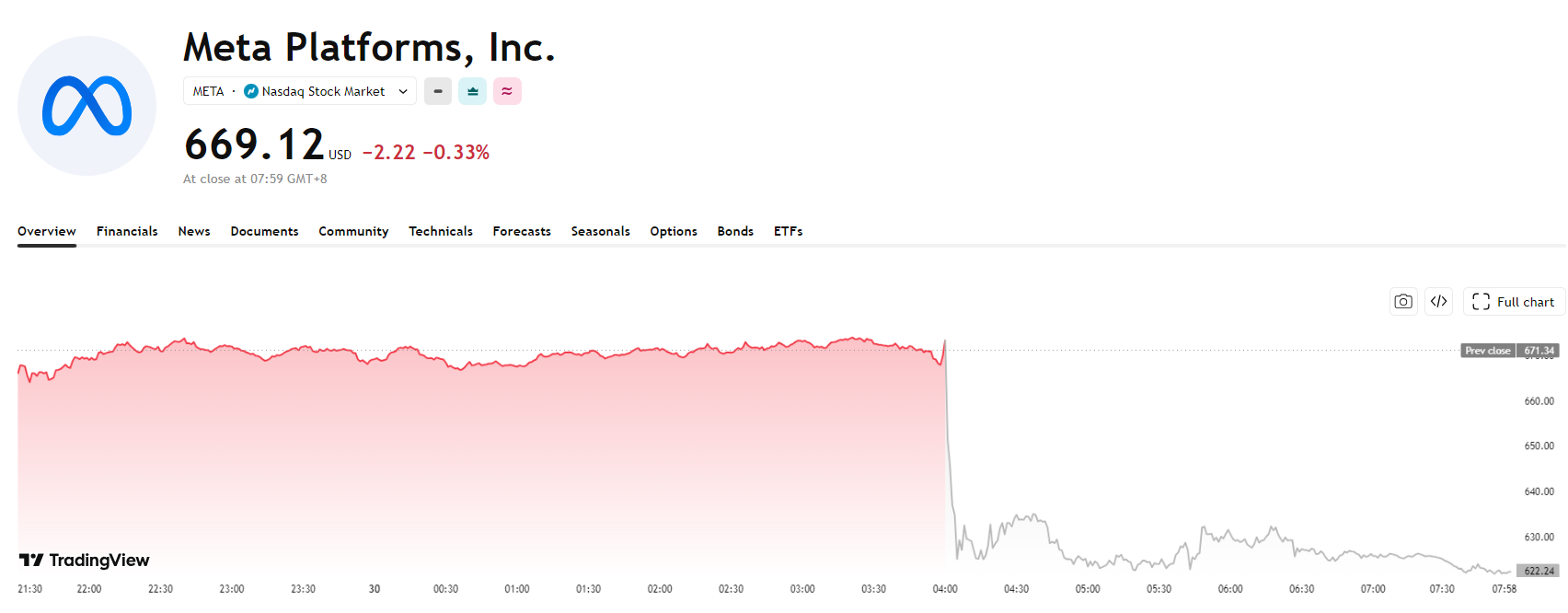 Meta stock price chart, source: TradingView
This content was translated using AI and reviewed for clarity. It is for informational purposes only.
Recommended Articles










Comments (0)
Click the $ button, enter the symbol, and select to link a stock, ETF, or other ticker.