


SAP First-Quarter Cloud Revenue Grows 27% Year-on-Year; After-Hours ADRs Once Rise Over 10%



AI Podcast


SAP SE's Q1 2026 results showed 6% revenue growth to €9.555 billion and a 9% net profit increase to €1.932 billion. Cloud revenue surged 19% to €5.962 billion, driven by strong demand and a 20% increase in cloud backlog. The company maintained its full-year guidance, projecting 23%-25% cloud revenue growth. Despite positive performance, market concerns persist regarding SAP's AI transformation, particularly the shift to consumption-based billing and its impact on revenue stability and short-term earnings predictability. Goldman Sachs, however, views AI's impact as significantly expanding the Total Addressable Market for software companies.
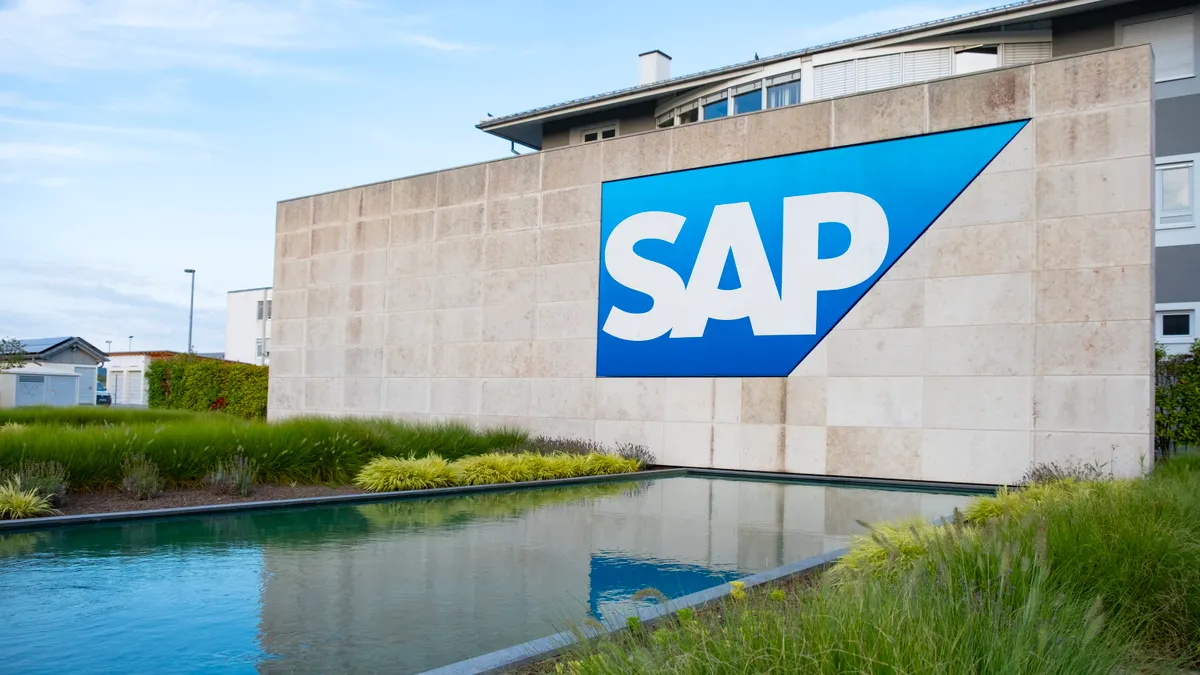
TradingKey - SAP SE reported its first-quarter 2026 financial results. During the period, under International Financial Reporting Standards (IFRS), total group revenue reached €9.555 billion, a year-on-year increase of 6%, which was largely in line with market expectations. Net profit attributable to the parent company was €1.932 billion, up 9% year-on-year; diluted earnings per share was €1.65, compared to €1.51 in the same period last year, representing a 9% increase.
In terms of specific business segments, cloud service revenue recorded €5.962 billion, exceeding the analyst consensus of €5.9 billion. This was up 19% from €4.993 billion in the prior-year period, or 27% on a constant currency basis. Meanwhile, revenue from software licenses and support fell 12% year-on-year to €2.586 billion.

Following the announcement, SAP's U.S. ADRs jumped more than 10% in after-hours trading before paring gains to finish up 6.39%.
Reviewing the company's historical stock performance, SAP's share price has nearly halved since peaking last July, with a cumulative decline of 47%, trading between a high of $313.28 and a low of $160.66. Based on the post-market price volatility, this earnings report has provided SAP with a temporary performance cushion.
Cloud business delivers stellar performance.
Focusing on the biggest highlight of these results: the cloud business. Cloud demand is currently robust, with the current cloud backlog at 21.9 billion yuan, up 20% year-over-year, or 25% at constant currencies.
Interestingly, as early as the previous earnings period, SAP reported the same 25% growth in cloud backlog, which CEO Christian Klein then described as a disappointing level. Its share price subsequently plummeted 15.2% that day, closing at $200.21.
This time, however, Klein stated: "This performance is driven by SAP's strong momentum in Business AI; our growth rate is exceeding the market average, and our market share continues to expand."
What prompted the CEO to signal a turnaround was the company's solid business growth. In the first quarter, SAP's cloud revenue performance was particularly strong in the Asia-Pacific and Japan (APJ) and Europe, Middle East, and Africa (EMEA) regions.
During the period, at constant currencies, cloud revenue in the APJ region reached 947 million yuan, up 30%, the fastest growth among the three major regions; cloud revenue in the EMEA region was 2.625 billion yuan, up 29% year-over-year; and cloud revenue in the Americas was 2.754 billion yuan, up 23% year-over-year.

Maintaining full-year guidance to stabilize investor confidence.
Regarding guidance, SAP maintained its full-year outlook based on the assumption that the Middle East conflict will subside in the near term and the integration of Reltio is nearing completion.
On a constant-currency basis, full-year 2026 cloud revenue is expected to reach 25.8 billion to 26.2 billion yuan (2025: 21.02 billion yuan), representing constant-currency growth of 23% to 25%.
Cloud and software revenue is projected to be 36.3 billion to 36.8 billion yuan (2025: 32.54 billion yuan), representing constant-currency growth of 12% to 13%.
Non-IFRS operating profit is forecasted at 11.9 billion to 12.3 billion Euros (2025: 10.42 billion yuan), reflecting constant-currency growth of 14% to 18%.
Against a backdrop of persistent macroeconomic uncertainty, SAP's decision to maintain its full-year guidance has provided much-needed reassurance to the market and serves as a direct endorsement of the business's resilience by management.
In terms of the guidance structure, the 23%-25% growth target for cloud revenue is significantly higher than the 12%-13% expectation for the overall cloud and software business; this not only confirms that cloud operations (especially AI-driven services) remain SAP's core growth engine but also echoes management's previous emphasis on 'strong momentum in Business AI,' making the transformation logic more compelling.
Earnings report fails to dispel market concerns over transformation prospects.
SAP also implemented a reform this quarter, embarking on a strategic transformation to deeply embed AI into its cloud service ecosystem. Christian Klein noted that the AI transition may bring "short-term pain" as the company gradually shifts its business model from traditional subscriptions to consumption-based billing based on AI usage.
However, this has been met with market skepticism, as revenue stability under the consumption model is in doubt and short-term earnings predictability has declined significantly. At the same time, the ongoing impact of AI on the traditional software industry has not yet settled, and investors worry that AI could cannibalize SAP's market demand.
Goldman Sachs, however, stands apart from the market's pessimism, stating that the "death narrative" for software companies is significantly overblown. The firm's research report notes that while traditional SaaS typically uses "per-seat" billing, the AI wave is driving software vendors to restructure pricing logic toward "labor units" or "productivity processes"—the core breakthrough being that software services can now tap into corporate labor cost pools that are much larger than IT budgets, directly resulting in a massive leap in the Total Addressable Market (TAM).
Simultaneously, value is being redistributed from frontier large model labs toward the software application and runtime layers; this structural shift provides positive support for the long-term valuation logic of SaaS stocks.
Yet, whether Goldman's conclusion is validated in upcoming corporate earnings remains to be seen. In general, uncertainties surrounding the AI transition remain real, and this first-quarter report is not a definitive endorsement of the company's outlook, but rather a key window for verifying the initial stage of its AI pivot. SAP still needs to prove the effectiveness of its transformation over the next several quarters.
This content was translated using AI and reviewed for clarity. It is for informational purposes only.
Recommended Articles








Comments (0)
Click the $ button, enter the symbol, and select to link a stock, ETF, or other ticker.