


Is Tesla a Buy in 2026? Why AI and Robotaxis Now Define TSLA’s $1.5T Valuation



AI Podcast


As of April 23, 2026, Tesla is recognized as a vertically integrated AI and clean energy titan. Its competitive advantage stems from owning the full technology stack, including proprietary AI chips and a vast Supercharger network, enabling continuous over-the-air updates. Revenue diversification is evident, with automotive sales complemented by significant growth in energy storage and a surge in Full Self-Driving (FSD) subscriptions to 1.28 million. The company is transitioning into robotics, with autonomous taxis and humanoid robots nearing production. Elon Musk remains CEO and largest shareholder. Its high valuation reflects its AI and robotics leadership, though competition and capital expenditures pose risks.
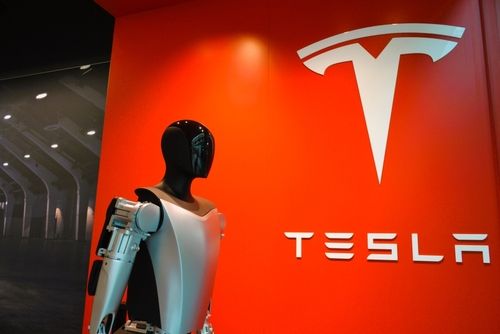
TradingKey - The narrative surrounding Tesla Inc. (TSLA) has undergone a fundamental transformation. As of April 23, 2026, Tesla is no longer viewed merely as an automaker; it is a vertically integrated titan at the intersection of physical artificial intelligence, renewable energy, and autonomous mobility. While legacy manufacturers and new EV players struggle with narrowing margins and market saturation, Tesla’s "ecosystem lock-in" strategy remains its primary competitive moat, decoupling its valuation from simple hardware delivery metrics.
What is Tesla? The Multi-Industry AI Conglomerate of 2026
Tesla is a technology and clean energy powerhouse that designs and deploys high-performance electric vehicles (EVs), grid-scale energy storage, and advanced robotics. Founded with the mission to accelerate the transition to sustainable energy, the company has evolved into an architectural force in the global economy.
Tesla's competitive edge lies in its radical vertical integration. Unlike traditional OEMs, Tesla manufactures its own high-density battery cells, develops proprietary AI training chips (Dojo), and operates the world’s largest DC fast-charging network with nearly 80,000 Supercharger connectors globally. By owning the full stack — hardware, software, and infrastructure — Tesla functions more as a Silicon Valley software giant than a traditional automaker, utilizing continuous over-the-air (OTA) updates to refine vehicle intelligence and safety long after the initial point of sale.
What Exactly Does Tesla Do? Revenue Streams and Key Business Units
While vehicle deliveries remain the primary volume driver, Tesla’s financial architecture is diversifying toward high-margin software and energy services. In the first quarter of 2026, Tesla reported revenue of $22.39 billion, with significant shifts in its core business segments:
- Automotive & Production: Despite a challenging global macro environment, Tesla delivered 358,023 vehicles in Q1 2026, maintaining its lead with the Model 3 and Model Y, alongside the scaling Cybertruck and the heavy-duty Semi. This segment still accounts for roughly 73% to 79% of total revenue but is no longer the sole focus of investors.
- Energy Generation & Storage: A long-term growth engine, Tesla’s energy unit (Powerwall, Megapack, and Solar Roof) has become a multi-billion-dollar stabilizer. In 2025, the company deployed over 31 GWh of storage, and Q1 2026 data shows this momentum accelerating as global power grids modernize.
- Services & Software (The FSD Engine): This is the fastest-expanding high-margin bucket. Active Full Self-Driving (FSD) subscriptions have surged to 1.28 million, representing a 51% year-over-year increase. This fleet effectively acts as a massive distributed sensor network, collecting real-world data to train Tesla’s neural networks.
- Autonomy & Robotics: Tesla is transitioning into a pure-play robotics firm. The "Cybercab" (a steering-wheel-less autonomous taxi) is moving toward volume production, while the "Optimus" humanoid robot is being integrated into Tesla’s own Gigafactories to automate complex industrial labor.
Who is the Owner of Tesla? Leadership and Governance
Elon Musk remains the single largest shareholder and the strategic visionary as CEO. As of late April 2026, Musk’s stake is estimated at approximately 13% to 14%, a holding worth tens of billions of dollars. His leadership continues to steer the company toward full autonomy and the "Master Plan Part 4."
The institutional base is anchored by the world’s top asset managers. The Vanguard Group, BlackRock (BLK), and State Street Global Advisors remain the largest institutional holders, collectively owning over 15% of the equity. Despite the volatility often associated with Musk’s involvement in other high-profile ventures — such as the upcoming SpaceX IPO and the integration of xAI — institutional support for Tesla’s AI-first roadmap remains resolute.
Why is Tesla So Famous? The Disruptive Business Model
Tesla’s market dominance is sustained by three industry-shaping innovations that rejected the 20th-century automotive playbook:
- Direct Sales & Verticality: By bypassing franchised dealerships, Tesla maintains total control over the brand experience and pricing, allowing for rapid response to market shifts and avoiding the inventory bloat that plagues competitors.
- The Supercharger Advantage: Recognizing that charging infrastructure was the largest barrier to EV adoption, Tesla built a global network of 60,000+ stations. In a stunning industry shift, almost all major automakers have now adopted Tesla’s North American Charging Standard (NACS), effectively making Tesla the "gas station" of the electric age.
- Software-Defined Hardware: Treating the car as a computer on wheels allows Tesla to remotely improve performance features — such as range efficiency or braking response — something legacy automakers are still struggling to execute at scale.
The Road Ahead: Robotaxis and the AI Pivot
The most significant catalyst on the immediate horizon is the launch of Tesla’s proprietary paid ride-hailing service, targeted for June 2026. Having already launched "unsupervised" Robotaxi rides in test markets like Austin and San Francisco, Tesla is moving from a one-time sales model to a recurring "mobility-as-a-service" model.
The Cybercab aims to drive the cost per mile below that of public transit. While regulatory hurdles for Level 4 and Level 5 autonomy vary globally, Tesla’s massive real-world data advantage gives it a significant lead over competitors relying on geofenced, LIDAR-based systems.
Should I Buy Tesla Stock Now? Investment Outlook for Q2 2026
As of April 23, 2026, Tesla commands a market capitalization of approximately $1.5 trillion, with a Price-to-Earnings (P/E) ratio often exceeding 300. This valuation clearly shows that the market is not pricing TSLA as a car company, but as an AI and robotics leader.
- The Bull Case: Tesla’s gross margins have rebounded to 21.1% in Q1 2026, proving the company can optimize costs while scaling. If Robotaxis and Optimus achieve mass deployment, the current stock price may eventually look like a "steal." The energy storage business alone provides a massive floor for the company’s valuation.
- The Bear Case: Near-term risks include intense competition from Chinese manufacturers and high capital expenditures as Tesla raises its 2026 AI infrastructure spending to $25 billion.
For investors in Q2 2026, the question is not whether Tesla sells the most cars next month, but whether its lead in physical AI will allow it to own the future of autonomous movement over the next decade.
Recommended Articles






Comments (0)
Click the $ button, enter the symbol, and select to link a stock, ETF, or other ticker.