


Alphabet vs. Oracle: Here's What the Debt Market Is Saying



Key Points
- Debt markets show more concern for Oracle's default risk than Alphabet's.
- Equity markets are wary of Oracle and Microsoft's exposure to OpenAI.
- Well-funded leaders like Alphabet may be safer artificial intelligence (AI) investments.
- 10 stocks we like better than Alphabet ›
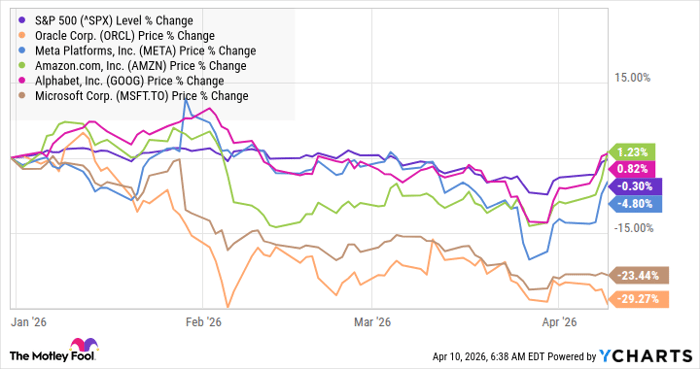
The market is, completely understandably, focused on artificial intelligence (AI) hyperscalers to determine whether there's an AI bubble brewing. Those concerns are magnified by the share price performance of the leading hyperscaler companies in 2026 (see chart).
The two that stand out the most are Oracle (NYSE: ORCL) and Alphabet (NASDAQ: GOOG) (NASDAQ: GOOGL), and a closer look at what bond markets are pricing in for their default risk says a lot about the two companies' prospects and the market's fears over an AI bubble.
Will AI create the world's first trillionaire? Our team just released a report on the one little-known company, called an "Indispensable Monopoly" providing the critical technology Nvidia and Intel both need.
Equity markets and hyperscalers
The underperformance of Oracle and Microsoft (NASDAQ: MSFT) in 2026 is clear in the chart. The most likely reason is that both have significant exposure to OpenAI. Oracle and OpenAI have a massive $300 billion cloud computing agreement whereby the former will build out AI data center infrastructure to sell computing services to OpenAI.
Meanwhile, Microsoft management confirmed on its last earnings call that 45% of its remaining performance obligations (RPO) are from OpenAI.
The equity markets are worried, but what are the debt markets saying?
Image source: Getty Images.
Debt markets
Looking at credit default swaps (CDSes) on company debt is a great way to assess the debt market's mood. CDSes are a form of insurance against a bond's default. They are priced in basis points (bps), where 100 bps equals 1%. As an example, it will cost you 2% of a bond's face value every year to insure against a default based on a CDS price of 200bps.
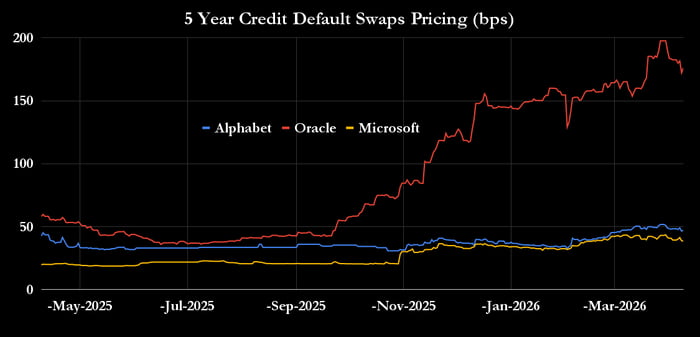
Here's a look at the pricing for Oracle, Alphabet, and Microsoft five-year bond CDSes over the past year.
Data source: S&P Global Market Intelligence. Chart by author.
What it means to investors
Clearly, the debt market is not particularly worried about a default at Alphabet and Microsoft. However, the debt market is more concerned about Oracle's risk of default, and the equity markets are worried about Oracle and Microsoft's ability to generate earnings from their OpenAI exposure.
Interestingly, OpenAI's recent funding round, in which Amazon, Nvidia, and Microsoft took part, was successful, with the company raising $122 billion based on a post-money valuation of $852 billion. The funding implies that investors remain willing to back AI companies' growth, but there are concerns about the cost of the buildout.
As such, it makes sense to stick to well-funded companies, like Alphabet, that are also leading in building engine models, rather than Oracle, which is building out AI infrastructure for OpenAI.
Recommended Articles






Comments (0)
Click the $ button, enter the symbol, and select to link a stock, ETF, or other ticker.