


Tesla Denies Developing Small Electric SUV, Is It Giving up on the Mass Market?



AI Podcast


Tesla China denied rumors of a smaller, cheaper SUV, while also discontinuing Model S and Model X production. This strategic pivot shifts focus from volume-driven, lower-priced vehicles to autonomous driving, the Optimus robot, and AI computing power, positioning Tesla as a robotics and AI company. While the company emphasizes future growth engines, Model 3 and Y sales face pressure from competitors, and the timely deployment of Robotaxi and mass production of Optimus are critical for its valuation. Investors should monitor Q1 2026 financial results, particularly gross margins, energy storage growth, and Robotaxi operational data.
TradingKey - April 10, 2026, Tesla ( TSLA) China officially debunked a market rumor: the report that "Tesla is secretly developing a smaller, cheaper electric SUV (4.28 meters long, priced lower than the Model 3, and planned for production at the Shanghai factory)" was explicitly denied.
Coincidentally, on the same day, Tesla officially confirmed it had previously suspended production of its high-end Model S and Model X vehicles. These two flagship models, which once represented the face of Tesla, have finally reached the end of their product life cycles after more than a decade in service.
Between denying the launch of a cheaper new model and axing its most expensive legacy cars, this series of moves has left many consumers and investors wondering: what exactly is Tesla up to? Is it unwilling to engage in a price war with BYD and Xiaomi, or is there a larger strategy at play?
I. Why the Market Is Eagerly Awaiting a More Affordable Tesla SUV?
In the first quarter of 2026, Tesla reported global deliveries of 358,000 units, up 6.5% year-over-year (official data) but short of the 370,000 units expected by Wall Street. Shares tumbled 5.42% on the news, wiping out $77.5 billion in market value. Even more striking was the production and sales data: Q1 production for the Model 3/Y exceeded sales by 50,000 units, marking the first instance of "overproduction" in nearly two years. This was primarily due to the expiration of the $7,500 federal EV tax credit in September 2025, making Q1 2026 the first full quarter without the subsidy. According to Cox Automotive, U.S. EV sales plummeted 28% in the first quarter.
The Chinese market remains hyper-competitive: in March 2026, BYD's sales exceeded 300,000 units, Xiaomi delivered 21,000 SU7s, and Leapmotor returned to the 50,000-unit level. In contrast, Tesla's wholesale volume in China was just 85,670 units, with a growth rate lagging behind several domestic brands.
In 2025, BYD unseated Tesla as the world's top seller of pure electric vehicles with 2.256 million units. The market naturally expected Tesla to replicate its Model 3/Y strategy—launching a more affordable vehicle to drive volume—but Tesla has chosen a different path.
II. Why is Tesla Halting Production of Model S and Model X?
On April 1, Elon Musk personally announced the "death sentence" for these two models on social media: custom orders are no longer being accepted, and with only a few hundred units left in global inventory, once they are sold out, that's it. The Model S was launched in 2012 and the Model X in 2015; this duo played a pivotal role in Tesla's early success—without them proving that electric vehicles could be luxurious, high-performance, and long-range, the subsequent explosive success of the Model 3 would have been unthinkable.
In the full year of 2025, combined sales for the Model S and Model X reached only about 50,000 units, while the Model 3 and Model Y sold 1.6 million units in the same period. Utilizing the most expensive production lines and tying up the best engineers for an output that is a mere fraction of the total, the economics simply do not make sense.
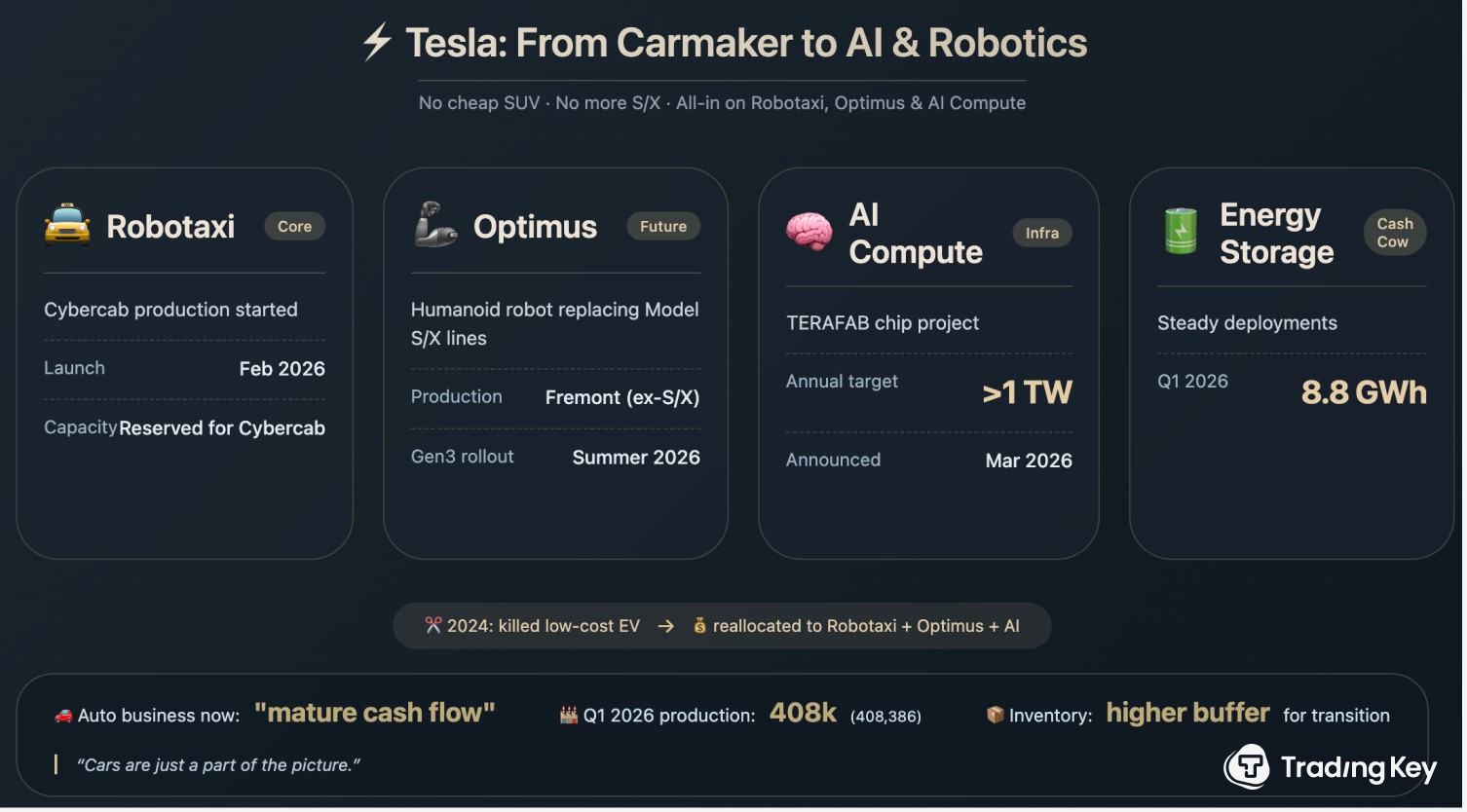
What will the vacated production lines be used for? Building a more affordable compact SUV? Musk's answer was unexpected: building the humanoid robot Optimus. Once the Model S/X lines at the Fremont factory are cleared, they will pivot entirely to the mass production of Optimus. Musk has stated publicly on multiple occasions that Optimus could eventually become the largest contributor to Tesla's market capitalization, far outweighing the importance of car sales.
Discontinuing the S/X is not about making room for a so-called "mini Model Y," but rather clearing the path for robotics. Resources are finite; increasing investment in one area inevitably requires scaling back in another.
III. Foregoing Low-Cost SUV: How Will Tesla Compete with Byd and Xiaomi for Market Share?
Since it has no intention of using low-priced vehicles to engage in a price war, what cards does Tesla actually hold?
The answer lies in the three keywords Elon Musk has been repeatedly emphasizing over the past two years: Robotaxi (autonomous taxi), Optimus (humanoid robot), and AI computing power.
As early as 2024, Musk did something that many found confusing: he scrapped a planned low-priced electric vehicle project and redirected all the saved capital and manpower toward Robotaxi. By 2025, this strategic direction became even clearer—the automotive business is positioned as a "mature, cash-flow-generating business," while the real growth engines are Robotaxi, Optimus, and AI infrastructure.
The data doesn't lie. In the first quarter of 2026, Tesla produced 408,000 vehicles; however, to reserve production capacity flexibility for the mass production of the Cybercab (Tesla's autonomous taxi), the company preferred to let finished goods inventory build up slightly. At the same time, the energy storage business saw installations reach 8.8 GWh in the first quarter, a year-over-year increase of approximately 67%, and this segment is quietly becoming a new cash cow.
This March, Musk also announced the launch of the chip manufacturing project TERAFAB, with a goal to produce over one terawatt of computing power annually, some of which will be used directly in electric vehicles and humanoid robots. In other words, Tesla is transforming itself from a "car-making company" into a "robotics and AI company," with cars being just one piece of this vast landscape.
This explains why debunking the small SUV rumors is so critical—any signal of strategic wavering could lead the capital markets to doubt Tesla's commitment to its transformation.
IV. Tesla Denial: What is the Real Strategic Calculation?
That said, a denial is just a denial, and it does not mean Tesla is ruling out the low-price market forever.
A noteworthy detail in the Reuters report suggests that an insider familiar with Tesla’s product planning revealed the company's new models will be centered on autonomous driving but will retain manual options, as "many global markets will struggle with autonomous driving regulations and implementation over the coming years."
In essence: the Robotaxi is the main priority, but Tesla understands its deployment won't happen overnight. Until autonomous driving achieves mass adoption, traditional EVs will remain the company's primary revenue driver. If Model 3 and Model Y sales continue to face headwinds, launching a new model to stimulate the market is certainly not inconceivable.
Thus, Tesla’s actual strategy likely involves a dual-track approach: publicly insisting it is "not developing a compact SUV" to maintain an image of strategic focus and prevent the stock price from being penalized for indecision, while internally quietly pushing forward with the development of new platforms that support both autonomous and manual driving as a contingency.
5. What Should Retail Investors Focus on Regarding Tesla Now?
First, when exactly will the Robotaxi be deployed on the road?
This is the core pillar of Tesla's valuation. If the commercialization timeline is repeatedly delayed, the entire investment thesis will have to be rewritten.
Second, can the Optimus robot achieve mass production?
Elon Musk has stated it could become a cornerstone of Tesla's market value, but there is still a long way to go from the lab to the factory floor.
Third, in the absence of new models, how much longer can the Model 3 and Model Y hold their ground?
These two models have been on the market for several years now; facing successive competitive pressures from the likes of BYD and Xiaomi, their product advantages are being steadily eroded.
On April 22, Tesla will release its first-quarter 2026 financial results. Key indicators to determine the company's trajectory will include whether gross margins held steady, the growth of the energy storage business, and the operational data for the Robotaxi.
This content was translated using AI and reviewed for clarity. It is for informational purposes only.
Recommended Articles







Comments (0)
Click the $ button, enter the symbol, and select to link a stock, ETF, or other ticker.