


Amid Memory Chip Supercycle, Buy Individual Stocks or ETF?



The memory chip market is experiencing a supercycle with DRAM and NAND prices surging, and major tech firms signing long-term agreements. Investors face a choice between individual stocks like Micron, SK Hynix, and Samsung, or ETFs. The DRAM ETF offers pure-play exposure but has low liquidity. Traditional semiconductor ETFs (SOXX, SMH) dilute memory exposure. PSI and XSD provide diversified semiconductor exposure. For those bullish on AI memory, the DRAM ETF is an option, while broad semiconductor interest favors SOXX or SMH. Long-term logic suggests memory chips are becoming scarce infrastructure.
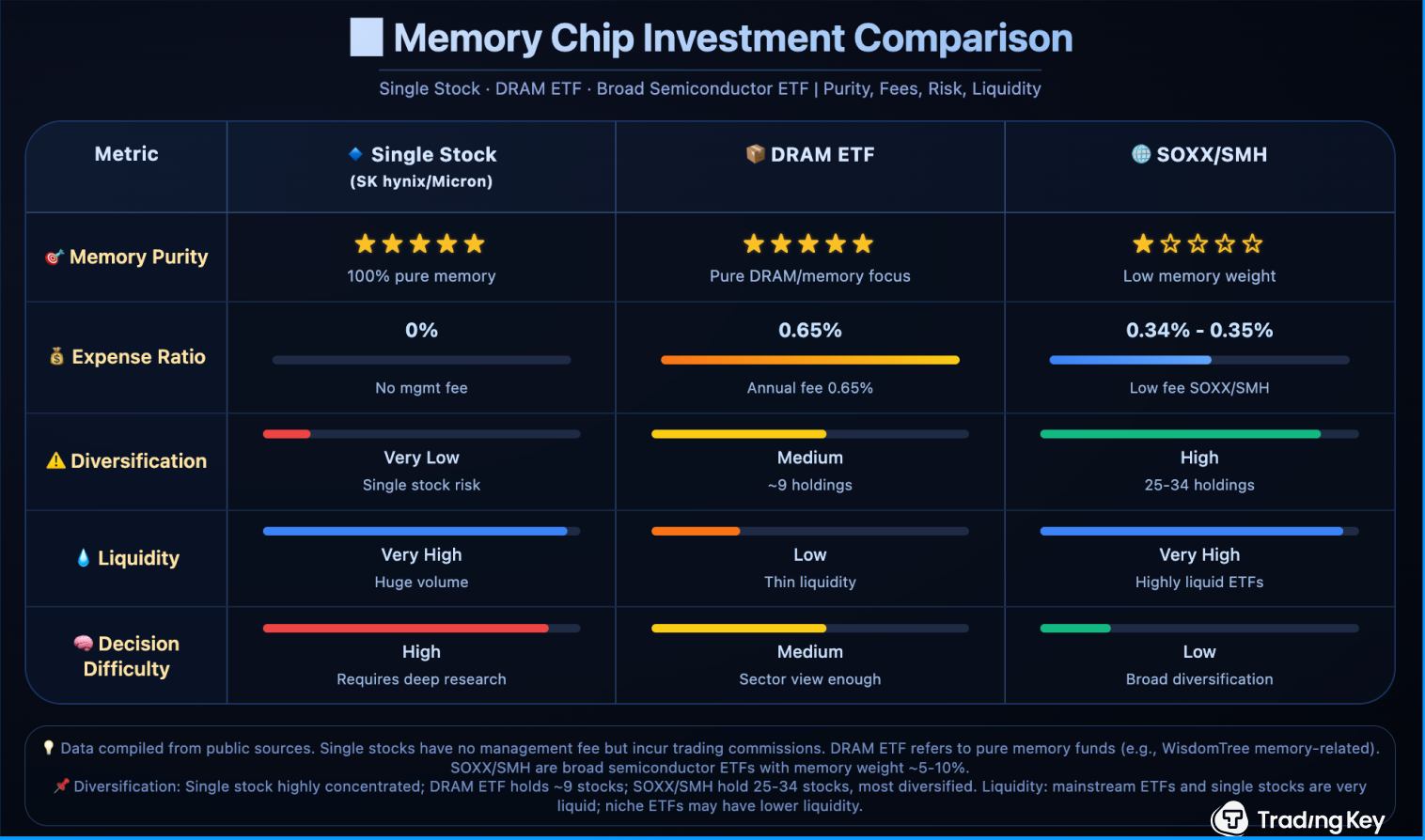
TradingKey - The memory chip market in the first quarter of 2026 is experiencing a once-in-thirty-year supercycle. DRAM contract prices have surged by more than 90% quarter-on-quarter, and NAND prices have risen by over 50%; Microsoft ( MSFT ), Google ( GOOGL) signed three-year long-term contracts with memory manufacturers for the first time, willing to pay 10%-30% in advance deposits; Samsung's quarterly profit hit a record high, and SK Hynix shares jumped nearly 15% in a single day. As the market heats up, retail investors are most concerned with whether to buy individual stocks directly or diversify through ETFs.
I. Micron, SK hynix, or Samsung: Which is the Better Investment?
There are currently three memory stocks attracting the most attention: Micron ( MU ), SK Hynix, and Samsung Electronics.
Micron Technology: The only pure-play DRAM giant in the U.S. market
- Stock Price & Market Cap: Approximately $406, total market cap of approximately $458.7 billion
- Latest Earnings: Single-quarter revenue of $23.86 billion, a year-on-year surge of 196%, the strongest profitability in history
- Highlights: Secured five-year strategic customer agreements; multiple brokerages have set target prices at $538
- Advantages: Strong liquidity, transparent financial reporting, and the convenience of direct trading in the U.S. market
- Shortcomings: Next-generation HBM4 market share is projected at only 18%, with technical progress lagging behind SK Hynix
SK hynix: HBM technology leader, but valuation is "discounted"
- HBM Market Share: 57% globally, the absolute leader
- Orders: Has secured NVIDIA's ( NVDA) next-generation AI platform share, approximately 70%
- Technology: 1c DRAM yields have risen to 80%; over half of the capacity will switch to the new process within the year, with monthly capacity reaching 190,000 wafers by year-end
- Valuation: Forward P/E is only about 5.7x, while Micron's forward P/E is about 9x—for every $1 earned, Micron is valued at $9, while SK hynix is valued at only $5.7
- Catalyst: Plans to list in the U.S. via ADRs, raising approximately $6.7-$10 billion; if successful, its valuation is expected to align with Micron
Samsung Electronics: The largest in scale, but temporarily lagging in HBM
- Market Cap: Approximately $824.3 billion, ranking first globally in DRAM/NAND capacity
- Earnings: First-quarter operating profit of 57.2 trillion KRW, up 755% year-on-year
- Issues: Dragged down by HBM yields, temporarily lagging in the AI race
- Counterattack: Actively investing to expand 1c DRAM capacity in an attempt to reclaim market share in the next-generation competition
II. How to Select Storage ETF?
DRAM ETF: Pure-play memory sector with highly concentrated holdings
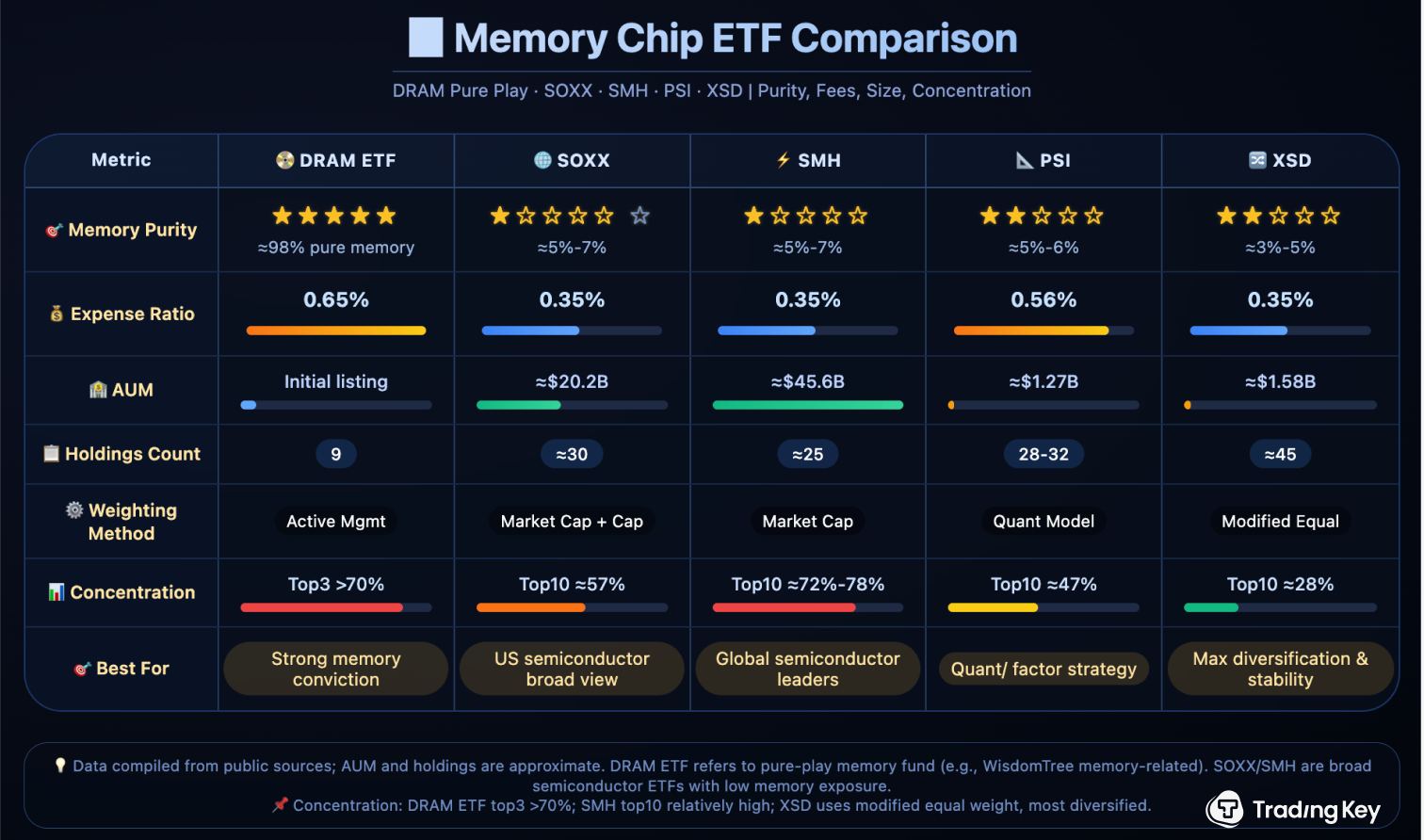
On April 2 of this year, the world's first pure-play memory-themed ETF, the Roundhill Memory ETF (Ticker: DRAM), was listed on the US stock market. It holds only 9 stocks with extremely strict selection criteria: constituent companies must derive over 50% of their revenue from the memory business. The top three holdings by weight are Micron Technology (24.63%), Samsung Electronics (24.11%), and SK Hynix (23.08%), accounting for over 70% in total. The management fee is 0.65%, utilizing active management with quarterly rebalancing.
Pros: Offers one-click exposure to major global memory stocks with nearly 100% purity. It is the only "memory-only" tool on the market that avoids other segments.
Cons: As it is in its early stages since listing, the fund's official website currently shows its assets under management (AUM) at $181.9 million. Additionally, it holds some assets through total return swaps, making its structure more complex than standard ETFs.
Traditional Semiconductor ETF: Memory exposure is heavily diluted
The largest semiconductor ETFs on the market are SOXX (approximately $20.2 billion) and SMH (approximately $45.6 billion), with expense ratios of only 0.34%-0.35%. However, their allocation to the memory sector is extremely low:
- SOXX (iShares Semiconductor ETF) : The top ten holdings are primarily NVIDIA (8.45%), Broadcom ( AVGO) (8.32%), Micron (7.07%), Advanced Micro Devices ( AMD) (6.62%), Applied Materials ( AMAT) (5.87%), etc. The weight of memory is far below 5%. SOXX tracks the NYSE Semiconductor Index, using a market-cap weighting scheme with caps: the top five stocks are capped at 8% and the rest at 4%, offering high diversification.
- SMH (VanEck Semiconductor ETF) : The top ten holdings include ASML ( ASML) (11.39%), TSMC ( TSM) (10.32%), Micron (9.50%), NVIDIA (9.27%), AMD (7.89%), etc. The memory sector is similarly diluted. SMH's weight distribution is more concentrated—NVIDIA and TSMC together account for nearly 20%, making it more sensitive to the performance of leading stocks.
If you are bullish on the memory sector, buying SOXX or SMH is equivalent to buying a basket of semiconductor stocks, where memory is only a very small part.
Alternative ETFs: PSI and XSD
For investors seeking diversified allocation within the semiconductor sector while maintaining some memory exposure, there are two alternative options:
- PSI (Invesco Dynamic Semiconductors ETF) : It uses a quantitative model for stock selection and weighting, with a 0.56% expense ratio. It holds approximately 28-32 stocks, with Micron as its largest holding at about 5.8%. PSI dynamically rebalances quarterly based on factors such as momentum, quality, and value.
- XSD (SPDR S&P Semiconductor ETF) : It employs a modified equal-weight methodology and holds about 45 semiconductor companies. Micron's weight is approximately 2.85%-4.48%. Individual stocks have a smaller impact on the portfolio, providing the highest degree of diversification. The top ten holdings account for only about 28% in total.
Understanding Core Differences at a Glance
Selection Advice for Different Investment Scenarios
- Strongly bullish on the AI memory sector -> DRAM ETF is the only "pure-play memory" choice, with concentrated holdings and the highest purity. However, investors should note its lower liquidity, which may result in wider bid-ask spreads.
- Bullish on semiconductors overall but unwilling to bet on individual stocks -> SOXX or SMH are the mainstream choices. SOXX is more diversified, suitable for conservative investors; SMH is more concentrated, suitable for investors with higher confidence in AI leaders.
- Believing in quantitative model stock selection -> PSI provides a dynamic rotation strategy.
- Seeking extreme diversification and stability over high returns -> XSD's equal-weight mechanism reduces the impact of individual stocks and single sub-sectors.
Remaining cautious about potential overheating in the memory industry -> Historical data suggests that when a sub-sector becomes hot enough to spawn specialized ETFs, it often indicates that the trend has entered a relatively late stage. If an overheating risk is perceived, more diversified options like SOXX, XSD, or a custom portfolio of individual stocks might be safer choices.
III. Individual Stocks Vs. ETF: Which Is More Cost-Effective?
- If you have conducted in-depth research on a specific company, investing directly in individual stocks may yield higher returns. Choose SK Hynix if you are bullish on its HBM technical leadership and potential valuation recovery; opt for Micron if you prioritize safety and liquidity.
- If you are optimistic about the entire memory sector but prefer not to bet on a single stock, the DRAM ETF provides a diversified portfolio of nine companies, offering 'one-click' allocation convenience for a 0.65% management fee. However, note that its smaller scale could lead to wider bid-ask spreads.
- If you are simply optimistic about the semiconductor industry as a whole and are unsure whether memory will outperform other segments, SOXX or SMH are more established options.
IV. What to Watch for in the Current Market?
The Supercycle Continues: A UBS research report suggests that AI-driven HBM demand continues to cannibalize DDR capacity, and the global DRAM supply-demand gap will persist through the fourth quarter of 2027. Contract prices in Q2 2026 are projected to rise by another 58%-63%.
Be Wary of Overheating Signals: BTIG's chief technical analyst noted that when a niche sector becomes hot enough to spawn dedicated ETFs, it usually indicates the market has entered a relatively late stage. The DDR4 spot market once plunged over 30% in a single day, and sentiment volatility cannot be ignored.
The Long-Term Logic Remains Unchanged: Microsoft and Google have signed three-year long-term agreements with memory manufacturers for the first time, introducing price floors and prepayment mechanisms. Memory chips are transforming from highly cyclical commodities into 'infrastructure-grade' scarce resources.
V. Summary
Memory chips are emerging as a core track for hardware investment in the AI era. Whether buying individual stocks directly or allocating through ETFs, the key lies in understanding your risk tolerance and investment objectives.
- Deep-dive researchers —— SK hynix (potential for a technology and valuation 'double play')
- Stability seekers —— Micron (excellent liquidity, direct U.S. stock trading)
- Investors looking to avoid stock picking —— DRAM ETF (basket allocation)
- Diversified semiconductor exposure —— SOXX/SMH (mature and steady)
There is no single correct choice, only the strategy that fits you. In a once-in-thirty-year supercycle, maintaining rationality and managing position sizing may be more critical than agonizing over 'individual stocks versus ETF.'
This content was translated using AI and reviewed for clarity. It is for informational purposes only.
Recommended Articles





Comments (0)
Click the $ button, enter the symbol, and select to link a stock, ETF, or other ticker.