


Has the Market Misjudged? Morgan Stanley Backs Nvidia: Long-Term Potential Seriously Undervalued



AI Podcast


Morgan Stanley has named Nvidia its top semiconductor pick, replacing Micron Technology, due to strong AI computing demand. The bank believes the market underestimates Nvidia's sustained growth driven by AI infrastructure and enterprise applications, while potentially overestimating the stability of the memory chip cycle. Nvidia's structural demand and product iteration offer greater certainty than memory chip supply-demand repair. This shift reflects a preference for long-term structural expansion over cyclical rebounds, with Nvidia's role in the AI ecosystem deemed irreplaceable.
TradingKey - Following a significant rally in the memory chip sector, Morgan Stanley has reshuffled its internal rankings for the semiconductor industry. The bank has named Nvidia (NVDA) as its top pick in the semiconductor sector, replacing its previous preference for Micron Technology (MU) , indicating its outlook on the medium- to long-term prospects of the core AI computing leader has turned positive once again.
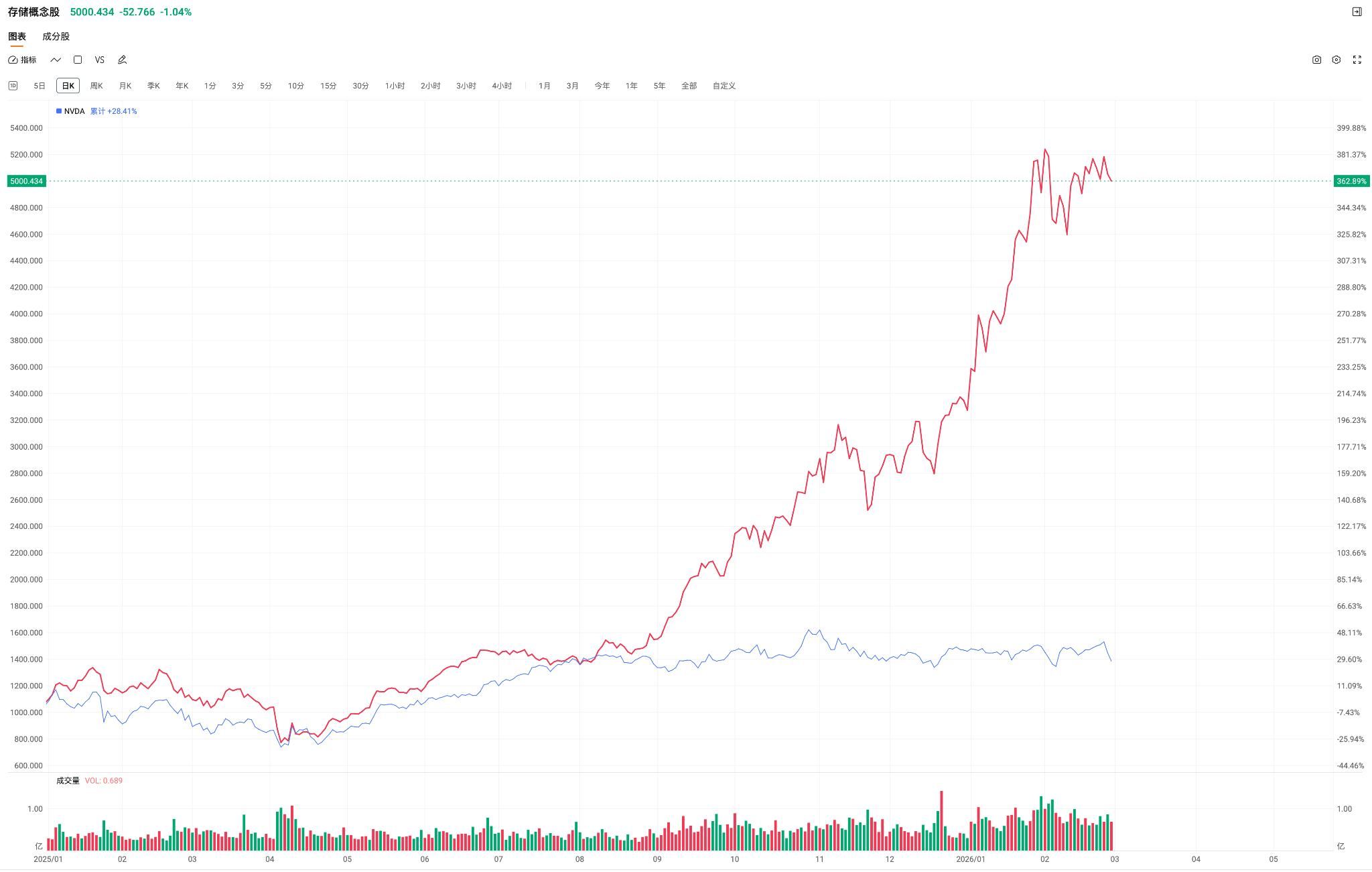
[Comparison of gains between memory stocks and NVDA since 2025, Source: Tradingkey]
In a recent report, Morgan Stanley analyst Joseph Moore noted a prevailing market view that the memory chip industry enjoys longer and more sustainable cycles, whereas processor chip companies face greater cyclical volatility. However, the bank does not entirely agree with this assessment. The report suggests that the market may be overestimating the stability of the memory chip price cycle while underestimating the sustained drive for high-end GPUs fueled by AI computing demand.
Over the past few months, Micron's stock price has risen significantly, driven by expectations of a recovery in memory prices, with some capital shifting to bet on a "supercycle" in the memory industry.
However, Morgan Stanley believes that earnings elasticity in memory chips depends more on the repair of supply-demand imbalances, and its sustainability remains to be seen. In contrast, Nvidia's growth logic is built more on the expansion of AI computing power in data centers, the scaling of models, and the implementation of enterprise-level applications, offering greater certainty in structural demand.
Market concerns regarding Nvidia previously centered on growth sustainability. As the base grows higher, investors worry that its growth rate will be difficult to maintain at high levels over the long term. However, Morgan Stanley judges that these doubts may gradually dissipate in the coming months, with investor focus shifting to earnings prospects around 2027. The report suggests that Nvidia's current pace of product iteration and the AI infrastructure investment cycle continue to support revenue expansion for several years to come.
From an industry allocation perspective, this adjustment also reflects a rebalancing of capital within the semiconductor sector.
The market's temporary preference for the memory sector was based on expectations of valuation recovery and price rebounds; however, as some gains have been realized, institutions are beginning to re-evaluate growth quality and visibility. Morgan Stanley's view implies that it places higher value on the structural expansion of long-term computing demand rather than a simple cyclical rebound.
In this reiteration, Morgan Stanley did not deny the improving trend in the memory industry but emphasized that the core position of the leading processor manufacturer in the AI ecosystem remains irreplaceable. As market doubts regarding growth sustainability gradually ease, Nvidia may once again become the primary direction for capital allocation within the semiconductor sector.
This content was translated using AI and reviewed for clarity. It is for informational purposes only.
Recommended Articles










Comments (0)
Click the $ button, enter the symbol, and select to link a stock, ETF, or other ticker.