


Why Nvidia, Broadcom and Palantir Crashed Today?



AI Podcast


Technology stocks, particularly software names, declined sharply following Anthropic's release of AI tools automating legal work and office tasks. This innovation fuels investor anxiety about AI's impact on the broader software industry, questioning the future of traditional enterprise software vendors. Major software companies experienced significant drops, with some analysts seeing this as a shift from speculative AI chasing to fundamental reassessment. The sell-off extended to semiconductor stocks, creating a market paradox where falling chip prices suggest diminishing AI returns, while declining software valuations imply AI will render existing software obsolete.
TradingKey - Technology stocks took a sharp turn lower on Wednesday, led by a heavy sell‑off in software names. Some of the year’s most popular stocks slid by double digits as investors tried to make sense of a new competitive threat: a fresh wave of artificial‑intelligence tools from Anthropic.
The immediate trigger appeared to be the start‑up’s latest release — a feature that promises to automate legal work, launched only a day earlier. But underneath the headlines lies a deeper worry about what fast‑moving AI could mean for the broader software industry.
Who Is Anthropic?
The company has been one of the quiet success stories of the AI race. In 2025 it launched Claude Code, a large‑language‑model capable of writing software on command. Within six months it had crossed $1 billion in revenue and become the reference point for AI‑assisted programming.
In January, Anthropic introduced Cowork, which lets users automate everyday office tasks — compiling reports, summarising files or creating databases — without any technical background. Last Friday it went one step further, releasing free open‑source plug‑ins for Cowork, including a module aimed at legal services that can carry out contract reviews automatically. Others were tailored to sales, finance, marketing and customer service.
Unlike OpenAI and Google (GOOGL) (GOOG), which are competing for consumer adoption, Anthropic has trained its sights on the enterprise market. Claude Code now sits at the centre of many professional developers’ workflows, and the firm’s Claude 4.5 Opus model leads independent benchmarks for coding capability. Roughly 90 % of the code underlying Claude Code itself is machine‑generated; inside the company, between 70% and 90% of new code is now written by AI.
Why Software Stocks Cracked?
For investors, the pace of Anthropic’s innovation raises an uncomfortable question: if AI can already automate so much, what happens to the thousands of companies that still sell enterprise software tools?
That anxiety spilled into the market this week, sparking a broad sell‑off in any business that looked vulnerable. Microsoft Corp. (MSFT) fell 3.7%, Salesforce Inc. (CRM) 6%, and Adobe Inc. (ADBE) 4.6%.
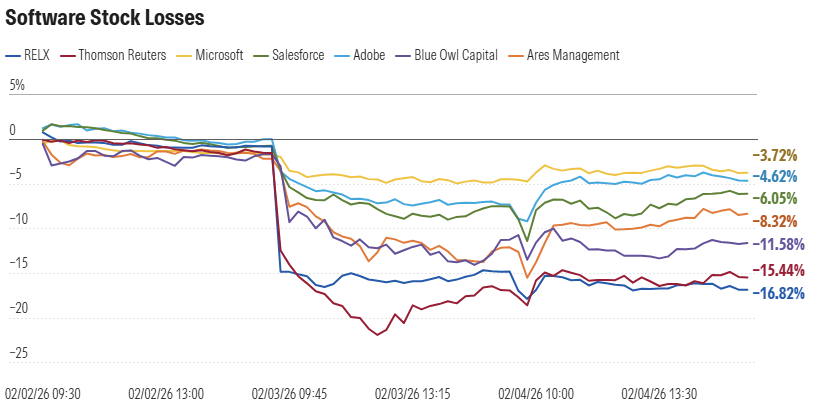
Source: Morningstar. Data as of Feb. 4, 2026, 16:00
Palantir Technologies Inc. (PLTR) — long seen as the sector’s purest bet on data‑driven software — dropped more than 11% on Wednesday alone.
“There’s clearly a ‘get me out’ element,” said Steve Sosnick, chief strategist at Interactive Brokers. This week’s swings, he added, looked like “a mix of institutional selling and momentum‑chasing retail money”. Investors, he said, are no longer just chasing the promise of AI but are “starting to look under the hood”.
Software stocks have struggled for months as investors wrestle with two competing fears: that AI will hollow out traditional licensing and subscription models, or that it will make established applications obsolete. Some on Wall Street think the latest drop goes too far. Mizuho analyst Jordan Klein wrote on Wednesday that recent results across the sector remain “fundamentally solid”.
Even so, the gloom is seeping into forecasts. Trivariate Research data show that both revenue and profit estimates for software companies in the Russell 3000 have been pared back. Analyst Shaposhnik said that suggests the slide is not purely emotional; fundamental expectations are coming down too.
How Did the Sell‑Off Spread to Chips?
By mid‑week the shockwaves had reached semiconductors. Shares of Nvidia Corp. (NVDA) and Broadcom Inc. (AVGO) each lost more than 3%, a move that analysts struggled to justify.
A strategist at Bank of America Corp. (BAC) said the “indiscriminate” selling echoed the panic that followed the DeepSeek episode — worries that were later proved unfounded. He argued that the scale of the downturn reveals a contradiction at the heart of the market’s thinking.
Falling AI‑chip prices suggest an industry losing its lustre, a sign that returns on heavy investment are diminishing. But sliding software valuations imply the opposite: that AI will soon become so efficient and widespread it will render much existing software unnecessary.
“Both stories can’t be true,” the note concluded. Put simply: if AI investment is a bubble destined to burst, then software isn’t about to be rewritten from scratch. Yet if AI really is transforming the way work gets done, the hardware powering that shift should still command strong returns — not be condemned as a failed bet.
Recommended Articles









Comments (0)
Click the $ button, enter the symbol, and select to link a stock, ETF, or other ticker.