


Why Every SpaceX Success Quietly Raises Tesla’s “Faith Ceiling”



AI Podcast


Tesla's elevated valuation is driven by its perception as a technology company, not just an automaker, with investors betting on Elon Musk's long-term execution capability, mirrored by SpaceX's successes. SpaceX's achievements in launch cadence, reusability, and satellite internet have established Musk's credibility in delivering complex, long-cycle engineering projects. This "credibility spillover" fosters market trust in Tesla's AI, autonomous driving, and robotics ventures, acting as a valuation floor and ceiling. Investors are essentially buying a long-term option on Tesla's future technological potential, with SpaceX's proven track record reducing perceived risk.
TradingKey - If viewed solely through the valuation framework of traditional automakers Tesla (TSLA) , many investors would feel it is detached from fundamentals. Its sales growth has slowed, price wars are eroding margins, and autonomous driving and robotics are still some time away from truly contributing large-scale profits.
The reality, however, is that capital markets remain willing to grant Tesla a valuation premium far exceeding that of traditional car companies.
The core support for its high valuation lies in the fact that the market has never viewed Tesla simply as a car manufacturer, but rather as a technology company centered on AI, autonomous driving, robotics, and energy systems.
The issue is that most of these sectors cannot prove themselves through profits in the short term. What investors are truly betting on is a judgment of long-term execution capability: whether Elon Musk can replicate the path he took with SpaceX for these seemingly radical technical roadmaps, turning the "impossible" into the "achievable" through sustained engineering delivery.
In What Areas Has SpaceX Achieved Success?
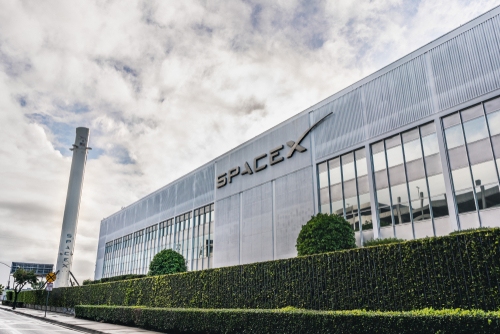
SpaceX achieved an unprecedented launch cadence with the Falcon 9. It completed approximately 165 Falcon 9 launches throughout 2025, setting an annual record, with the majority used to deploy its own Starlink satellite constellation. This demonstrates the company's superior efficiency in supply chain, ground operations, recovery and refurbishment, and rapid turnaround, far surpassing traditional aerospace giants.
Starship completed its tenth test flight and deployed dummy Starlink satellites, marking the gradual maturation of reusable rocket designs and key subsystems.
Beyond rocket launches, SpaceX's Starlink satellite internet project provides high-speed network services across many parts of the globe, showcasing the company's ability to manage the implementation and operation of complex systems while generating steady cash flow.
Longer-term goals, such as Falcon Heavy and Starship deep-space exploration missions, are also progressively validating the company's narrative regarding high-difficulty, long-cycle engineering.
How Does SpaceX Reshape the Market's "Perception of Execution" Regarding Musk?
Before SpaceX, reusable rockets, low-cost commercial spaceflight, and high-frequency launches were considered science-fiction concepts in mainstream perception. Even within the aerospace industry, many voices argued that such a path was neither economically nor engineeredly viable.
Over the past decade, SpaceX has not only proven these paths viable but also consistently lowered flight costs, increased launch frequency, and raised technical barriers.
From the perspective of capital markets, this success is not just a victory for the aerospace industry; more importantly, it has established an extremely rare "long-term engineering track record" for Elon Musk personally.
This means that when he introduces strategic goals with long cycles, massive technical challenges, and difficult short-term commercial returns again, the market no longer views them merely as visions or stories, but subconsciously incorporates them into pricing expectations for the company's long-term value realization.
How Does This "Credibility Spillover" Transmit to Tesla?
Although SpaceX and Tesla are financially independent companies, they remain linked in investors' cognitive frameworks through the core variable of "Elon Musk."
Whether it is FSD autonomous driving, Optimus robots, or the Dojo supercomputer system, these projects are logically identical to SpaceX's rockets—engineering projects characterized by massive investment, long cycles, and high failure risks, but which reshape industry landscapes upon success.
Having seen SpaceX turn one seemingly impossible goal after another into reality, the market is more willing to project the same patience and trust onto Tesla's long-term projects.
This projection is not reflected in any single quarter's revenue; rather, it manifests in the valuation system as investors' willingness to pay an "option price" upfront for Tesla's unfulfilled future.
Why Does This Raise Tesla's "Ceiling of Belief"?
The so-called "ceiling of belief" is essentially the amount of time cost and uncertainty the market is willing to bear for an uncertain future. As SpaceX succeeds, the market's trust in the "Musk concept" is continuously refreshed, leading to a repricing of the probability of success for Musk's specific goals.
This defines Tesla's valuation floor during fundamental volatility and its valuation ceiling when narrating AI and robotics stories. Even if the automotive business faces temporary pressure, as long as the market believes in Musk's long-term track record of "turning the impossible into reality," it is difficult to price Tesla strictly as an ordinary cyclical stock.
Tesla's stock is more like a long-term option betting on a future technological path. The existence of SpaceX serves precisely to increase the probability weighting recognized by the market for this option. It contributes no direct profit, yet continuously lowers the market's risk pricing for the "ultimate failure of these grand narratives."
Consequently, Tesla's stock price often depends not on quarterly EV deliveries, but on whether market confidence in long-term narratives like AI, autonomous driving, and robotics has shifted. One of the underlying anchors for this confidence is SpaceX's repeatedly proven execution capability.
What Does This Mean for Investors?
Understanding this "psychological linkage" between SpaceX and Tesla helps explain why TSLA's valuation framework remains in a different dimension than traditional automakers. It also explains why debates between bulls and bears often center not on short-term performance, but on whether the long-term vision is trustworthy.
In essence, with every SpaceX success, Musk's long-term vision advances, and investors' confidence in Tesla grows. The accumulation of this confidence ultimately raises the "ceiling of belief" for the company in capital markets.
Our assessment is not isolated; analysts in the market hold similar views, with Adam Sarhan's perspective aligning closely with ours.
Adam Sarhan, CEO of 50 Park Investments, said: Historically, whenever one of Musk's companies reaches a major milestone, it tends to lift market sentiment for his other ventures. A high-profile SpaceX IPO could attract a wave of new investors captivated by its innovation narrative, and that enthusiasm often spills over into Tesla.
This content was translated using AI and reviewed for clarity. It is for informational purposes only.
Recommended Articles





Comments (0)
Click the $ button, enter the symbol, and select to link a stock, ETF, or other ticker.