


Burry Bullish on Meme Stocks, GameStop Shares Surge Again. Is It Still the Time to Buy?



AI Podcast


GameStop's stock price surged following news of purchases by Michael Burry and CEO Ryan Cohen. The company's valuation is primarily driven by market sentiment, not fundamentals, due to its evolving business model and unproven viability. While collectibles now contribute significantly to revenue and offset declining hardware sales, the reliance on brand perception for high margins is a risk. Investment volatility, unreliable information, and potential depreciation of tokenized assets, alongside its meme stock status, present considerable investment risks. Consequently, GameStop may not be a suitable value investment in the short term.
TradingKey - Classic Representative of Meme Stocks GameStop (GME) The stock price surged by more than 8% during Monday's session after Michael Burry, the fund manager famous for the movie 'The Big Short,' posted that he has been buying GameStop shares.
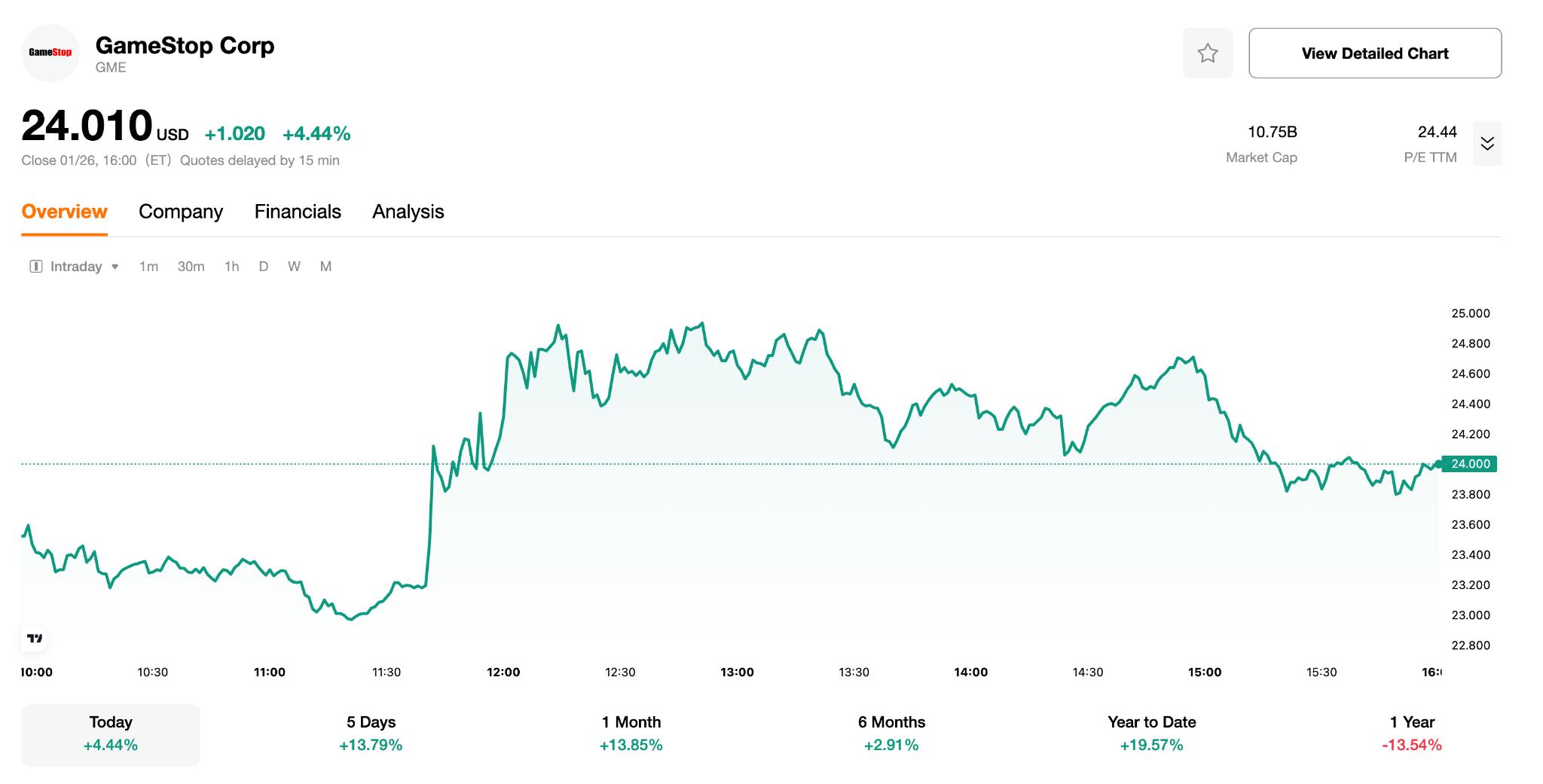
Meanwhile, just a week ago, GameStop CEO Ryan Cohen made significant insider purchases, increasing his stake in the company.
The convergence of multiple identities makes it difficult to assign a standard valuation to GameStop; instead, market sentiment is the primary driver of its stock price. Given that its fundamentals haven't shown clear improvement and its business viability remains unproven, GameStop may not be a good target for value investing in the short term.
What Kind of Company Is GameStop?
GameStop is a global specialty retailer focused on video games, gaming consoles, consumer electronics, and related accessories. The company operates a worldwide network of physical retail stores and e-commerce platforms, offering both new and pre-owned products including the latest gaming software, hardware, collectibles, and lifestyle merchandise.
In addition to physical stores, GameStop operates a digital platform for trade-ins and online purchases, and offers a membership program providing customers with exclusive content and rewards.
GameStop has transitioned from a declining traditional retailer to a focus of short squeezes driven by the Reddit community. In recent years, the company has shifted its revenue focus toward high-margin collectibles and achieved profitability recovery through cost controls; however, a significant portion of its profits stems from non-recurring items, such as changes in the fair value of digital assets.
The GME stock price is influenced by both fundamental improvements and residual meme stock sentiment. Investment risks include extreme price volatility, unreliable information sources, and inherent business model limitations, while its allocation to Bitcoin adds further complexity.
What Notable Events Has GameStop Triggered?
Starting in 2019, Keith Gill consistently posted screenshots of his long positions in GameStop (GME) and long-form analysis videos on r/WallStreetBets, emphasizing that the market's pessimistic pricing of GameStop was excessive and repeatedly noting that extremely high short interest could trigger a short squeeze.
As the stock price took off, the market value of his public positions swelled from hundreds of thousands to tens of millions of dollars. Under the r/WallStreetBets narrative of a 'grassroots turnaround,' a massive influx of retail investors not only bought GameStop shares directly but also swarmed into short-dated, out-of-the-money call options, causing option trading volume and open interest to skyrocket.
By January 2021, GameStop's short interest briefly exceeded 100% of its float. This was primarily due to large-scale active shorting by several hedge funds and institutional investors based on the logic that traditional brick-and-mortar game retail would be rendered obsolete by digital distribution, turning the ticker into a highly crowded short trade.
Under this extreme short structure, concentrated retail buying of call options triggered a classic Gamma mechanism: to hedge short Gamma and short Delta, option sellers (market makers) were forced to continuously buy GameStop shares as the price rose. This created passive long pressure against short positions, layering a Gamma squeeze on top of a short squeeze.
During the most volatile trading days, daily volume for certain near-term, deep out-of-the-money call options exceeded 100,000 contracts. The cost of these options relative to the underlying stock surged from a few percentage points to dozens, and the combination of passive hedging by market makers, short covering, and retail spot buying pushed the stock price to nearly $500 in a very short period.
The above is cited from 'GameStop: From Epic Short Squeeze to Q3 Earnings, Where Does This Meme Stock Go Next?'
Does GameStop Offer Good Investment Value?
Although GameStop's profitability has improved, we remain cautiously optimistic as the company has yet to identify a clear growth engine. GameStop currently maintains only three major business segments, with revenue still primarily driven by hardware and accessories.
Notably, while hardware and accessories contributed over 60% of sales revenue in the second quarter of fiscal 2026, they dropped to less than 50% by the third quarter, replaced by rising revenue from the collectibles and software segments. Most striking was the collectibles business, which for the first time accounted for over 30% of revenue, indicating sustained high growth in that segment.
An increasing share of profit is actually coming from the high-growth, high-margin collectibles segment, which is offsetting the structural decline of the traditional business. However, the high margins of collectibles depend heavily on brand recognition and value perception; GameStop must bet on IP creation and refinement, as growth in collectibles alone seems insufficient to sustain the weakness in its traditional operations.
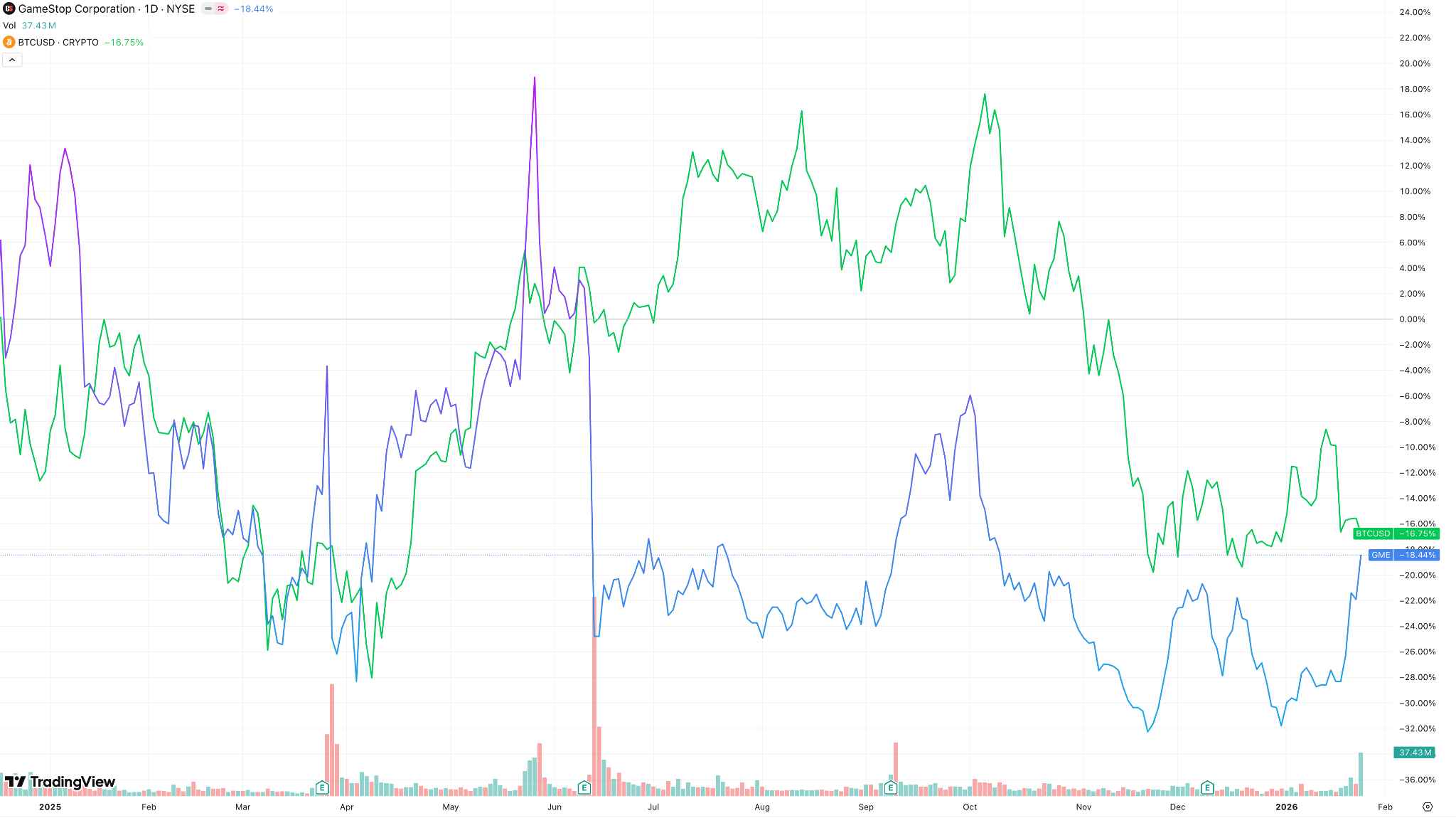
Furthermore, analysts suggest that with Bitcoin recently entering a volatile, downward-trending bear market, the potential depreciation of GameStop's tokenized assets has led many investors to worry about deteriorating fundamentals.
The convergence of multiple identities makes it difficult to assign a standard valuation to GameStop; instead, market sentiment is the primary driver of its stock price. Given that its fundamentals haven't shown clear improvement and its business viability remains unproven, GameStop may not be a good target for value investing in the short term.
This content was translated using AI and reviewed for clarity. It is for informational purposes only.
Recommended Articles








Comments (0)
Click the $ button, enter the symbol, and select to link a stock, ETF, or other ticker.