


World’s Richest Man Arrives at Davos. Musk Talks AI, Optimus, Life’s Ultimate Questions: The Next 10 Years Will Change Everything



AI Podcast


Elon Musk, at his first Davos appearance, outlined grand technological visions including AI surpassing human intelligence by 2025. Tesla's Optimus robot sales are eyed for 2027, while Robotaxi testing is underway nationwide, aiming for widespread US deployment by year-end. SpaceX targets Starship full reusability this year, potentially slashing space access costs. Musk also predicted AI's role in economic expansion and humankind's eventual ability to solve aging.
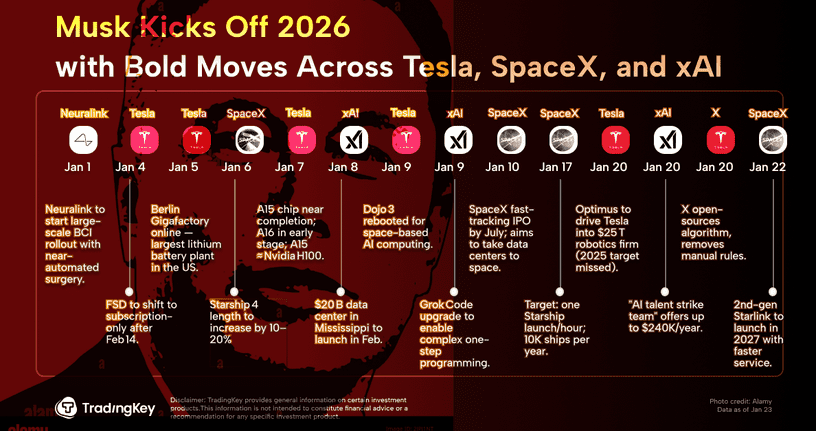
TradingKey - At this year's World Economic Forum in Davos, the arrival of an "unexpected guest" sparked heated discussion—the world's richest person, CEO of Tesla (TSLA) and SpaceX, Elon Musk, suddenly appeared on the official schedule and confirmed he would deliver a speech.
According to the previously public agenda, Musk was not originally on the attendee list. However, just the day after U.S. President Donald Trump's public speech, the Davos Forum temporarily updated its schedule, and Musk was promptly added as a speaker. This is expected to be his first official appearance at the annual event.
Interestingly, in recent years, Musk had reservations about the Davos Forum, once publicly calling it "boring" and "inessential." Consequently, his appearance this time is particularly noteworthy.
In his speech that day, Musk presented his grand vision for future technology trends, covering fields such as humanoid robots, autonomous driving, artificial intelligence, and space exploration. He predicted that AI could surpass human intelligence by the end of this year, marking another key turning point in the development of human civilization.
He noted that Optimus, the humanoid robot developed by Tesla, is currently in use in its factories to handle basic tasks and is expected to be capable of more complex work by the end of this year. If its subsequent performance in safety, functionality, and stability meets the required standards, official public sales could launch as early as the end of next year.
Meanwhile, Musk also revealed that Tesla's autonomous taxi service, Robotaxi, is progressing rapidly, having begun testing "driverless" operations in Austin, Texas. He stated, "By the end of this year, this service will become very, very widespread across the United States."
In the space sector, SpaceX is also accelerating its development. He mentioned that the company hopes to achieve full reusability of the Starship rocket by the end of this year at the latest, which is a significant step in advancing human deep-space exploration.
During his remarks, Musk reiterated that the pace of AI development should not be underestimated, predicting that AI will reach an intelligence level "smarter than any human by the end of this year or next year at the latest."
Will AI Surpass Humans by Next Year?
Regarding the development of AI, Musk offered a controversial yet compelling assessment. He predicted that AI could surpass human intelligence by the end of this year, or "by next year at the latest," "becoming smarter than any human."
Musk pointed out that the true limit of AI is no longer the algorithms or computing power itself, but the availability of energy. "The essence of AI is inclusive. Currently, the technological gap between open-source and closed AI models is only about one year. Major tech companies are racing to dominate the global market, but whether AI deployment can be scaled depends on the power supply."
Discussing the future potential of AI, Musk reaffirmed his judgment: "By the end of this year, we will have AI smarter than any human, no later than next year; by 2030 or 2031, which is about 5 years from now, AI will be smarter than all of humanity combined."
However, he also warned of the risks of technological misuse, particularly the potential dangers posed by robots and AI. He noted, "The most important thing is to have AI maximize its pursuit of truth, rather than falling into a tragedy like 'The Terminator'."
When exploring the impact of technology on future economic structures, Musk suggested that AI and robots will jointly drive a global economic expansion. He stated, "If AI is nearly free and robots are widespread, then global economic output will equal the average productivity of each robot multiplied by the total number of robots. Ultimately, we will have enough AI and robots to meet all human needs—goods and services will be extremely abundant."
Optimus Robot to Hit the Market as Early as 2027
Elon Musk has, for the first time, clarified the commercialization timeline for the Optimus humanoid robot. He stated that the Tesla-developed robot will undergo functional expansion and performance validation over the next two years, with official public sales expected to open as early as 2027.
Currently, some Optimus robots are already performing basic tasks within Tesla's factories, and by the end of 2026, they will have the capability to perform more complex industrial operations. Musk pointed out that the company will only start public sales once it is confident that the robots have reached sufficiently high standards in safety, functionality, and reliability. He noted that at that point, users will essentially be able to "ask the robot to complete various daily tasks," including home care, pet companionship, and even caring for elderly parents.
As early as the earnings call in early 2025, Musk cautiously stated that a "very rough forecast" was that Optimus would begin small-scale deliveries to other companies in the second half of 2026.
Despite Musk providing a clear timeline, the development of Optimus has not been without its setbacks. According to various reports, Tesla had canceled production plans for thousands of Optimus robots originally intended for internal deployment, primarily due to challenges in designing the mechanical hands, forearms, and sourcing components.
Furthermore, he admitted that the initial production pace for both the Optimus humanoid robot and the upcoming Cybercab model would be very slow to ensure that performance, safety, and user experience meet the necessary requirements.
Despite the clearer timeline, Musk remains extremely optimistic about Optimus's future potential. At the forum, he depicted a scene: "When AI's computing power approaches zero cost and intelligent robots are everywhere, the global economy will expand exponentially. Access to goods and services will be easier than ever before, and in the future, it might even be hard for you to think of what else a robot could do for you."
He has repeatedly predicted that the number of humanoid robots will far exceed that of humans in the future. These robots will not only continue to be used in industrial manufacturing but will also widely permeate household environments, capable of almost anything from washing dishes and childcare to providing emotional companionship.
Is Autonomous Driving "Solved"? Musk Doubles Down on Robotaxi Plan
At the same time, Musk boldly claimed that Full Self-Driving (FSD) "is essentially a solved problem" and predicted that Tesla's autonomous taxis will become "very widespread" in the United States by 2027.
Musk stated that Tesla's FSD system is being updated almost weekly, and some insurance companies have already offered a 50% premium discount to owners who enable this feature due to its excellent safety performance.
He also revealed that the Robotaxi business is currently operational in several cities, including Austin, Texas, with wide deployment expected across the U.S. by the end of this year. Meanwhile, "supervised" FSD in the European market is expected to receive regulatory approval as early as next month.
Musk further announced that Tesla plans to build a broad autonomous ride-hailing network in the U.S. by the end of 2026. This highly anticipated Robotaxi plan could become a key breakthrough for Tesla in its AI-powered mobility business.
However, compared to the ambitious promotion, Tesla's progress in commercialization has been stymied by setbacks. As early as June 2026, when the company first launched the Robotaxi service in Austin, vehicles still required human safety supervisors. Subsequently, the ride-sharing service launched in San Francisco was also driven by human drivers.
In fact, as early as October 2025, Musk claimed that Tesla would have 500 autonomous taxis on the road in Austin by the end of that year. However, just a month later, he lowered that figure to "about 60." His promise to achieve autonomous driving coverage for "about half of the U.S. population" by the end of that year also failed to materialize.
Currently, Tesla still hasn't received official permission to operate vehicles on California's public roads without safety supervisors. Nevertheless, shortly after his forum speech, Musk posted on X that the Robotaxi service in the Austin area had entered the "unsupervised" operational phase.
This update was confirmed by Ashok Elluswamy, Vice President of AI, who stated that Tesla will gradually introduce a "very small number" of unsupervised vehicles into the supervised fleet and plans to increase the proportion incrementally.
At the same time, Tesla's slow progress in the commercialization of autonomous driving reflects the broad challenges facing the entire self-driving industry.
In the U.S. market, Google's (GOOGL) subsidiary Waymo remains the leader in Robotaxi services. As of the end of 2025, its service has launched in five cities, including San Francisco and Phoenix, and officially entered the Miami market this week; Amazon (AMZN) subsidiary Zoox also joined the fray that same year, further intensifying market competition pressure.
On the other hand, consumer attitudes remain conservative. Several surveys from the EV Intelligence Report show that U.S. users remain highly cautious about autonomous taxis, with safety consistently being the primary concern and a major obstacle to adoption.
A regulatory storm at the end of 2025 further damaged Tesla's reputation. Relevant authorities in California determined that Tesla's promotion of autonomous driving features involved "misleading marketing" and suspected advertising fraud, adding further uncertainty to its Robotaxi rollout.
Space Is the Cheapest AI Platform
Musk revealed that SpaceX's core goal this year is to achieve full reusability of the "Starship" rocket system. He stated that Starship will be the "largest flying vehicle ever built by humanity." Once a full recovery cycle is achieved, it will slash the cost of entering space to 1/100th of its original amount, bringing launch costs below $100 per pound, significantly lower than current air freight prices.
Currently, SpaceX has successfully demonstrated the technology to catch rocket boosters on the launch pad via ground equipment, but has yet to achieve full recovery of the Starship spacecraft itself. In contrast, while the company's Falcon 9 rocket has made significant progress in recovery (with the first-stage booster reused over 500 times), it still requires component replacements and has not achieved full reusability.
Musk believes that if full Starship recovery can be realized, it will greatly improve launch efficiency, significantly lower the barrier for heavy satellites, orbital construction, and even deep-space missions, and pave the way for future space commercialization and infrastructure, especially in the fields of aerospace communication and AI infrastructure.
In addition to rocket reuse, Musk shared new ideas about SpaceX building a "Space AI Network." He stated that within the next two to three years, SpaceX plans to deploy a fleet of solar-powered AI satellites, noting that solar panels in space would be about five times more efficient than ground systems due to continuous sunlight and the lack of atmospheric interference.
In his view, space will become "the place with the lowest cost to run AI."
Humanity Will One Day Solve the Challenge of Aging
In fact, reversing aging has been a long-standing dream of human civilization.
At the meeting, Musk shared his deep insights on extending human life and reversing aging. He admitted that while he has not focused on scientific research in the aging field for the long term, he believes this major problem will eventually be solved.
"I think aging is actually a relatively solvable problem," Musk stated. "When we truly identify the causes of aging, I believe the answer will be obvious. It is not an incredibly complex or incomprehensible mechanism."
He cited human physiological characteristics as an example, noting that an individual's cells generally exhibit a consistent aging process rather than localized differences. "It would be strange if a person's left arm aged while their right arm remained young. This suggests there must be a 'synchronized clock' in the body that regulates the overall aging rhythm of approximately 35 trillion cells."
However, he also acknowledged that longevity is not a pure blessing.
"You know, the existence of death actually has its own logic. In natural systems, a finite lifespan can provide the impetus for renewal and evolution." He analyzed that if human lifespans were extended indefinitely, social structures might become rigid, lacking vitality and creativity.
"Society might become stagnant and lose the possibility of change," he added. "But the question is, do I really think we can find ways to extend life or even reverse aging? The answer is: I think it's very likely."
Musk's first appearance at the Davos Forum?
Looking back, the relationship between Elon Musk and the World Economic Forum in Davos has been nuanced, and arguably somewhat strained.
As early as 2022, Musk publicly stated that he had "declined the invitation to Davos" and remarked on social media that the forum was "boring as hell." However, the World Economic Forum quickly clarified that it had not issued him an invitation that year. In fact, Davos has not invited Musk to attend since 2015.
At the time, a forum spokesperson explained that the organizers had indeed invited Musk to the annual meeting several times in the past, the most recent being in 2015, but he had never registered or actually attended.
By 2023, Musk's criticism escalated further, as he again took to social media to publicly question the value of the forum's existence. He wrote: "Are they trying to be the boss of Earth!?"
Against this backdrop, Musk's sudden appearance on the Davos schedule has become one of the most high-profile highlights of the forum's history, drawing significant attention to whether he has entered a new phase of "mending relations" with this gathering of global elites.
This content was translated using AI and reviewed for clarity. It is for informational purposes only.
Recommended Articles







Comments (0)
Click the $ button, enter the symbol, and select to link a stock, ETF, or other ticker.