


Marvell Stock: Is Now the Time to Invest in this Undervalued Chip Stock? Predictions for MRVL Stock Surge by 2026



AI Podcast


Marvell Technology reported record Q3 revenue of $2.075 billion, up 37% year-over-year, and announced a $3.25 billion acquisition of AI startup Celestial AI. The company's strong performance in ASICs for data centers, coupled with its pure-play semiconductor focus and AI exposure, outpaces competitors like Broadcom. Despite a relatively attractive valuation and analyst price targets averaging $114, Marvell is considered a high-risk growth stock due to customer concentration and GAAP losses. Investors are advised to monitor partnership announcements and earnings for potential buying triggers.
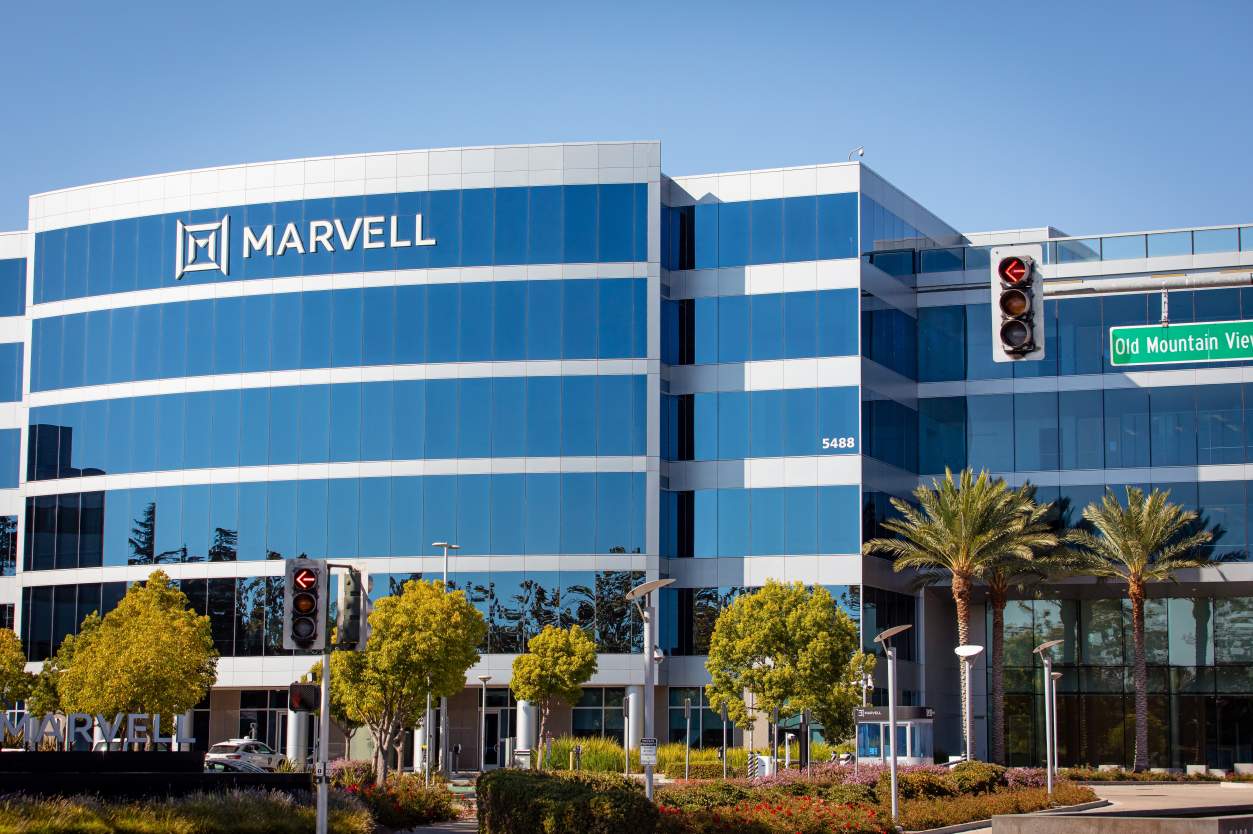
TradingKey - In post-market trading on December 2, 2025, semiconductor company Marvell (nasdaq: mrvl) reported strong fiscal third-quarter 2026 earnings and optimistic guidance, in addition to announcing a $3.25 billion acquisition. This news propelled the stock to surge as much as 9.9% after the market opened on December 3.
Compared to semiconductor industry giants such as Nvidia and Broadcom, this stock is relatively inexpensive (priced at just $92). Furthermore, it has fallen 16% year-to-date (as of market close on December 10), even as its revenue growth has been rapid. Some analysts are even boldly predicting that MRVL's share price could double by 2026. Is now the time to buy this stock?
Recent Marvell News
Marvell Technology Inc. reported record third-quarter revenue and unveiled plans to acquire AI startup Celestial AI for $3.25 billion, a strategic move designed to bolster its competitiveness in the burgeoning artificial intelligence infrastructure market. The chipmaker's Q3 earnings report revealed revenue climbed to $2.075 billion, marking a 37% increase from a year earlier and hitting a new all-time high. Furthermore, Marvell's CEO suggested total revenue could reach $10 billion in the next fiscal year.
The acquisition of Celestial AI aims to simultaneously expand Marvell's presence in both silicon chips and photonics. Marvell anticipates this deal will begin contributing revenue in the second half of fiscal year 2028.
What is Marvell Stock?
Marvell Technology, a California-based fabless semiconductor company founded in 1995 and listed on Nasdaq in 2000, specializes in chip design and integration. Key characteristics define its strategy.
1. The company's operations solely encompass chip design, architecture, and software integration, excluding chip manufacturing. Marvell consequently outsources chip production, packaging, and testing to foundries such as TSMC.
2. Marvell's core business and recent growth engine is its ASIC (application-specific integrated circuit) chip segment. Marvell serves large cloud computing clients like Amazon AWS and Microsoft Azure, designing and optimizing chips for their infrastructure architectures and specific workloads to help reduce compute costs. Broadcom is Marvell's primary competitor in the ASIC chip market.
3. Marvell primarily supplies chips for data centers. Furthermore, it provides chips for enterprise networking, carriers, and automotive Ethernet, among other sectors.
4. Beyond its customized ASIC chips, Marvell also offers standard products. These include network switches, PHY (physical layer) transceivers, controllers, and storage drives.
Historical Trend of MRVL Stock Price
2000-2002: IPO Amid Dot-Com Bubble, Soaring Then Crashing
Marvell Technology (MRVL) went public on June 27, 2000, at $15 per share, closing at $56.63 that day, buoyed by the dot-com bubble's final phase. The bubble had peaked on March 10, 2000, when the Nasdaq Composite hit its high of 5132.52 points. Subsequently, the broader U.S. stock market began a descent, eventually bottoming out in October 2002.
In its initial trading, MRVL's stock price continued to climb due to lingering market exuberance, even reaching a high of $27.44 in September 2000. It then steadily declined, hitting a low of $1.98 in April 2001.
2002-2019: Extended Period of Low Volatility
Following the dot-com bubble's collapse, MRVL's stock price recovered between 2002 and 2006. This rebound was primarily driven by a recovery in the semiconductor industry and Marvell's consistent revenue growth and improved profitability over several quarters.
However, after peaking in January 2006, MRVL's stock price again declined due to a slowdown in the semiconductor industry's growth. In 2008, the global financial crisis triggered a systemic market collapse, sending MRVL shares to a low of $4.48 in November 2008. The stock subsequently recovered, then fluctuated within the $10-$30 range for many years.
2020 to Present: Stock Surge Amidst the AI Wave
From 2020-2021,the pandemic accelerated digital transformation,leading to a surge in data center demand. Consequently, MRVL's stock soared from around $20 at the beginning of 2020 to a high of $93.85 by the end of 2021. In 2022, as the global economy entered a period of high inflation and rising interest rates, MRVL's stock fell 58.41% for the year, hitting a low of $33.75 in early 2023.
The true breakout moment occurred in May 2023. Following the market close on May 25, Marvell CEO Matt Murphy highlighted AI's significant commercial potential during the earnings call,projecting the company's AI-related sales to "at least double" in fiscal year 2024.This forecast spurred a substantial rally in MRVL's stock the next day, with an intraday gain reaching 32% on May 26. This marked the beginning of MRVL truly benefiting from the AI wave, signaling the start of its rebound cycle.
In fiscal year 2024, Marvell's AI revenue reached $550 million, nearly triple its AI revenue from fiscal year 2023. For fiscal year 2025, Marvell's AI-related ASIC business continued its growth,driving the data center segment to become its largest revenue source.Driven by surging data center demand and the company's substantial performance growth, the stock surged 68.46% in 2023 and an impressive 90.55% in 2024.
In January 2025, MRVL refreshed its historical high, with its share price reaching $127.48. This was primarily driven bya five-year partnership agreement with Amazon finalized in late 2024. Under this agreement, Marvell will supply Amazon's data centers with custom AI chips, along with digital and optical networking chips. This underscores a long-term commitment from a major client for Marvell's ASIC business, significantly boosting market confidence.
Although MRVL's stock plunged 20% on March 6 due to weaker-than-expected earnings, marking its largest single-day drop since 2001, it has gradually rebounded since May and has now stabilized around $90.
Marvell Q3 Revenue Growth Outpace Broadcom. What Was Behind It?
Marvell Technology Inc.'s latest earnings showed quarterly revenue growth of 37% to $2.075 billion, outpacing Broadcom Inc.'s 28%. This signals strong performance despite its smaller size.
This disparity is primarily due to Marvell's smaller company size and revenue base. Consequently, a similar absolute increase in revenue can translate into a higher percentage growth rate for Marvell.
From a business structure perspective, Marvell operates as a more pure-play semiconductor chip company. Broadcom, in contrast, has acquired software firms like CA Technologies and VMware in recent years, thereby reducing the proportion of revenue contributed by its chip business. Marvell, however, focuses solely on high-performance hardware research and development, particularly after acquiring Avera Semiconductor in 2019 and pivoting its focus to the ASIC business. Therefore, when the semiconductor industry experiences robust overall growth, Marvell's revenue growth also significantly accelerates, unburdened by other business segments.
Notably, Marvell also has a larger proportion of its business tied to AI, which consequently contributes a greater share of its revenue. Amid soaring data center demand, AI-related businesses are experiencing higher growth rates. This stands as another key reason why Marvell's revenue growth significantly outpaced Broadcom's this quarter.
While faster revenue growth may suggest greater growth potential for Marvell, investors should exercise caution. First, rapid revenue growth does not necessarily equate to strong profitability; the efficiency of the company's profit conversion warrants close scrutiny. Second, Marvell's revenue largely depends on a few major cloud service providers, leading to high customer concentration. This implies its revenue performance is highly susceptible to client-specific dynamics, undermining its overall stability.
Is MRVL Stock more cost-effective?
MRVL Valued Lower
Marvell Technology (MRVL) currently trades at a price-to-earnings (P/E) ratio of approximately 34 times, based on trailing twelve-month (TTM) figures. While this surpasses the industry average, it remains considerably lower than competitors such as Nvidia, at around 45 times, and Broadcom, nearing 100 times.
Similarly, Marvell’s TTM price-to-sales (P/S) ratio is about 11 times. This valuation, though slightly above the sector average, is substantially below Nvidia’s approximately 24 times and Broadcom’s 32 times.
In an environment where artificial intelligence (AI) stocks frequently command elevated valuations, Marvell's P/E and P/S ratios appear relatively rational. This indicates investors can acquire the stock without incurring an excessive valuation premium.
MRVL Poised for Growth
Compared to other semiconductor companies, Marvell is increasingly streamlining its operations and plans to accelerate its focus on the Application-Specific Integrated Circuit (ASIC) business. This specialized approach is expected to drive faster growth rates for the company. Furthermore, Marvell's recent acquisition of Celestial AI will substantially boost its competitiveness within the rapidly expanding AI chip market.
The rationale behind this move lies in Celestial AI's core optical interconnect technology. This innovation transmits data using light rather than traditional copper wires, promising to resolve a significant data center bottleneck. Consequently, the acquisition propels Marvell into a new technological frontier, establishing it as one of the few companies capable of delivering both conventional chip technology and advanced optical interconnect solutions, thereby broadening its addressable market.
Marvell projects that the acquisition will start contributing revenue in the latter half of fiscal year 2028. The company anticipates fourth-quarter fiscal 2028 revenue from this segment to reach $125 million, with fourth-quarter fiscal 2029 revenue projected to double to $250 million.
2026 MRVL Stock Forecast
Forty-four analysts tracked by TradingKey’s scoring system project over 20% upside for the stock, setting an average price target of $114 compared to its $92.47 close on December 10. Specifically, Morgan Stanley has a $112 target, Deutsche Bank projects $125, and JPMorgan Chase sees the stock climbing to $130.
Furthermore, the company currently forecasts earnings per share (EPS) of $2.84 for fiscal year 2026. Analysts, moreover, widely anticipate a 25% increase in net profit for fiscal year 2027. Based on the current 34x price-to-earnings (P/E) ratio, the share price could reach $120 in 2026.
Is MRVL Stock a buy now?
MRVL is a high-risk growth stock, better suited for investors with a higher risk tolerance and longer investment horizons.The company reports losses under GAAP and carries approximately $1.7 billion in net debt as of November 1. Its acquisition of Celestial AI, valued at up to $3.25 billion, has yet to generate returns. Furthermore, the company faces high customer concentration, with revenue heavily reliant on a few major cloud clients; a cessation of these partnerships could lead to a substantial drop in revenue.
Conversely, MRVL is also an attractive option for those bullish on the semiconductor industry's growth and seeking investment targets focused on AI hardware expansion. Moreover, if you possess a deep understanding of semiconductor technology and firmly believe in the prospects of optical interconnect technology, MRVL stands as a compelling investment choice.
Currently, the stock's valuation has becomerelatively reasonable, meaning investors buying now will not incur a significant valuation premium. Should you prefer to wait for clear upside signals before buying, monitor Marvell's partnership announcements, earnings releases, and technological advancements. Potential buying triggers include the company announcing significant client wins, securing substantial orders, or its earnings reports demonstrating improved profitability and successful product integration of technology from Celestial AI.
Summary
Marvell stands out among chip giants as a focused player in ASICs and optical interconnects, offering high growth potential. However, concentrated customers and limited diversification mean greater volatility. The company's intense focus on Application-Specific Integrated Circuits (ASICs) and cutting-edge technologies, such as optical interconnects, underpins its prospects for rapid expansion. Nevertheless, Marvell faces clear disadvantages. High customer concentration coupled with low business diversity may compromise its ability to withstand market shocks, consequently leading to more pronounced share price fluctuations.
This content was translated using AI and reviewed for clarity. It is for informational purposes only.
Recommended Articles









Comments (0)
Click the $ button, enter the symbol, and select to link a stock, ETF, or other ticker.