


Kioxia Tumbles 8%, SoftBank Falls Over 6% as Japanese Chip Stocks Face Fresh Sell-Off



AI Podcast


During the Asian trading session on July 29, the Nikkei 225 plummeted as semiconductor stocks reacted to SK Hynix’s underwhelming Q2 results. Beyond specific earnings misses, systemic concerns regarding the sustainability of AI capital expenditures—exacerbated by fears of a circular financing model and competition in lithography equipment—are driving valuation adjustments in Japan and South Korea. Increased market volatility is amplified by liquidity constraints, leveraged ETFs, and foreign futures. Looking ahead, Kioxia’s July 31 earnings and impending US tech giant reports, alongside Federal Reserve policy signals, remain critical catalysts that could sustain downward pressure on regional valuations.
TradingKey - During the Asian trading session on July 29, the Nikkei 225 Index continued to weaken after opening, with the semiconductor sector extending the panic-selling momentum from the previous day. As of press time, Kioxia Holdings fell nearly 8%, SoftBank Group dropped over 6%, and Tokyo Electron fell nearly 5%.
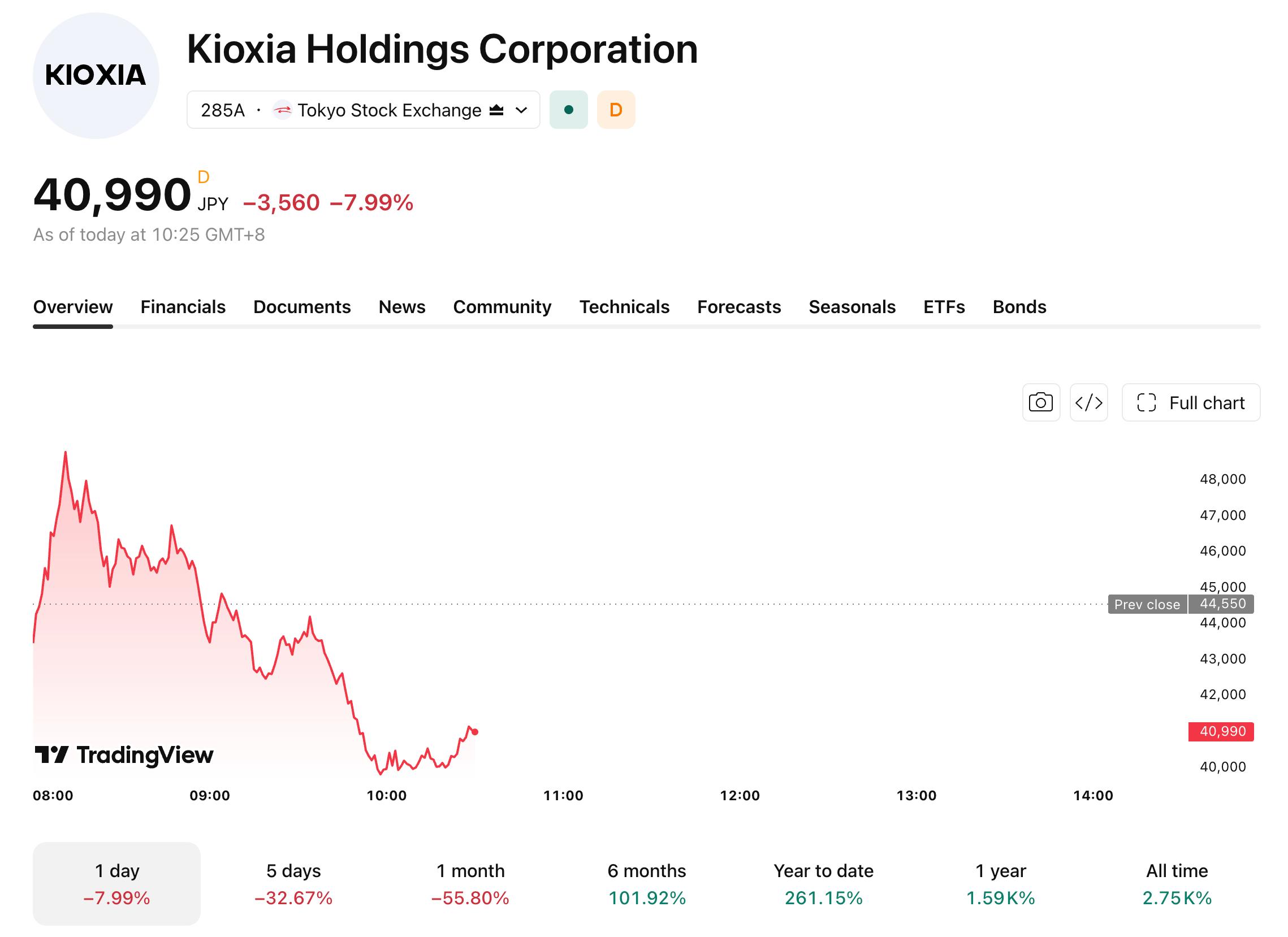
[Source: TradingView]
The direct cause of this plunge was SK Hynix's ( SKHY) earnings falling short of expectations. Before the market opened on July 29, SK Hynix released its Q2 financial results: revenue was 79 trillion won (equivalent to $54.3 billion), missing the market expectation of 84 trillion won; operating profit was 60.54 trillion won (equivalent to $42.0 billion), lower than analysts' expectations of 64.22 trillion won. Following the announcement, SK Hynix's share price plummeted over 11% intraday.
However, a more fundamental reason is that systemic market doubts over the sustainability of AI investment are still fermenting, with the source of these doubts originating in US stocks. Nvidia ( NVDA) is leading over $750 billion in AI infrastructure investments, partnering with SK Group and OpenAI. However, the market is concerned that this circular financing model may be distorting the true demand in the AI industry.
Meanwhile, media reports regarding China beginning mass production of its self-developed deep ultraviolet (DUV) lithography equipment have further heightened market concerns over the long-term competitiveness of Japanese semiconductor equipment manufacturers.
Li Huihui, a professor at emlyon business school, pointed out that the Japanese and South Korean markets correspond to valuation adjustments in different segments of the AI investment chain: South Korea prices the scarcity premium of HBM, while Japan prices capital expenditure expectations for semiconductor equipment. Both are highly dependent on the continuous realization of AI capital expenditures; once the market wavers on the outlook for AI spending, the declines in these two markets will be amplified.
The amplifying factors stem from three areas: concentrated ownership structures leading to insufficient liquidity, leveraged ETFs buying high and selling low to magnify volatility, and foreign futures trading intensifying short-term directional pressure. These factors also explain why the declines in Japanese and South Korean semiconductor stocks are typically much larger than those of their US peers.
In the short term, doubts over whether AI investment is excessive may continue to weigh on the valuations of Japanese and South Korean stock markets over the next one to two quarters. Kioxia's earnings report will be released on July 31; if its guidance falls short of expectations, the selling pressure could persist.
In addition, this week's Federal Reserve interest rate decision and Microsoft ( MSFT ), Meta ( META ), Apple ( AAPL ), Amazon ( AMZN )—the earnings of these four major tech giants will also serve as new variables. If hawkish signals are released or if financial guidance weakens, the Japanese semiconductor sector may face further downward pressure.
This content was translated using AI and reviewed for clarity. It is for informational purposes only.
Recommended Articles









Comments (0)
Click the $ button, enter the symbol, and select to link a stock, ETF, or other ticker.