


South Korea Stocks Halt Again, SK Hynix Market Cap Breaks $1 Trillion Mark.



AI Podcast


SK Hynix shares surged over 10%, pushing its market cap past $1 trillion, becoming the third global memory chip company to achieve this. Driven by high-bandwidth memory (HBM) demand for AI servers and its role as a core Nvidia supplier, SK Hynix's stock has gained significantly. Full-year 2026 HBM capacity is sold out, with shortages expected through 2027. Potential labor disruptions at Samsung Electronics also catalyzed order shifts to SK Hynix. The company's planned U.S. ADR listing is anticipated to attract further global capital. The market now views SK Hynix as a structural AI infrastructure beneficiary, with pricing power expected to persist until 2027.
TradingKey - During the Asian trading session on May 27, SK Hynix shares surged more than 10% intraday, with its market capitalization historically surpassing $1 trillion, making it the second Asian semiconductor manufacturer to reach this milestone after Samsung Electronics and the third memory chip company globally to exceed a $1 trillion valuation.
1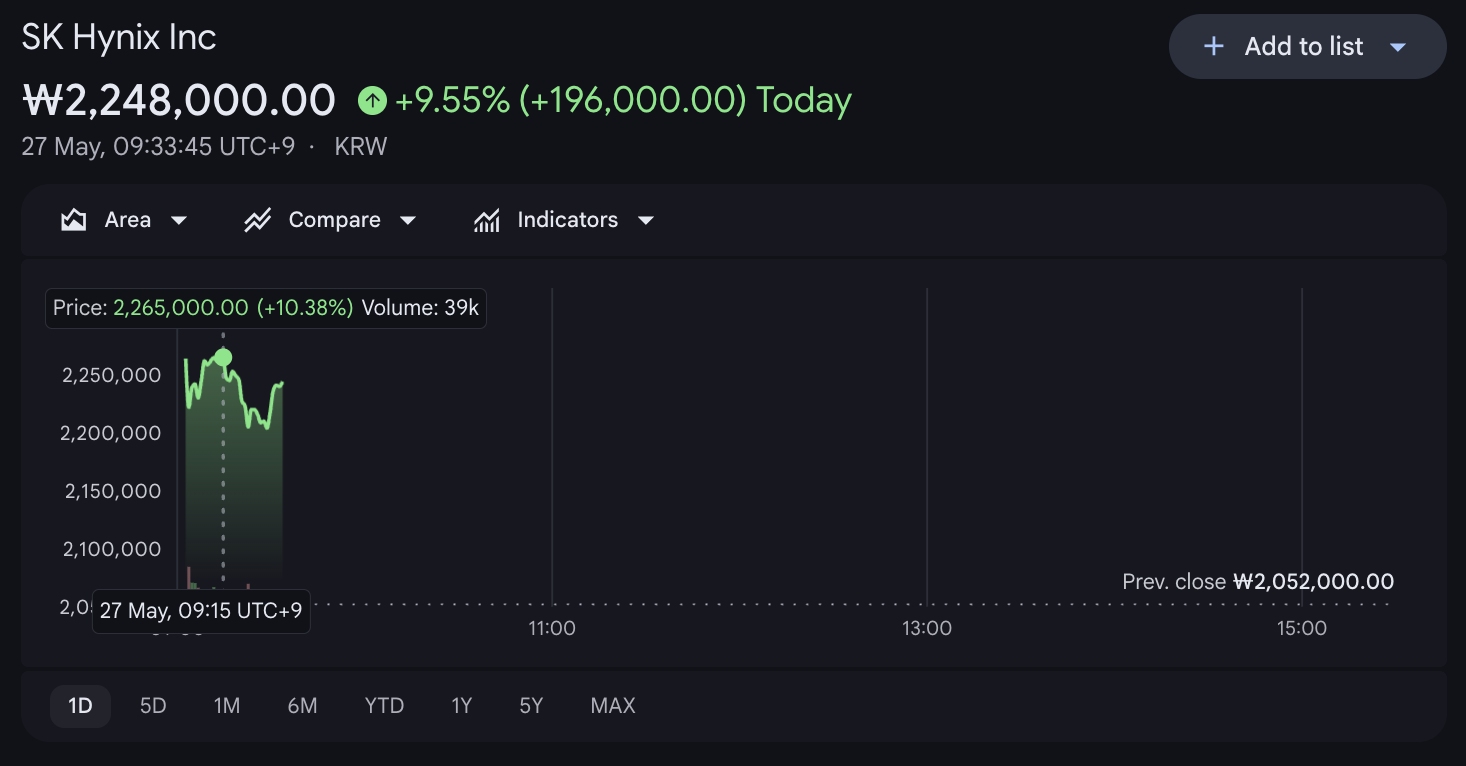
[SK Hynix once rose over 10%, Source: Google Finance]
Earlier, South Korea's KOSPI index surged nearly 5% at one point, and KOSPI 200 futures rose 5%, triggering a circuit breaker that suspended program trading for five minutes.
Over the past year, SK Hynix's stock price has surged over 900% cumulatively, with a total gain of 274% in 2025 and a further increase of more than 200% so far in 2026.
As a core supplier of HBM chips for Nvidia, SK Hynix has benefited deeply from the explosive demand for high-bandwidth memory in AI servers. HBM chips are considered the bottleneck of AI infrastructure, as memory bandwidth replaces pure computing power as the most critical constraint in AI computing deployment.
Strong momentum in AI demand continues to accelerate.
Since 2025, orders from tech giants such as Nvidia, Google, and AMD for SK Hynix have continued to climb, and the company's HBM capacity for the full year of 2026 is already sold out, with shortages expected to persist through 2027.
Meanwhile, earlier this month, over 50,000 employees at Samsung Electronics originally planned an 18-day general strike. Market expectations that Samsung's production hurdles would further exacerbate global memory chip supply constraints drove customers to accelerate order transfers toward competitors like SK Hynix, providing an additional short-term catalyst for the stock price.
Although it was announced late on May 20 that the strike would be suspended, emergency arbitration by South Korea's Ministry of Employment and Labor only delayed the strike by 30 days. The fundamental disagreement between labor and management over bonus distribution remains far from resolved, and supply anxieties have not fully dissipated.
Notably, SK Hynix has confidentially filed for a U.S. ADR listing this year, which will allow American investors to participate directly in its secondary market trading after the listing. This progress opens the door for the company to further attract global capital and is expected to drive a continuation of its valuation re-rating.
While the risk of relying on a few major customers remains, the market is redefining SK Hynix from a cyclical memory manufacturer to a structural core beneficiary of AI infrastructure. Analysts expect the memory chip shortage to last until 2027, granting SK Hynix, Samsung, and Micron unprecedented pricing power.
This content was translated using AI and reviewed for clarity. It is for informational purposes only.
Recommended Articles





Comments (1)
Click the $ button, enter the symbol, and select to link a stock, ETF, or other ticker.