


Major Asia-Pacific Stock Indices Close Lower, Geopolitics Pressure Markets, Investor Wait-and-See Sentiment Rises



AI Podcast


Asia-Pacific stocks declined on April 17, breaking a three-day rally, driven by profit-taking and caution over US-Iran relations. Major indices like Japan's Nikkei 225 and South Korea's KOSPI saw significant drops. Despite President Trump's optimism on a US-Iran nuclear deal framework, a lack of specifics and historical differences fostered investor wariness. The Bank of Japan's cautious outlook on inflation and economic growth, coupled with shifting interest rate hike expectations, further fueled a wait-and-see sentiment among investors.

TradingKey - On April 17, major Asia-Pacific stock indices fell collectively, ending a three-day winning streak. Market analysts believe that with the weekend approaching and uncertainty surrounding US-Iran relations, investor sentiment for taking profits and staying on the sidelines has significantly intensified.
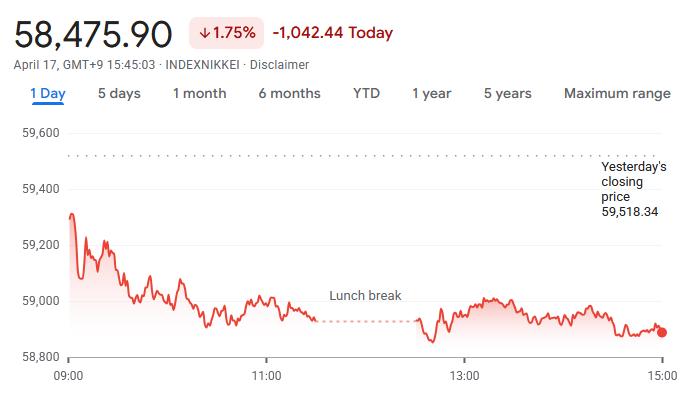
On that day, the Nikkei 225 Index closed down 1.8% at 58,475.90 points, while the Topix Index fell 1.4% to 3,760.81 points. South Korea's KOSPI also closed 0.55% lower at 6,191.92 points. Just a day earlier on April 16, the Nikkei 225 had fully recovered its losses since the US-Iran conflict, closing at a record high with a single-day gain of 2.64%.
US President Donald Trump publicly stated on the 16th local time that the US and Iran have reached a "substantial" framework agreement on the nuclear issue. He noted that Iran agreed to nearly all demands, the agreement would span over 20 years, and the outlook for reaching a formal deal "looks very optimistic."
However, investors remain cautious about the prospects of US-Iran negotiations. Analysts pointed out that despite the positive signals from Trump, the market has yet to see specific details of the agreement, and long-standing differences between the two nations mean that reaching a smooth long-term deal remains uncertain.
Under these circumstances, investors choosing to lock in profits ahead of the weekend and wait for further clarity became the primary driver behind the weakness in Asia-Pacific markets.
In addition to geopolitical factors, the Bank of Japan's monetary policy trajectory also impacted the market. BoJ Governor Kazuo Ueda stated today that Japan currently faces upside risks to prices and downside risks to the economy. He noted that the country is experiencing rising inflation triggered by "negative supply shocks," which is more difficult to control via monetary policy than inflation driven by robust demand.
The Bank of Japan's Policy Board will determine the most appropriate policy to achieve its 2% inflation target at its meeting later this month, taking into account the duration of the shocks and the overall economic environment.
According to the latest money market pricing, the probability of the Bank of Japan raising interest rates to 1% at the end of this month is approximately 19%, down from about 55% on Monday, while the probability of a rate hike in June has risen to 76%. Ueda's remarks and the shifts in rate hike expectations have further intensified the wait-and-see sentiment among investors.
This content was translated using AI and reviewed for clarity. It is for informational purposes only.
Recommended Articles










Comments (0)
Click the $ button, enter the symbol, and select to link a stock, ETF, or other ticker.