


Crypto’s Great Recovery: Is the Post-Conflict Surge a Sustainable Rally or a Sophisticated Bull Trap?



AI Podcast


Cryptocurrencies surged as Bitcoin surpassed $70,000, driven by easing Middle East tensions and coordinated efforts to cool oil prices. President Trump's remarks suggesting war de-escalation and the US, Japan, and G7's readiness to tap strategic oil reserves led to a crude oil price pullback, reallocating capital to risk assets. However, the sustainability of the crypto rally remains uncertain, contingent on the Middle East situation. Escalating rhetoric from President Trump and ongoing strikes in Iran introduce significant global financial uncertainty, potentially causing extreme volatility in the crypto market. Bitcoin faces resistance at $72,000 and support at $60,000.
TradingKey - President Trump claims the war is basically over; cryptocurrencies surge collectively as Bitcoin rallies past $70,000.
In early trading on March 10 (GMT+8), the cryptocurrency market recovered, with the Fear & Greed Index rebounding from 8 to 13, and the total market capitalization jumping over 3% to $2.36 trillion. Among them, Bitcoin (BTC) surged more than 5%, while Ethereum (ETH), Binance Coin (BNB ), and Solana (SOL) all rose by more than 4%.
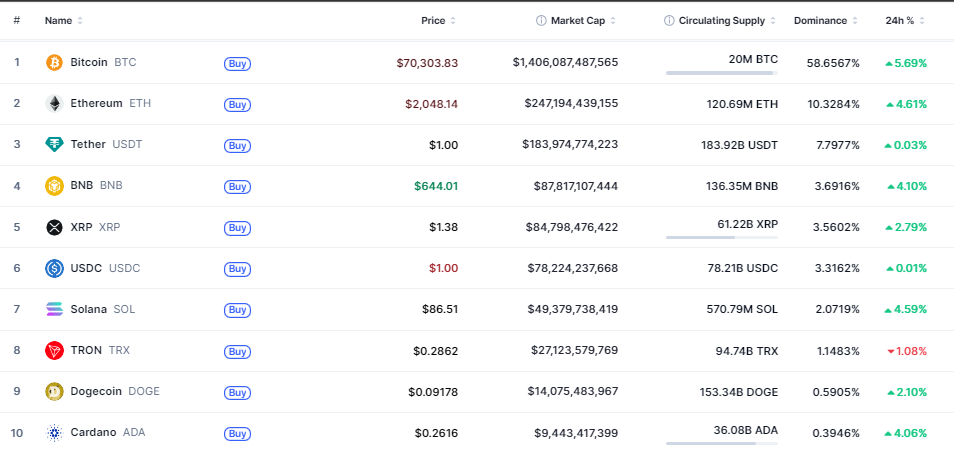 Performance of the top ten cryptocurrencies by market cap. Source: CoinMarketCap
This cryptocurrency rally was not driven by internal factors, but rather by two external forces: the easing of tensions in the Middle East and coordinated efforts by multiple nations to cool oil prices (USOIL). US President Trump suggested in an interview that the war between the US and Iran is largely over, a move that spurred a rebound in risk assets such as cryptocurrencies and equities.
Additionally, the US, Japan, the G7, and other countries or organizations have announced they are ready to tap into strategic oil reserves, which undoubtedly increased supply. Crude oil prices pulled back as much as 27%, forcing capital back into markets such as cryptocurrencies and stocks. However, can the crypto market sustain these inflows? Will the rally continue? In the short term, this depends largely on the future trajectory of the Middle East situation.
Currently, although the US has signaled a de-escalation of the war, its actions remain questionable. On one hand, Iran has not responded, and the announcement was unilateral from the US. More importantly, various signs suggest this may merely be a de-escalation strategy adopted by the US to suppress crude oil prices.
In the early hours of March 10, Tehran time, the Israel Defense Forces announced they had completed a new round of large-scale airstrikes on the Iranian capital, Tehran. Furthermore, US President Trump’s remarks were highly provocative, claiming, 'If Iran does anything to stop the flow of oil through the Strait of Hormuz, they will be hit by the US twenty times harder than now.' Trump also stated, 'We will absolutely not rest until Iran is completely defeated.'
At present, the US has activated its war machine, and with President Trump acting like an unleashed wolf, this move undoubtedly increases global financial uncertainty. The crypto market is no exception and could experience extreme volatility with sudden surges or crashes at any time; as such, conventional notions of 'bull traps' or 'bear traps' do not apply.
Specifically, the shifting situation in the Middle East is steering the direction of the crypto market. If a truce is reached between the US and Iran and tensions ease, investor risk appetite will rise, driving asset prices higher. Otherwise, prices could retreat to previous levels or even hit new lows. For Bitcoin, $72,000 remains a key resistance level, while $60,000 serves as a critical support level.
This content was translated using AI and reviewed for clarity. It is for informational purposes only.
Recommended Articles









Comments (0)
Click the $ button, enter the symbol, and select to link a stock, ETF, or other ticker.