


Bitcoin Stuck in Range Struggle, Can US-Iran Conflict Help a Breakout?



AI Podcast


Bitcoin has failed to act as a safe-haven asset amid escalating geopolitical tensions, losing its "war premium." Despite recent conflict developments and Iran's airstrike on Israel, BTC has remained range-bound, demonstrating its classification as a risk asset rather than "digital gold." Historical data shows price declines during the Russia-Ukraine and Israel-Palestine conflicts, and during Iran's direct actions. However, prolonged US involvement in the Iran situation could prompt Federal Reserve rate cuts or increased money supply to fund war efforts, potentially providing a tailwind for Bitcoin prices.

TradingKey - As the US-Iran conflict continues to escalate, Bitcoin prices remain range-bound, losing their war premium.
On Tuesday (March 3), the US-Iran conflict escalated further, but Bitcoin (BTC) failed to break through key resistance levels, remaining within the $60,000–$72,000 range. This morning, Bitcoin's price rebounded by over 3%, approaching $70,000 again, currently trading at $68,449.
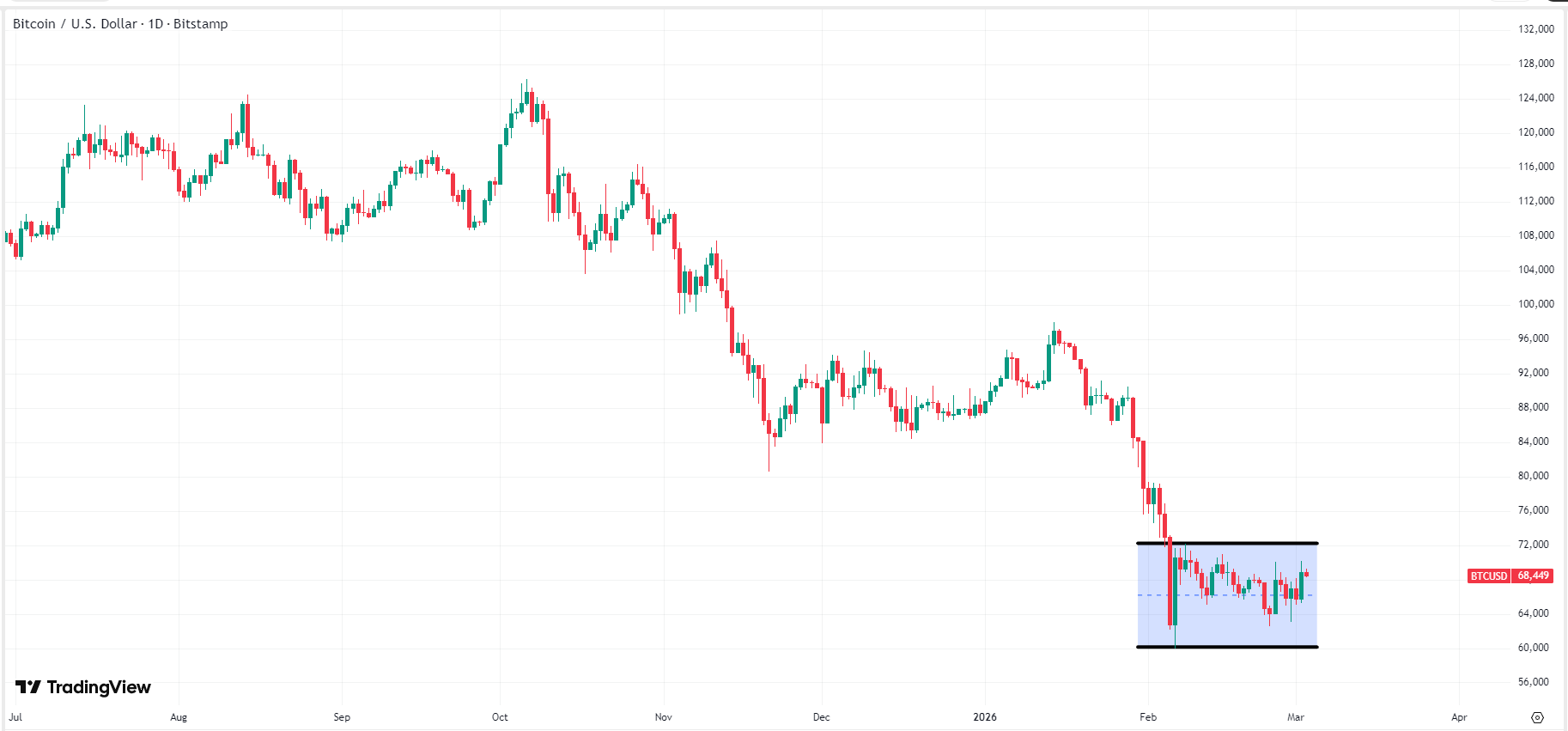 Bitcoin price chart, Source: TradingView
In the view of many, war stimulates safe-haven demand, driving up the prices of assets such as gold (XAUUSD) and Bitcoin. However, the reality has been different; Bitcoin prices have underperformed or even declined during recent conflicts. This proves that Bitcoin remains a risk asset, and 'digital gold' is merely a slogan that has not gained recognition from capital markets.
On February 24, 2022, the day the Russia-Ukraine war broke out, Bitcoin prices instantly plummeted by more than 9%, hitting a low of $34,000. On October 7, 2023, when the Israel-Palestine conflict erupted, Bitcoin failed to rise, instead fluctuating below $27,000 within days for a cumulative decline of about 2%. In April 2024, during Iran's airstrike on Israel, BTC plunged about 7% that night. On January 28, 2026, as the US-Iran war officially commenced, Bitcoin's price performance was lackluster, continuing its previous range-bound trend.
Although Bitcoin is losing its war premium, the conflict could prompt the Federal Reserve to cut interest rates, which is a potential tailwind for Bitcoin prices. BitMEX co-founder Arthur Hayes stated, 'The longer the US remains involved in the Iran situation, the more likely the Fed is to cut rates or print money to support war spending, which will drive Bitcoin prices higher.'
This content was translated using AI and reviewed for clarity. It is for informational purposes only.
Recommended Articles







Comments (0)
Click the $ button, enter the symbol, and select to link a stock, ETF, or other ticker.