


Brent Oil Nears $100 Mark, US-Iran Ceasefire Fails to Dispel Strait of Hormuz Shipping Panic



International oil prices remained elevated near $100 per barrel due to escalating tensions in the Strait of Hormuz. Iran's attacks on two merchant ships intensified the U.S.-Iran standoff, increasing geopolitical risk premiums and disrupting critical shipping routes that account for 20% of global oil consumption. Despite President Trump's indefinite extension of a ceasefire agreement to facilitate peace talks, Iran expressed skepticism regarding U.S. sincerity and has not committed to new negotiations. The ongoing blockade and attacks significantly contribute to current high oil prices.

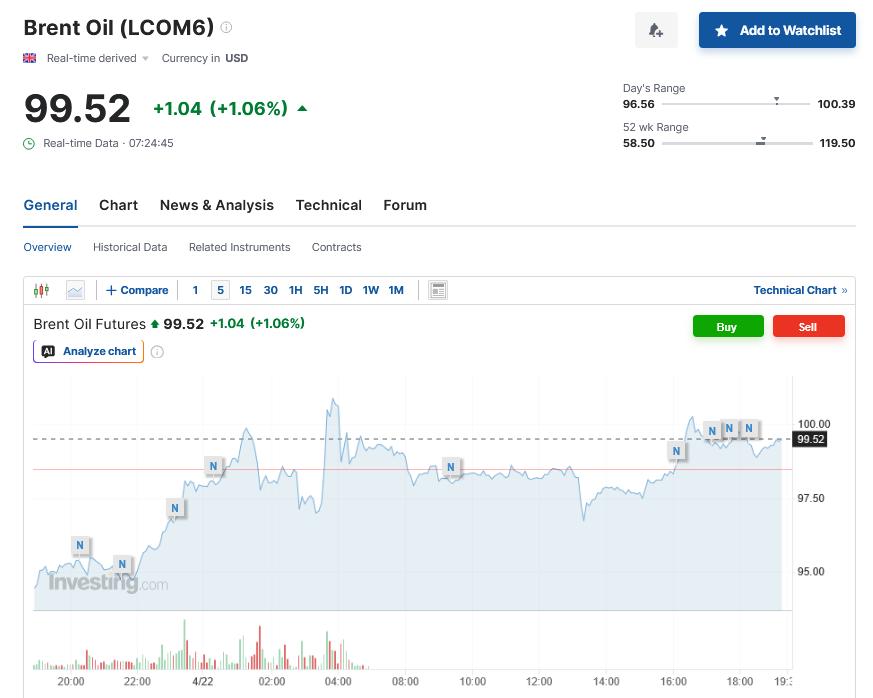
TradingKey - International oil prices fluctuated at high levels below $100 per barrel on Wednesday. Although U.S. President Trump announced an indefinite extension of the U.S.-Iran ceasefire agreement in an attempt to create space for peace talks, the shipping blockade in the Strait of Hormuz continues to push up the market's geopolitical risk premium.
As of 7:24 a.m. ET, global benchmark Brent crude futures were trading at $99.52 per barrel, up 1.06% on the day.
On Wednesday, Iran launched attacks on two merchant ships in the Strait of Hormuz, pushing the U.S.-Iran standoff to a new height and plunging the already struggling Islamabad ceasefire negotiations into a deeper stalemate. Led by the Islamic Revolutionary Guard Corps, the morning raid saw the first container ship shelled without warning. While no casualties were reported, a second attack on a merchant ship hours later significantly heightened transit risks in this critical waterway, causing the geopolitical risk premium to climb rapidly.
Iranian Foreign Ministry spokesperson Esmaeil Baghaei stated that Iran has not yet decided whether to participate in a new round of negotiations with the United States. In an interview with the media, he said that Iran participated in the first round of talks with sincerity and seriousness, but the U.S. side was indifferent, lacked sincerity, and maintained an inconsistent stance.
Baghaei made it clear that Iran would consider participating in the Islamabad negotiations in Pakistan if it aligns with its national interests, but no decision has been finalized yet. He also pointed out that the U.S. blockade of Iranian ports constitutes an act of aggression, stating that firing on and seizing Iranian merchant vessels is not the behavior of a country truly committed to a serious diplomatic process.
On Tuesday, Trump announced an indefinite extension of the U.S.-Iran ceasefire agreement to allow space for both countries to continue peace negotiations and end the conflict.
However, prospects for U.S.-Iran peace talks remain highly uncertain, as both Tehran and Washington have refused to send delegations to the next round of negotiations scheduled in Pakistan this week.
Crude oil supply through the Strait of Hormuz accounts for approximately 20% of total global oil consumption. Since the conflict broke out in late February, Iran has effectively blockaded shipping lanes in the strait, leading to severe disruptions in maritime activity. This has become a key factor supporting oil prices, which now remain significantly higher than pre-conflict levels.
This content was translated using AI and reviewed for clarity. It is for informational purposes only.
Recommended Articles











Comments (0)
Click the $ button, enter the symbol, and select to link a stock, ETF, or other ticker.