


Precious Metals Suffer 'Black Tuesday': Spot Gold Falls Below $4,100, Silver Plunges 5%



AI Podcast


Precious metals faced a significant sell-off during the Asian session on June 23, with spot gold and silver hitting lows not seen since June 11. Despite institutional inflows in major ETFs and increased COMEX net longs, broader market sentiment remains bearish due to hawkish Federal Reserve signals and rising Treasury yields. Increased probabilities of a September rate hike and easing geopolitical tensions have prompted major banks, including Goldman Sachs and Citi, to lower their gold price targets. While long-term capital shows tactical accumulation, gold prices remain pressured by a strong dollar and the absence of imminent rate cuts.

TradingKey - During the Asian session on June 23, precious metals markets suffered a broad sell-off, with spot gold ( XAUUSD) dropping over 2% at one point to around $4,090/oz; spot silver (XAGUSD) fell over 5% at one point to $61.83/oz, with both hitting their lowest levels since June 11.
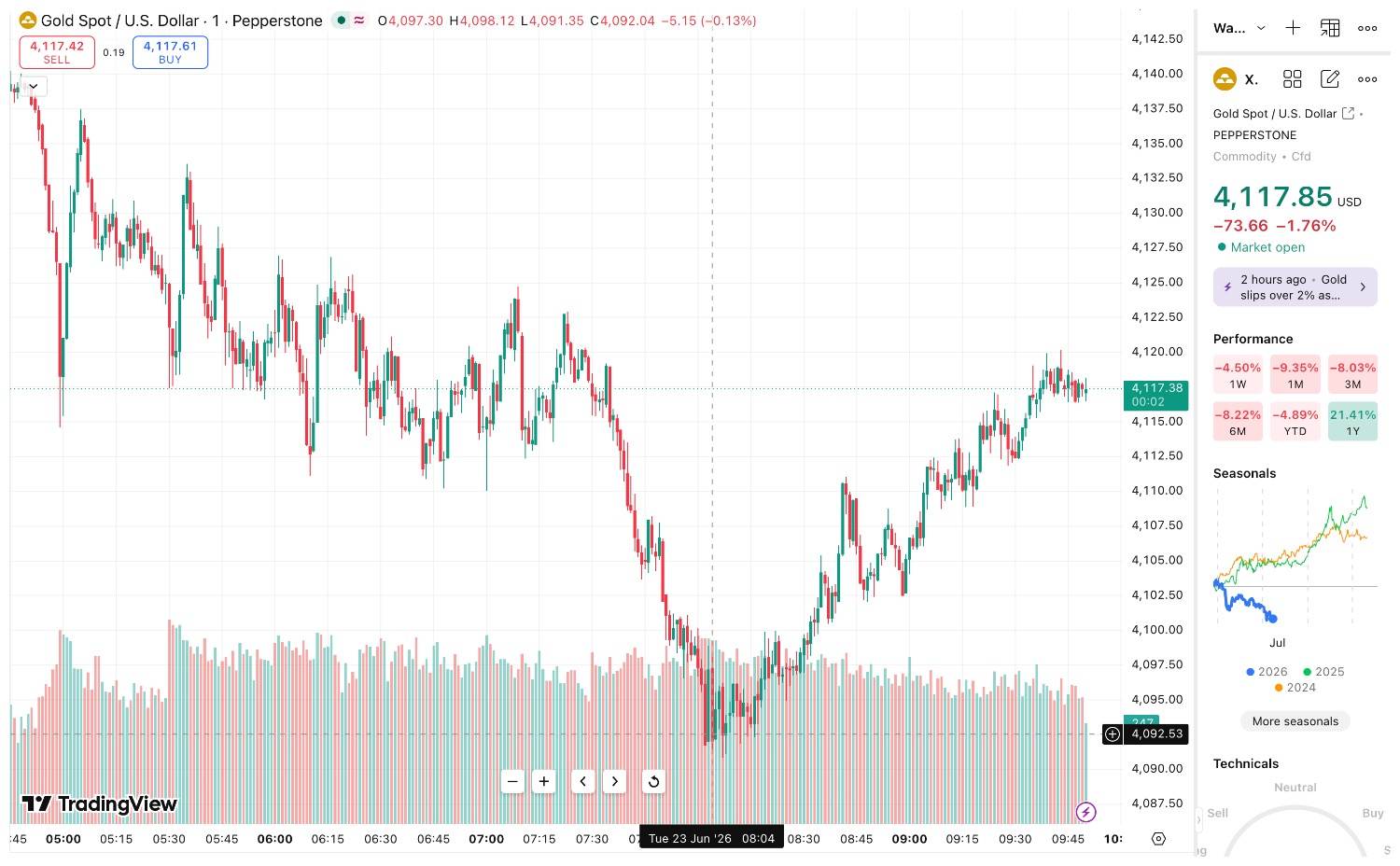
[Source: TradingView]
Recently, gold-related ETFs have experienced massive redemptions, with selling pressure clearly visible. Data show that over the past 60 days, seven gold ETFs recorded a combined net outflow of 17.661 billion yuan, with only one achieving a net inflow. As of June 9 , 21 gold-related ETFs have seen cumulative net redemptions of over 1.6 billion units since the second quarter, resulting in a net outflow of 13.111 billion yuan. After a net outflow of 87 tonnes in March, global gold ETFs experienced another net outflow of 8.5 tonnes in May.
However, another segment of capital is bucking the trend to increase positions. On June 22, holdings of SPDR Gold Trust, the world's largest gold ETF, rose by 1.713 tonnes to 1,022.2 tonnes, marking a second consecutive day of additions; holdings of iShares Silver Trust, the world's largest silver ETF, also increased by 84.4 tonnes to 15,023.49 tonnes. Even more noteworthy is the signal from the derivatives market. According to CFTC data, for the week ended June 16, COMEX gold speculators increased their net long positions by 9,258 contracts to 112,918 contracts.
How should this contradictory signal be interpreted? This typically indicates that retail investors and some institutions are panic selling, while long-term capital continues to buy.
Why are gold prices falling?
Following the June policy meeting, newly appointed Fed Chair Kevin Warsh sent a hawkish inflation-fighting signal. The dot plot showed that nine of the 18 committee members support one more rate hike this year, and hints of rate cuts from the prior six months were removed. According to the latest FedWatch data, the market has fully priced in a September rate hike, with the probability rising to 73.9%. Deutsche Bank warned that if the Fed does raise rates, gold prices could drop to $3,800. The 10-year US Treasury yield briefly rose above 4.5%, and the 2-year yield rose to 4.23%, the highest since February 2025. The US Dollar Index climbed above 101.
High-level talks between the US and Iran in Bürgenstock, Switzerland, achieved a breakthrough as both sides agreed on a roadmap to reach a final agreement within 60 days, with the US temporarily lifting oil sanctions on Iran and issuing a 60-day temporary waiver. Capital that had previously flowed into gold as a safe haven has begun to withdraw.
Goldman Sachs ( GS) lowered its year-end 2026 gold target price from $5,400 to $4,900, characterizing the move as "tactical caution" on the grounds that rate cuts are highly unlikely this year, with the next cut pushed back to 2027. Citi ( C ), JPMorgan ( JPM ), Morgan Stanley ( MS ), ANZ, and Commerzbank have also lowered their gold targets in succession, with Citi cutting its forecast twice within a single month. UBS ( UBS) strategist Joni Teves stated that downside risks for gold have significantly risen, and there is greater uncertainty regarding the duration of the current consolidation cycle.
In the face of the continuous decline in gold prices, Morgan Stanley pointed out that while central bank purchasing continues to provide a floor, ETF demand remains highly sensitive to the Fed's path, real yields, and the US dollar. As long as rate hike expectations persist, it will be difficult for ETFs to see large-scale inflows.
Gold prices tumbled from a peak of around $5,600 in January to a low of $4,023 in early June, erasing all year-to-date gains. SPDR continuously increased holdings near $4,200, and CFTC net longs rose instead of fell, showing that long-term capital is moving in the opposite direction of short-term sentiment.
The Fed's policy path, geopolitics, and the global economy remain the three key variables for the market outlook. Against the backdrop of lingering rate hike expectations and a strong US dollar, the final confirmation of a bottom still requires more signals.
This content was translated using AI and reviewed for clarity. It is for informational purposes only.
Recommended Articles









Comments (0)
Click the $ button, enter the symbol, and select to link a stock, ETF, or other ticker.