


Breaking 100! The Three-Front Battle Driving Silver Into the Strategic Asset Era



AI Podcast


Silver has surpassed $100/oz, driven by a credit crisis in paper silver, China's export controls, de-dollarization, and nuclear energy demand. COMEX faces significant delivery pressure in March, with open interest far exceeding registered stocks. This could lead to price bands of $100-120, $120-150, or even $150-180. Tech giants like Samsung and Tesla are securing physical silver through direct deals, bypassing exchanges, signaling a shift to vertical integration. Mine supply is constrained by declining ore grades, by-product status, and long development cycles. Core industrial demand is inelastic, creating an "impossible triangle" where price increases cannot quickly rebalance the market, suggesting a structurally rising channel for silver driven by physical scarcity.

In late January 2026, silver decisively broke above the 100‑dollar‑per‑ounce mark and has since been holding and pushing higher, and the market is now asking the same question: what happens next?
In my previous analysis, “2026 Silver Run: When the Paper Game Collapses and Silver Returns as a Strategic Asset,” I argued that four structural forces are driving a wholesale repricing of silver: a credit crisis in paper silver, China’s export controls, de‑dollarization‑driven central bank buying, and demand lock‑in from a nuclear energy revival. At that time, silver was still hovering around $90, and most analysts’ 2026 average price forecasts were stuck in the $55–70 range.
Those forecasts have now all failed. My call has been validated: what silver is going through is not a speculative bubble, but a fundamental revaluation of its price.
But breaking 100 is only the prologue. The truly critical phase is only just beginning, as the silver market moves into several overlapping, deep‑seated games whose evolving dynamics will continue to reshape the path silver prices take over the coming period.
March Delivery – COMEX’s Race Against Time
The countdown has begun
There is roughly one month to go until the first notice day (February 27) for COMEX’s March contract. March is normally one of the primary delivery months for silver futures, but this year’s March is turning into a math problem that is hard to solve.
As of mid January, COMEX registered stocks – that is, silver that is actually available for delivery – were down to just over 30 million ounces. At the same time, open interest in the March contract represents potential delivery demands of more than 500 million ounces.
Every ounce of deliverable silver is backing more than 20 ounces of paper promises.
If only 20% of March contract holders stand for physical delivery, COMEX would need to produce 100 million ounces. If it is 30%, it would need 150 million ounces. If it is 40% – entirely possible in today’s fearful market – the demand would reach 200 million ounces.
And the exchange only has just over 30 million ounces on hand.
Three outcomes, three price bands
The market is now staring at three possible March outcomes, each of which could send silver onto a very different trajectory.
Scenario | Delivery pressure in March | What could happen in March | Reference price pattern |
Scenario A: Smooth passage | Low | Most positions are rolled or hedged before expiry, and only a small fraction of open interest insists on taking metal; registered stocks plus some eligible inventory can cover the demand, so although the process is tight, there are no major incidents. | Silver chops around current elevated levels (say, roughly in the $100–120 band), with swings driven more by sentiment and macro factors; March itself does not become a turning point. |
Scenario B: High pressure but controllable | Medium | The share of longs demanding physical delivery is clearly higher than in past years, stocks are drawn down quickly, and the back office must actively coordinate replenishment from eligible stocks and off‑exchange sources; some individual contracts may be negotiated out for cash, but overall delivery is still completed. | The market slaps a higher price tag on delivery risk, and silver has a chance to step up to a new range (for example, the $120–150 band), though it is still not a fully “out‑of‑control” situation. |
Scenario C: Delivery system under severe strain | High | Physical demand far exceeds effective stocks, warrants are rapidly exhausted, and the exchange is forced to fight fires by raising margins, tweaking rules on the fly, and strongly encouraging cash settlement; in extreme cases, short trading halts or suspensions are not out of the question. | Prices become more prone to gaps and violent short‑term swings, while spot premia and prices in markets like Shanghai begin to set the tone; silver could swing wildly in a high range (for example, $150–180), reflecting a scramble for metal and a credit discount more than simple supply‑and‑demand balance. |
At the end of the day, what really pushes the market into one outcome or another is not so much how the chart looks, but how the key players choose to play their cards. For the big Wall Street institutions, what they truly fear is not a minor hiccup in any single delivery cycle, but the risk that events get amplified into questions about the dollar and the U.S. financial system itself. If the situation begins to slide toward the worst case scenario, it is almost certain that they will lean on industry groups and lobbyists to press for regulatory intervention under the banner of “maintaining market stability.”
Regulators, for their part, have seen this kind of movie before. In 1980, when the Hunt brothers tried to corner silver, the exchanges and regulators jointly hiked margins and restricted new long positions, forcibly stomping out an extreme squeeze. Around silver’s drop from $50 in 2011, there were multiple rounds of margin hikes that flushed out the most aggressive leveraged money. Going further back to earlier eras of gold and silver controls, cash settlement and ad hoc rule changes were also anything but rare.
The Mine Grab – A Vertical Integration Revolution by Industrial Giants
While the exchanges are grappling with delivery risk, another, more discreet but equally critical battle is unfolding at the mines and smelters.
Samsung’s pre emptive strike
In October last year, Samsung C&T, one of Samsung Group’s parent entities, finalized a mining prepayment deal that did not look flashy on its face but carried major strategic weight: via a subsidiary it provided a 7 million dollar prepay offtake facility to Canada’s Silver Storm Mining to restart the La Parrilla silver mine in Mexico, with 6,000 meters of underground drilling at La Parrilla kicking off in mid January 2026 to prepare for a potential restart in Q2 2026.
But there is one clause in the contract that made procurement managers across the industry gasp:
“As consideration, Samsung obtains the exclusive right to purchase 100% of the mine’s silver lead concentrate output for the next two years.”
This is not market based procurement. This is resource lock up.
Samsung did not go to COMEX to buy paper silver, nor did it chase prices higher in the spot market. It paid cash to restart a mine and then used a contract to lock in two full years of production for itself. That means the silver from this mine has already been permanently removed from the global pool of tradable supply before a single ounce is dug out of the ground.
Why is Samsung willing to do this? Because its solid state battery technology relies on a silver carbon composite anode layer, and silver in this application simply cannot be replaced. Once solid state batteries enter mass production, Samsung’s silver demand will grow exponentially. Before that moment arrives, it has to make sure it holds the metal in its own hands – regardless of the market price.
Tesla, Apple, and the 72 hour buying blitz
Samsung is not the only one acting.
In mid January, reports surfaced that Tesla had launched a one off purchase of 85 million ounces of physical silver – more than the entire registered stock at COMEX. This transaction was assembled through a mix of mine contracts, vault purchases, and private deals, without touching any public exchange.
At the same time, a purported internal procurement scenario from Apple made the rounds: under extreme supply disruption assumptions, the company would be prepared to lift its psychological ceiling for long term silver supply contracts to around $573 per ounce, purely to ensure continuity of its supply chain.
These are not speculative trades. They are survival purchases.
For a company that sells around 230 million iPhones a year, each containing about 0.3 grams of silver, the cost of a factory shutdown due to lack of silver would run into the billions of dollars. Under those conditions, paying $500 per ounce for silver is economically rational – because it is still cheaper than the cost of stopping the line.
Vertical integration 2.0: Tech companies become miners
What we are seeing is a fundamental reversal of the logic that has governed manufacturing supply chains.
For the past 40 years, the gospel of globalization and just in time manufacturing has been: do not hold inventory, do not own your suppliers, only buy what you need when you need it. The underlying assumption has been that the market will always have product, and prices can always be negotiated.
The silver market of the last two years is blowing that assumption up.
Rumors are widespread that some leading electronics and EV giants, including Apple and Samsung, are evaluating direct long term supply agreements with silver mines in Latin America to cut their reliance on exchange stocks. Over the next few years, tech companies could commit hundreds of millions to tens of billions of dollars to lock in critical metals ahead of time.
This is no longer procurement. This is vertical integration. The tech giants are pulling the entire chain – from mine to smelter to warehouse – into their own control. We may soon see Apple directly acquiring a silver mine, Tesla buying a lithium refinery, or Nvidia investing in a rare earth processing plant.
This is a complete reversal of the globalization trend of the past four decades.
And for smaller players without the capital to lock in upstream supply – EV startups, mid sized electronics manufacturers, solar module makers – the realization will be brutal: they are being pushed out of the market entirely.
Over the next few years, this will reshape the entire industrial landscape. It will no longer be the most advanced technology that wins, but the safest supply chain.
The Supply Side Impossible Triangle – Why $150 Silver Still Won’t Fix the Shortage
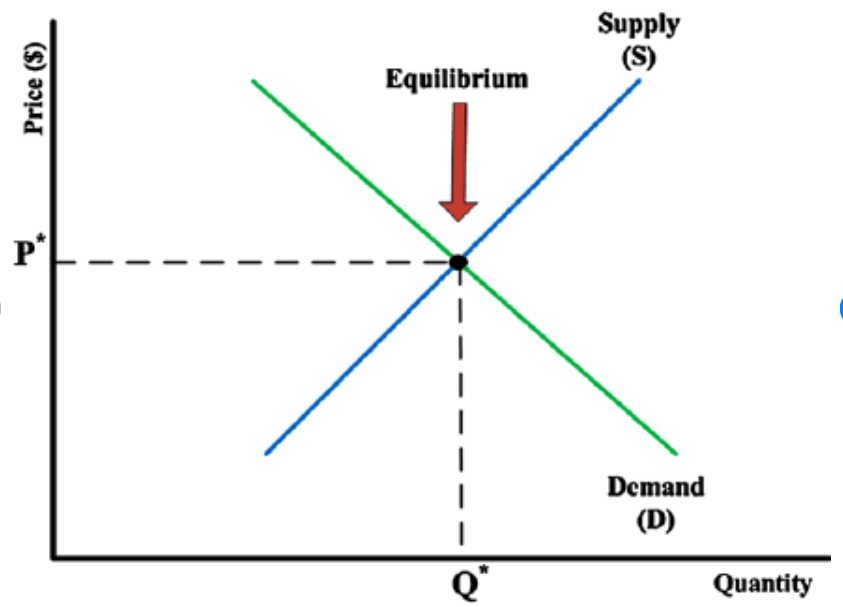
Economics textbooks tell us: when prices rise, supply goes up, demand goes down, and the market rebalances.
Source: ResearchGate
But today’s silver market is breaking this logic.
The mining death spiral
Global silver mine production peaked in 2016 at 900.1 million ounces. Since then, even as silver prices have more than doubled over the following nine years, 2025 mine output is only about 835 million ounces, roughly 7% below the peak.
Why have prices risen while production has fallen?
First reason: collapsing grades.
Over the past decade, the average ore grade at the world’s 12 largest primary silver mines has fallen by 36%. Reserved grades are down nearly 40%. Resource grades have weakened even more than reserves.
This means that to produce the same amount of silver, miners must process more than 1.5 times as much ore as ten years ago. Costs, energy consumption, and environmental impact are all rising in lockstep.
Part of this is the hangover from high grading. After silver’s price crash in 2013, many miners focused on the richest parts of their deposits to maintain output and profits. That propped up production in the short term but left behind low grade ore that is only economic if blended with high grade material.
Now, the easy ore is gone. What remains is the hard rock.
Second reason: silver is a by product.
Some 70–80% of global silver output is produced as a by product of copper, lead zinc, and gold mines. This means silver production is driven primarily by mining decisions for copper, lead, zinc, and gold, not by the silver price itself.
When silver goes from $30 to $100, a copper focused mine will not ramp up production just because silver has tripled, because its economics are determined by copper; silver is merely ancillary revenue.
This makes silver supply extremely sluggish in responding to price signals. Even if silver hits $150, if copper and zinc prices do not rise in tandem, the incremental mine supply will be very limited.
Third reason: time lags.
Even if today’s price is high enough to spur investment in new projects, it takes on average 7–10 years for a new silver mine to go from exploration, feasibility studies, environmental permitting, financing, and construction to first production.
That means the high prices of 2026 will not translate into new output until at least 2033–2036.
In the 7–10 years before that, the supply curve is essentially locked.
The recycling illusion
So can recycling plug the gap?
In theory, silver can be recycled indefinitely with no loss of quality. In reality, the bottleneck is not technology but economics.
Today, global recycled silver mainly comes from several buckets: industrial scrap and chemicals are the largest source, followed by recovered silver from electronic and electrical components, plus some flowback from jewelry and silverware. Together they contribute around 180–190 million ounces per year – about 20% of total supply.
That share has barely grown in the past decade.
Why? Because in most applications, especially solar and electronics, the silver content per unit is tiny, and the cost of recovering it often exceeds the value of the silver itself.
A single solar module contains only 15–20 grams of silver paste. To recover that 20 grams from a discarded panel, it must be disassembled and subjected to chemical leaching, electro refining, and other steps. At silver prices of $30–50, this process is simply uneconomic.
Even at $100 silver, recycling only just about covers its costs. To truly incentivize large scale recycling, silver might need to reach $150–200 and stay there for several years, giving the industry time to build out enough infrastructure.
More importantly, only a small fraction of global electronic waste is currently handled by formal recycling channels. Most still ends up in landfills or is processed inefficiently and informally. Even if silver prices double, this structural problem cannot be resolved in the short term.
Demand Side: Industrial Consumption as a One Way Valve
If supply cannot respond quickly, can high prices crush demand instead?
The answer: only partly – core demand is hard to budge.
In fringe uses such as traditional photography or decorative applications, demand does fall when silver rises above $100.
But in core industrial uses, silver’s share of total cost is so small that price has almost no impact on demand.
Silver paste only accounts for 3–5% of a solar module’s total cost. When silver rises from $50 to $100, the module cost increases by just 1.5–2.5%. At the level of a utility scale solar farm’s total capex, that increase is negligible.
Without silver, however, the factory must shut down.
For manufacturers, paying $150 per ounce for silver is far cheaper than bearing the losses from a production halt. This is why a company like Apple would be prepared, in extreme scenarios, to authorize purchase prices as high as $500 per ounce: the cost of not buying is a full production line going dark.
By 2025, industrial demand had reached 680 million ounces, about 60% of total demand. Within that:
• Solar PV: roughly 200–250 million ounces, and as global installations continue to grow, this number is unlikely to shrink in 2026–2028
• Electric vehicles: roughly 40–60 million ounces, and with rising EV penetration, it can only go higher
• Data centers, 5G, semiconductors: each segment is still small individually, but all are growing at very high rates
• Nuclear reactor control rods: as scores of new reactors planned for before 2030 come online, the nuclear sector will cumulatively lock in several million to ten million plus ounces of silver over their lifetimes
These are, in economic terms, relatively inelastic demands. They will not disappear just because silver is 50% more expensive, because without silver, these factories, power plants, and reactors cannot operate at all.
The Impossible Triangle Deadlock
Put the supply side and demand side together, and you get an impossible triangle:
1. Mine supply is constrained by 7–10 year plus development cycles and cannot react effectively to price
2. Recycled supply is constrained by infrastructure and economics; even a doubling of price only improves it at the margin
3. Core industrial demand is highly inelastic; even at $150 silver, it is hard to push it down sharply
The result: price increases cannot quickly rebalance the market.
In the 2026–2030 silver market, the traditional playbook – high prices rapidly stimulating supply and suppressing demand to restore balance – becomes slow and inefficient. Price action is more likely to manifest as extended periods of elevated levels, punctuated by intermittent violent shocks.
What does this mean?
It means the market can only plug the gap by chewing through above ground inventories until those stocks are exhausted and prices are forced up to a level high enough to trigger genuine demand destruction – only then is a new balance possible.
In the years leading up to that point, silver is likely to sit in a structurally rising channel, driven by physical scarcity rather than speculative froth.
Conclusion: This Time Is Different
In my previous piece, I wrote that silver is transitioning from an industrial metal with some monetary traits to an asset with three identities: industrial, monetary, and strategic.
This boom is unlike any previous spike in silver.
Looking back at earlier major runs: the Hunt brothers’ 1980 squeeze was largely leverage driven speculation; the post crisis 2011 surge was mainly a spillover of risk off sentiment; the 2021 Reddit squeeze was a social media fuelled, short term frenzy.
By contrast, the 2026 silver rally is structural and multidimensional.
It is powered by four mutually reinforcing forces: a credit crisis at the exchanges, geopolitical cuts to supply, hard locked industrial demand, and a supply side that has lost its ability to respond to price signals.
These four forces have never appeared together in quite this way. Their combination is creating a price discovery vacuum we have not seen before.
$100 is not the end point. It is merely a signpost, reminding us that the old pricing rules are breaking down.
The new rules are not yet fully formed, but one thing is clear:
In this new world, only physical metal truly counts. Paper promises are no longer something you can take on trust.
Recommended Articles









Comments (0)
Click the $ button, enter the symbol, and select to link a stock, ETF, or other ticker.