


TradingKey 2025 Markets Recap & Outlook | Gold Records Its Best Performance in Half a Century, Wall Street Predicts $5,000 Breach in 2026



AI Podcast


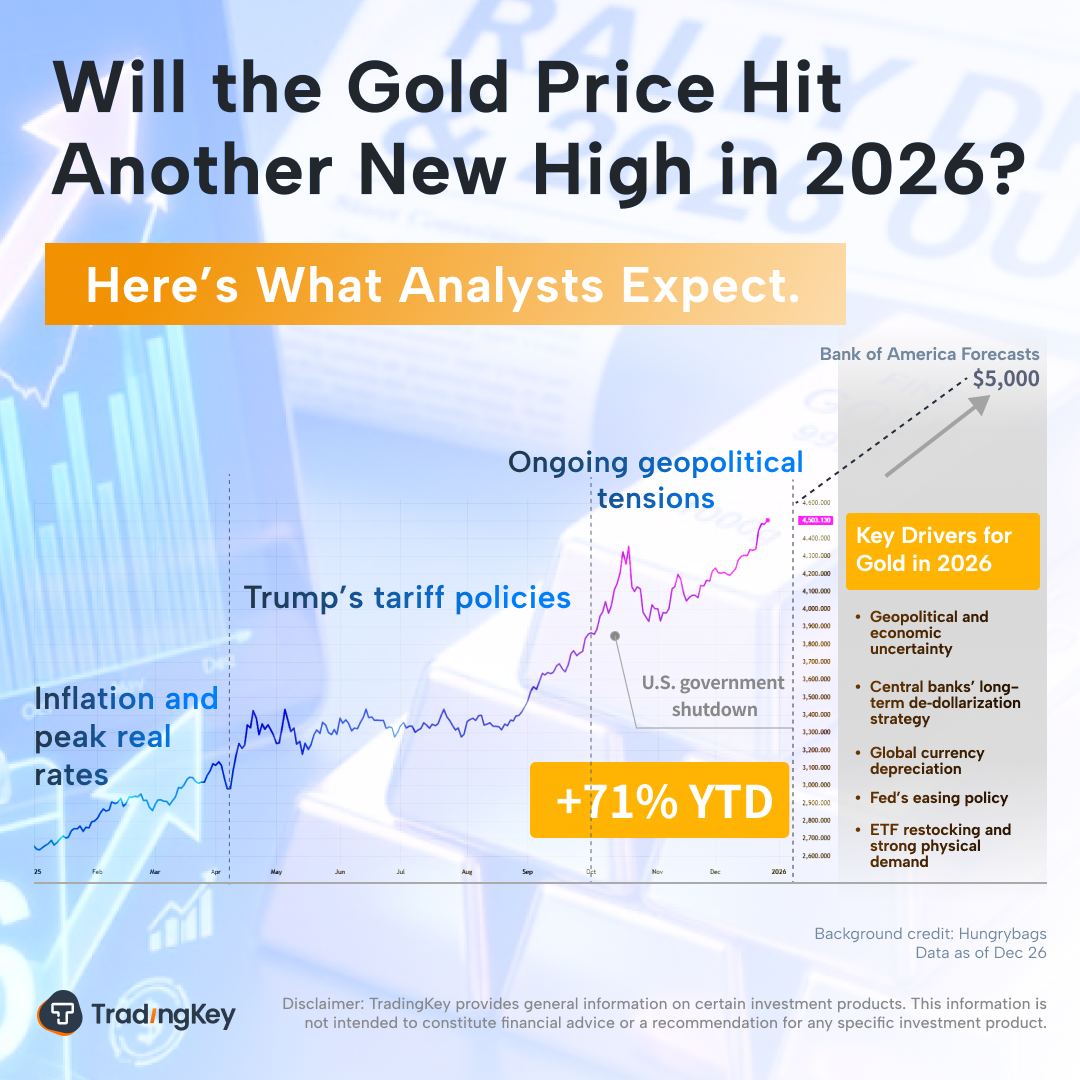
Gold has experienced its best year since 1979, with spot prices rising 71% to a new high of $4,531 per ounce, driven by geopolitical and economic uncertainties, including tariff announcements and government shutdown crises. This rally reflects a shift from short-term hedging to a long-term store of value, fueled by a distrust in the dollar-dominated financial system and expectations of Federal Reserve rate cuts amidst increasing U.S. debt. Central bank purchases are also amplifying gold's surge, with gold reserves now exceeding U.S. Treasuries in global central bank holdings. Major institutions forecast continued gains in 2026, though technical overbought signals and potential weakening of rate cut expectations pose short-term risks.

TradingKey - Amid increasing global economic uncertainty, gold is experiencing its best year since 1979, recording its largest gain in 46 years.
As of December 26, the price of gold futures (New York gold) has surged this year by 74% , while spot gold (London gold) has risen by 71% . Spot gold just broke above the $4,500 mark, setting a new annual high of $4,531 per ounce, marking the 50th time this year it has refreshed its historical high; simultaneously, gold futures set a new high of $4,561 per ounce .
As 2025 draws to a close, Wall Street's major institutions have affirmed gold's status as the premier safe-haven asset, and a consensus has formed: Gold will continue to rise in 2026.
Fundamental Support for Gold Prices Comes from Its Safe-Haven Attribute
Although the specific reasons driving gold price increases have varied across different periods, the primary support for gold prices has always stemmed from its safe-haven attribute, and this underlying logic has consistently remained unchanged.
By examining gold's rapid short-term appreciation this year, it becomes evident that the rise in gold prices is inseparable from the dual catalysts of geopolitical and economic risks .
This year's parabolic rise in gold prices began in April with the tariff announcement. On April 1st, following President Trump's declaration of tariff policies, dollar-denominated assets suffered a historic blow: the total market capitalization of U.S. stocks evaporated by approximately $6.6 trillion on April 3rd-4th, marking the largest two-day decline in history; concurrently, the U.S. dollar depreciated sharply, falling by nearly 5% that month. The VIX volatility index briefly surged past 50, signaling that the market had entered a state of extreme panic.
Adding insult to injury, the U.S. at that time also witnessed a rare phenomenon of a simultaneous sell-off across stocks, bonds, and currency, meaning U.S. equities, U.S. Treasuries, and the U.S. dollar all declined in tandem. Typically, when U.S. stocks fall, U.S. Treasuries and the dollar often serve as destinations for capital flowing out of equities, consequently appreciating. This time, however, due to the exposed fragility of U.S. credit assets, capital opted to flee the U.S. and flow into other safe-haven assets, such as gold, thereby triggering a substantial rally in gold prices.
In October of this year, influenced by the U.S. government shutdown crisis, coupled with the U.S. government's announcement of sanctions against Russia, gold prices for the first time breached the $4,000 mark on October 8th. Notably, it took merely 36 days for gold prices to climb from $3,500 to $4,000. After breaking past $4,000, gold entered a high-level consolidation phase, spending most of its time above $4,000.
In December, gold experienced a short squeeze during the Christmas period. Prices, which had been hovering around $4,400, surged dramatically during the Asian trading session on December 24th, breaking through the $4,500 mark, with an intraday gain exceeding $40. This rally vividly reflected market sentiment. Trading was thin during Christmas, market liquidity was low, and there was a lack of short positions from traders. Under these conditions, news suddenly emerged of the U.S. imposing a naval blockade on Venezuela, igniting existing market anxieties and consequently triggering a sharp upward movement in gold prices.
In summary, since 2025, nearly all short-term spikes in gold have been associated with sudden economic or geopolitical risks .
From Short-Term Safe Haven to Hedging Against Dollar Credit
As previously mentioned, gold's rally this year has been underpinned by its safe-haven nature, but this safe-haven logic has undergone a subtle shift— The market is no longer buying gold as a short-term safe-haven tool but rather as a long-term store of value asset.
Previously, the market typically bought gold to hedge against short-term volatility, with the most classic examples being geopolitical conflicts such as the Russia-Ukraine war and the Israel-Iran conflict. After such sudden events, investors would typically sell gold and switch to higher-yielding assets. However, since 'Liberation Day' this year, gold's overall trend has been almost unwavering in its ascent, , essentially because the market no longer trusts the dollar-dominated financial system .
Investors buying gold in 2025 are casting a 'vote of no confidence' in the U.S. dollar's creditworthiness, and are purchasing long-term insurance against the systemic depreciation of fiat currencies. Specifically, the strengthening expectation of interest rate cuts is typically the fuse igniting this distrust.
Typically, interest rate cuts also benefit gold. When interest rates are lowered, the yields on interest-bearing assets decline, causing gold, a non-interest-bearing asset, to narrow its yield gap with interest-bearing assets. Consequently, the actual cost of holding gold decreases.
However, this year, the relationship between interest rate cuts and gold prices has not been so straightforward. While the Federal Reserve initiated its first rate cut of the year in September, the market's strong expectations for cuts significantly preceded the Fed's actions. This is because various economic indicators this year all point towards an inevitable rate cut by the Fed, with one of the most crucial facts being the contraction in the labor market.
The Federal Reserve's move to cut interest rates effectively signaled to the market that the employment situation was critical, and the deterioration of the labor market is a clear symptom of an economic recession. It can be said that gold's rally in 2025, driven by rate cut expectations, is intrinsically linked to these concerns about an economic downturn.
Beyond economic recession, interest rate cuts also introduce another concern to the market. This year, Donald Trump has repeatedly 'ordered' Federal Reserve Chair Powell to push for rate cuts, one reason being that the U.S. government is already heavily indebted.
According to publicly available data from the U.S. Treasury Department, the total debt of the U.S. federal government amounted to 38.38 trillion dollars as of the end of 2025. The total debt increased by approximately 2.17 trillion dollars this year, and is currently expanding at a rate of nearly 1 trillion dollars every three months on average. .
The upcoming year, 2026, marks a significant year for U.S. debt repayments, and the U.S. government faces immense refinancing pressure. The total amount of U.S. Treasury bonds expected to mature in 2026 falls within the range of 8-10 trillion dollars, which means approximately one-third of the total U.S. debt will need to be repaid next year.
In addition to the principal due, the substantial interest payments are also a major pain point for the U.S. government. In 2025, U.S. net interest expense approached 1 trillion dollars, exceeding expenditures on defense or Medicare. The situation is even more severe in 2026, with the Congressional Budget Office forecasting net interest outlays to reach 1.1-1.2 trillion dollars .
Under these circumstances, Trump requires the Federal Reserve to substantially lower benchmark interest rates to thereby reduce the cost of borrowing new money to repay old debts, and also decrease interest expenditures. Once the market comprehends the calculations behind the Fed's rate cuts, it will naturally interpret rate cuts as another signal of an urgent U.S. debt situation.
Currently, demand from foreign central banks for U.S. Treasuries has significantly decreased, while the U.S. government, pressured by its debt burden, is forced to issue bonds on a large scale. This vicious cycle will gradually lead the U.S. into a state of high interest rates, high debt, and low creditworthiness, causing the U.S. dollar to depreciate sharply and intensifying the global process of 'de-dollarization', and gold naturally emerges as a beneficiary of this trend.
Central Bank Purchases: Amplifying Gold's Surge
In 2025, gold investment is not merely supported by the panic sentiment of retail and institutional investors; central banks' gold-buying spree is also proceeding in parallel.
According to Deutsche Bank data, as of October 2025, gold's share in global central bank reserves (foreign exchange + gold) surged from 24% at the end of June this year to 30% , while dollar assets declined to a historic low of approximately 40%. Another data point is that the total market value of gold reserves held by global central banks in Q2 2025, historically, for the first time, exceeded their holdings of total U.S. Treasury bonds, signaling that the era of U.S. Treasury bonds as the king of "risk-free assets" is over.
World Gold Council data shows that physical gold ETF holdings reached a new historical high in 2025, with central bank gold purchases accumulating to 634 tons in the first three quarters, with full-year purchases expected to surpass 1,000 tons, extending the strong momentum of over 1,000 tons of gold purchases from 2022-2024. Although this projected figure is lower than the 2023 peak of 1,086 tons, it remains significantly above the ten-year average, indicating the aggressive pace of central bank gold accumulation.
Despite gold's impressive rally this year, major central banks continue to acquire gold while reducing their exposure to dollar-denominated assets, primarily driven by distrust in dollar assets. As de-dollarization efforts intensify, major institutions anticipate that the central bank gold-buying spree will continue throughout 2026. JPMorgan estimates central bank purchases in 2026 to be around 755 tons, a decrease from the past three years but still high compared to the average level prior to 2022.
Wall Street's Consensus: Gold's Rise is Only at Midpoint, Continuing in 2026
As the new year approaches, major Wall Street investment banks have issued their gold price forecasts for 2026, generally anticipating that gold prices will continue to reach new historical highs.
Institutional Gold Price Forecasts for 2026
Institution | Target Price |
Bank of America | $5,000/ounce |
UBS | Base Case Mid-Year Target Price: $4,500/ounce Upside Scenario Target Price: $4,900/ounce Downside Scenario Target Price: $3,700/ounce |
Citigroup | Base Case: $3,650/ounce Bull Case: Reaching $5,000/ounce by year-end Bear Case: $3,000/ounce |
Goldman Sachs | Year-End Target Price: $4,900/ounce |
Morgan Stanley | Medium-Term Target Price: $4,500/ounce Q4 Target Price: $4,800/ounce |
JPMorgan Chase | Q4 Average Target Price: $5,055/ounce |
TD Securities | First Half: $4,400/ounce |
Heraeus | $3,750-$5,000/ounce |
JPMorgan Chase stated that global central bank gold purchases have become "structural demand" , and the Federal Reserve, in response to high debt pressure, will lead to real interest rates remaining negative for an extended period, which is highly beneficial for gold, as gold is the last line of defense against fiat currency depreciation. Goldman Sachs believes that the frequently changing U.S. tariff policies and trade war risks, are strong catalysts for gold's rally. TD Securities stated that the "Christmas short squeeze" has already revealed that gold's short positions are extremely vulnerable, and any positive news in 2026 could trigger a new rapid ascent.
Both institutional perspectives and this analysis are optimistic about gold's upward trend in 2026. However, it is worth noting that since the 2025 gains have already exceeded 70%, there are technical overbought signals, which means gold could experience a short-term profit-taking pullback. Furthermore, from an external environment perspective, if various economic data weaken expectations for a Federal Reserve rate cut, it could also negatively impact gold prices in the short term. Overall, however, gold is still expected to be one of the best safe-haven and investment assets in 2026.
This content was translated using AI and reviewed for clarity. It is for informational purposes only.
Recommended Articles










Comments (0)
Click the $ button, enter the symbol, and select to link a stock, ETF, or other ticker.