


Silver Is Spiking Out of Control — Here’s What’s Fueling the Rally and If You Should Jump In Now



AI Podcast


Silver prices have surged nearly 110% year-to-date, outperforming gold due to expectations of Federal Reserve rate cuts, tight global supply exacerbated by its critical mineral status, rising Western debt, and safe-haven demand from geopolitical conflicts. Supply is structurally inelastic as a byproduct of other mining, while industrial demand in solar, EVs, and electronics is robust. Silver's smaller market size and lower price point also attract investors seeking volatile safe-haven assets. Continued weakness in the dollar and monetary easing, alongside electrification trends, are expected to support further price appreciation.
TradingKey - As of press time, silver prices have surged past $60 an ounce, with year-to-date gains nearing 110% and significantly outperforming gold's 60% rise.
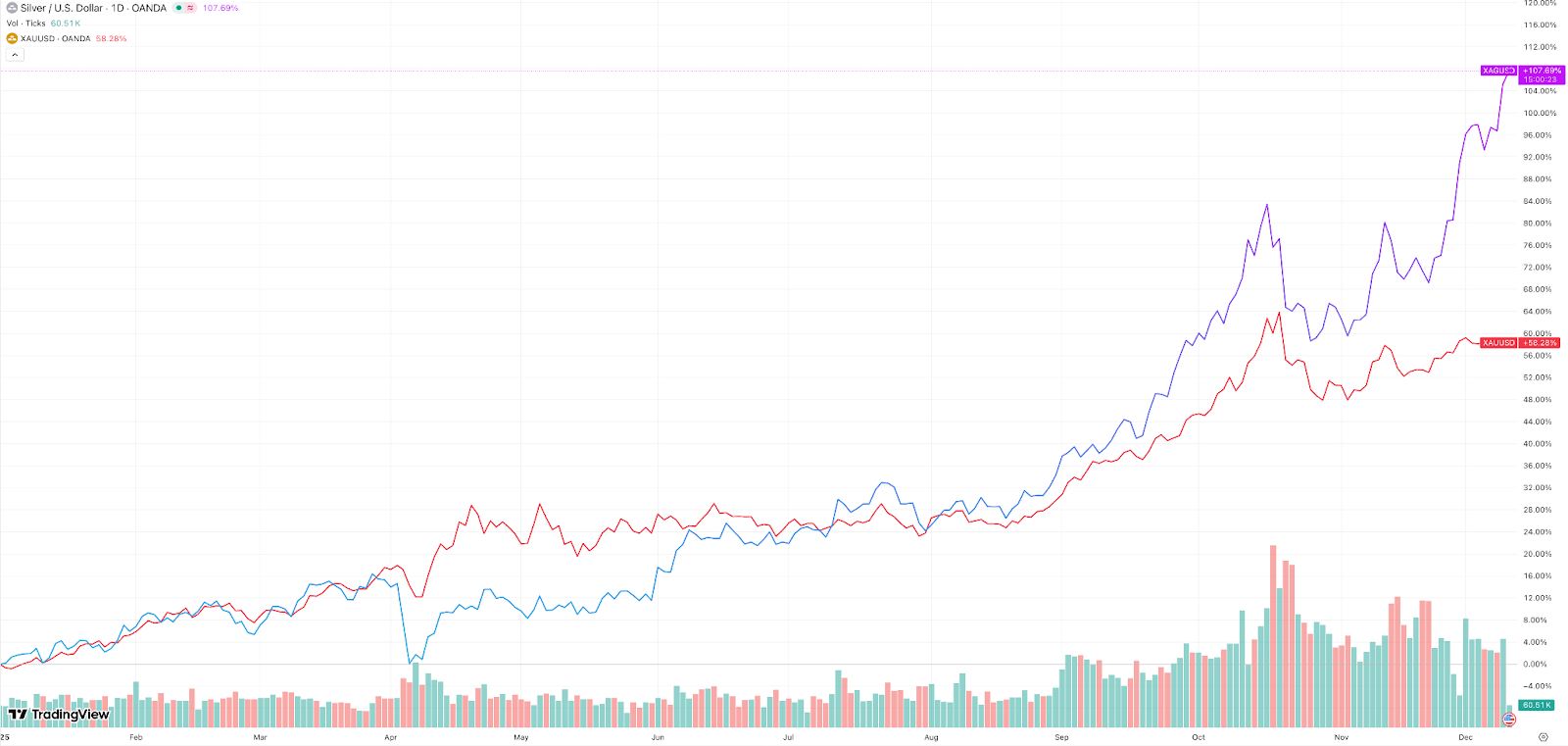
[Silver/Gold Year-to-Date Gains, Source: TradingView]
As seen from the chart, the intertwined rally of gold and silver diverged starting in September, with silver demonstrating independent outperformance over gold. Even during gold's high-level corrections, silver exhibited stronger recovery capacity. By the end of November, silver had not only fully recouped its decline, but its sustained upward momentum also attracted numerous investors, while gold's appeal significantly diminished.
What factors are driving silver's surge?
Most market participants believe that the primary factors driving silver's price increase include: escalating expectations for Federal Reserve interest rate cuts, persistent tightness in global supply, the continuous rise in most Western countries' debt, and safe-haven demand stemming from regional conflicts.
Fed Rate Cut Expectations
The Federal Reserve's current rate-cutting cycle, ongoing since last August, has continuously reduced the dollar's appeal. Lower interest rates typically enhance the attractiveness of non-yielding assets that pay no dividends or interest. Consequently, liquid capital in the market has shown a preference for flowing into precious metals.
While the future path remains unclear, persistent concerns about a softening labor market have led to market expectations of a continued 25-basis point rate cut at upcoming Fed meetings.
Global Supply Tightness
Last month, the United States added silver to the Geological Survey's list of critical minerals. This move fueled concerns about potential future tariffs on silver and also contributed to its price surge. Consequently, it led to a significant inflow of silver into the US, exacerbating supply tightness in other regions.
Ewa Manthey, Commodity Strategist at ING, highlighted that silver's robust performance this year stems from a confluence of factors. On one hand, global supply remains persistently tight. On the other hand, industrial demand continues to be strong, particularly with increasing consumption of silver in solar energy, electric vehicles, and electronic products.
Manthey further noted that silver supply exhibits structural inelasticity. Approximately 70% to 80% of global silver output is derived as a byproduct from lead, zinc, copper, or gold mines. Therefore, even with rising silver prices, production is challenging to increase commensurately unless demand for these associated metals also rises simultaneously.
Western Debt Escalation and Geopolitical Conflicts
Recently, outstanding US Treasury debt surpassed the $30 trillion mark for the first time, nearly double the level in 2018. Furthermore, as of November, the total US federal government debt reached $38.4 trillion, approaching the statutory debt ceiling of $41.1 trillion.
Russian Federation Senator Aleksey Pushkov disclosed on Telegram that an aggressive contingency plan is being discussed within the EU: should Trump bypass the EU and reach a direct agreement with Russia on the Ukraine issue, the EU might consider selling approximately $2.3 trillion in US Treasury bonds held by Europe to pressure Trump by disrupting US financial markets.
Additionally, the Israeli-Palestinian conflict and the Russia-Ukraine conflict remain unresolved, with markets continuing to digest the impact of potential cease-fire agreements and negotiations on safe-haven sentiment.
Although silver's price movements often mirror gold's, its smaller market size results in higher volatility and greater sensitivity to dollar fluctuations. Furthermore, silver's significantly lower price compared to gold attracts numerous investors seeking an affordably priced safe-haven asset.
In the coming months, silver is poised to benefit from the same upward drivers as gold: a weakening dollar, monetary easing, and a resurgence in demand for safe-haven assets amid geopolitical tensions. Additionally, broader electrification, grid upgrades, and increased automotive usage are also expected to boost silver prices.
David Wilson, Director of Commodity Strategy at BNP Paribas, stated that silver possesses a substantial base of retail and speculative capital. When prices strengthen, this often further accelerates capital inflows, reinforcing the upward trend.
For retail investors, we believe that silver's allocation risk may be lower than most assets in the short term. Its robust fundamental support is unlikely to allow for significant bearish momentum in the market. Therefore, we still recommend investors allocate a reasonable portion to silver assets.
This content was translated using AI and reviewed for clarity. It is for informational purposes only.
Recommended Articles







Comments (0)
Click the $ button, enter the symbol, and select to link a stock, ETF, or other ticker.