


Better Buy: Micron or Nvidia Stock



Key Points
Nvidia's GPUs dominate the artificial intelligence (AI) computing market.
Memory chip shortages are causing Micron's revenue to boom.
Two of the hottest stocks on the market are Nvidia (NASDAQ: NVDA) and Micron (NASDAQ: MU). Both companies are thriving on heightened data center demand, and each has integral products for the artificial intelligence (AI) training ecosystem. Nvidia makes graphics processing units (GPUs), while Micron makes memory chips. That makes these two partners rather than competitors.
However, there can only be one stock that's the better buy between them. So, which one is it?
Will AI create the world's first trillionaire? Our team just released a report on the one little-known company, called an "Indispensable Monopoly" providing the critical technology Nvidia and Intel both need. Continue »

Image source: Getty Images.
Nvidia's business is more stable
In the GPU world, Nvidia stands on top. Its ecosystem and hardware are better than the competition's, making it the top choice for any company looking to build out its AI model. There is a lot that differentiates Nvidia's products from rivals, so it has earned a premium as a result.
Micron is a bit different. There isn't a whole lot to separate one memory manufacturer from another, which results in a commoditized market. When demand is high and supply is low, as it is now, memory prices soar. That's exactly what we're seeing, and it's powering Micron's stock to new heights.
The issue is that this memory shortage won't last forever. Micron and its peers are all building new fabrication facilities to meet demand. Eventually, demand will slow or decrease, or supply will catch up and cause memory prices to crater.
Once that occurs, it will return Micron's business to the flatline state that it once was. That will be a painful day for shareholders.
Nvidia is certainly thriving off of component shortage, but its pricing isn't nearly as affected by overall demand as Micron's. As a result, I'm giving the business edge to Nvidia.
Winner: Nvidia
Nvidia's growth is impressive, but it's nowhere near Micron's
From a growth standpoint, Nvidia is doing quite well. Wall Street analysts project 79% revenue growth during fiscal Q1 and 86% during Q2. Those are impressive figures, especially for the world's largest company by market value.
However, Micron's growth is even better. Next quarter, Wall Street analysts expect 261% revenue growth and 246% in the quarter after that. Micron's business is booming, and there's no way to get around that. It's easily the winner here, even though there's nothing to be disappointed in with Nvidia's growth figures.
Winner: Micron
Valuing each company is tricky
As discussed, Micron operates in a commodity market, which means the stock market usually assigns a lower valuation to a stock. That's because a cycle can turn against a company on short notice, creating more risk for investors. This is seen in Micron's fairly low forward price-earnings ratio.
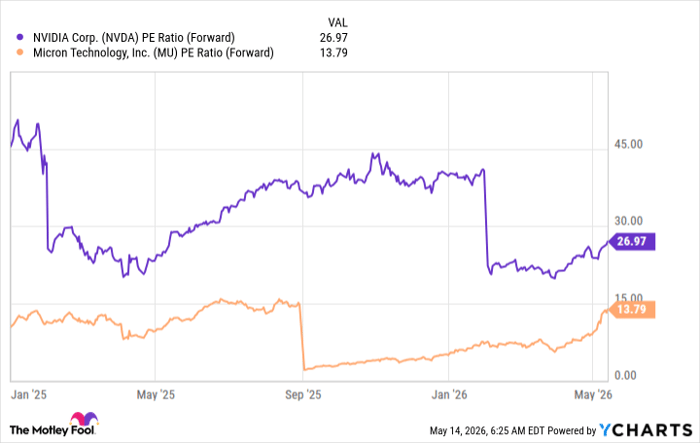
NVDA PE Ratio (Forward) data by YCharts
Nvidia trades at about double the relative price tag of Micron, and investors may question why Micron trades at a discount to Nvidia when it's growing much faster. This discount is being slowly erased, but I'm unsure if Micron will ever fully close the gap or if it ever should.
If the memory chip shortage is resolved Micron will likely return to a single-digit price-to-earnings ratio. But until then, a mid-teens valuation makes sense.
That's right where each company is, so I cannot declare a winner here.
Winner: Tie
A tie?
Both companies are phenomenal investments, but which is better comes down to the individual investor's goals. If you want more of a set-it-and-forget-it AI investment, Nvidia fills that role nicely. If you want ultimate upside but may have to deal with more volatility and you will need to sell before the memory chip market inevitably falls, Micron is a better pick.
Each investor must make that choice for themselves, or they can buy both and reap the gains of two of the biggest beneficiaries of the AI build-out.
Should you buy stock in Nvidia right now?
Before you buy stock in Nvidia, consider this:
The Motley Fool Stock Advisor analyst team just identified what they believe are the 10 best stocks for investors to buy now… and Nvidia wasn’t one of them. The 10 stocks that made the cut could produce monster returns in the coming years.
Consider when Netflix made this list on December 17, 2004... if you invested $1,000 at the time of our recommendation, you’d have $469,293!* Or when Nvidia made this list on April 15, 2005... if you invested $1,000 at the time of our recommendation, you’d have $1,381,332!*
Now, it’s worth noting Stock Advisor’s total average return is 993% — a market-crushing outperformance compared to 207% for the S&P 500. Don't miss the latest top 10 list, available with Stock Advisor, and join an investing community built by individual investors for individual investors.
*Stock Advisor returns as of May 18, 2026.
Keithen Drury has positions in Nvidia. The Motley Fool has positions in and recommends Micron Technology and Nvidia. The Motley Fool has a disclosure policy.
Recommended Articles








Comments (0)
Click the $ button, enter the symbol, and select to link a stock, ETF, or other ticker.