


Nvidia vs. AMD: The Better AI Chip Stock for 2026



Key Points
AMD stock has significantly outperformed Nvidia on the market in 2026, driven by accelerating growth and a robust revenue pipeline.
Nvidia, meanwhile, continues to grow at a solid pace and has a massive revenue backlog for 2026 and 2027 that can help sustain its strong growth.
A closer look at the valuations of both companies will make it clear which of these two chip stocks investors should consider buying right now.
Semiconductor stocks are enjoying yet another terrific year, as evidenced by the 70% jump in the PHLX Semiconductor Sector index so far in 2026. Artificial intelligence (AI), not surprisingly, has played a central role behind this red-hot rally in the semiconductor sector.
Market research firm Gartner estimates that the global semiconductor industry's revenue could increase by 64% in 2026 to $1.32 trillion. The robust demand for AI processors and networking components will power this outstanding growth. That's why now is a good time to take a closer look at the prospects of Nvidia (NASDAQ: NVDA) and Advanced Micro Devices (NASDAQ: AMD), two chip designers that have been witnessing impressive revenue and earnings growth driven by AI.
Will AI create the world's first trillionaire? Our team just released a report on the one little-known company, called an "Indispensable Monopoly" providing the critical technology Nvidia and Intel both need. Continue »
Let's see which of these two semiconductor stocks is a better buy for 2026.
Image source: The Motley Fool.
Nvidia is the dominant force in AI chips, but AMD has turned out to be the better investment this year
Nvidia dominates the AI chip market with an estimated share of 81%, according to market research firm IDC. This explains why the company's revenue in fiscal 2026 (which ended on Jan. 25, 2026) shot up by 65% to a record $215.9 billion. Nvidia also reported an impressive 60% increase in earnings per share during the fiscal year to $4.77.
However, Nvidia stock has underperformed the PHLX Semiconductor Sector index this year, rising only 18% as of this writing. Meanwhile, shares of AMD have shot up by a remarkable 114% in 2026, driven by the company's growing prominence in AI chips. AMD reported robust year-over-year revenue growth of 38% in the first quarter of 2026 to $10.25 billion. Its adjusted earnings jumped by 43% in Q1 to $1.37 per share.
The outlook, however, was the icing on the cake. AMD expects its revenue growth to accelerate to 46% in the current quarter. The non-GAAP gross margin forecast of 56% points toward a year-over-year jump of 13 percentage points, suggesting that huge earnings growth is in the cards. AMD's accelerating growth will be powered by the lucrative contracts the company has signed with OpenAI and Meta Platforms to deploy a combined 12 gigawatts (GW) of chips for their AI data centers.
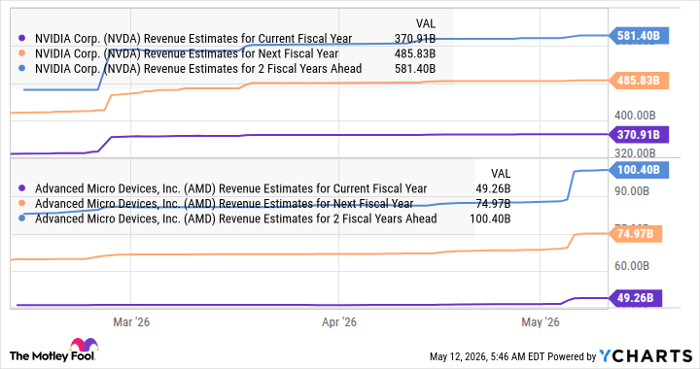
Not surprisingly, consensus estimates are projecting a 76% increase in AMD's earnings in 2026 to $7.33 per share, followed by an identical increase next year. Nvidia, on the other hand, has a massive order pipeline of $1 trillion for its Blackwell and Vera Rubin processors for 2026 and 2027. This explains why even Nvidia's earnings are anticipated to jump by 75% in 2026. However, analysts expect its earnings growth to slow to 35% in 2027.
It is easy to see why that's the case. Nvidia has already established a strong revenue base and is facing growing competition in AI chips. AMD, meanwhile, has a smaller revenue base, which means that its revenue and earnings growth rate could exceed Nvidia's thanks to its massive contracts with OpenAI and Meta.
The Meta Platforms deal, for instance, could add $100 billion to AMD's top line, according to the Wall Street Journal. The OpenAI deal is expected to open a similar growth opportunity for AMD. Given that AMD's trailing-twelve-month revenue stands at $37.4 billion, the contracts with Meta and OpenAI could significantly boost its growth once the chipmaker starts deploying its chips for them in the second half of 2026.
In all, AMD's smaller revenue base and strong revenue pipeline put it on track to grow faster than Nvidia.
Data by YCharts
Will AMD continue to outperform Nvidia?
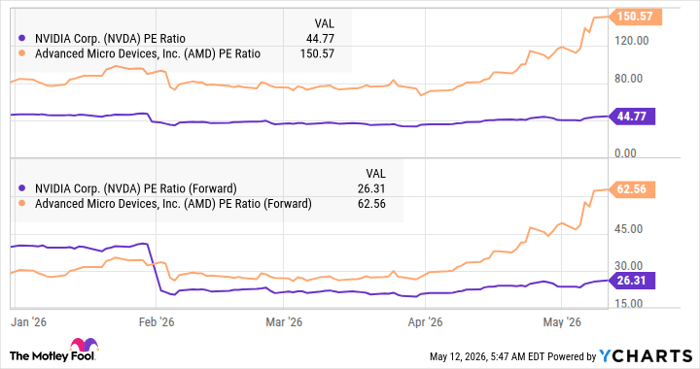
You may think that AMD's faster growth could translate into more upside. However, the stock's terrific rally in 2026 has made it quite expensive when compared to Nvidia.
Data by YCharts
Nvidia's muted returns and phenomenal growth explain why this AI stock is trading at a significantly lower valuation than AMD. What's more, the market may be underestimating Nvidia's growth potential, as the company's move into the physical AI space could open a massive long-term opportunity that could help it sustain its impressive growth for years to come.
Moreover, Nvidia's price/earnings-to-growth ratio (PEG ratio) of 0.68 is lower than AMD's 1.09, based on the annual earnings growth these companies could deliver over the next five years, according to Yahoo! Finance. The PEG ratio is a forward-looking valuation metric that accounts for a company's earnings growth potential. A reading below 1 indicates that a stock is undervalued relative to its anticipated growth.
Nvidia, therefore, looks like the better bet for investors looking to buy an AI chip stock right now in 2026. Its healthy growth potential and attractive valuation could eventually send it on a bull run. In contrast, AMD's expensive valuation could weigh on its performance after stellar returns this year.
Should you buy stock in Advanced Micro Devices right now?
Before you buy stock in Advanced Micro Devices, consider this:
The Motley Fool Stock Advisor analyst team just identified what they believe are the 10 best stocks for investors to buy now… and Advanced Micro Devices wasn’t one of them. The 10 stocks that made the cut could produce monster returns in the coming years.
Consider when Netflix made this list on December 17, 2004... if you invested $1,000 at the time of our recommendation, you’d have $460,826!* Or when Nvidia made this list on April 15, 2005... if you invested $1,000 at the time of our recommendation, you’d have $1,345,285!*
Now, it’s worth noting Stock Advisor’s total average return is 983% — a market-crushing outperformance compared to 207% for the S&P 500. Don't miss the latest top 10 list, available with Stock Advisor, and join an investing community built by individual investors for individual investors.
*Stock Advisor returns as of May 13, 2026.
Harsh Chauhan has no position in any of the stocks mentioned. The Motley Fool has positions in and recommends Advanced Micro Devices, Meta Platforms, and Nvidia. The Motley Fool recommends Gartner. The Motley Fool has a disclosure policy.
Recommended Articles








Comments (0)
Click the $ button, enter the symbol, and select to link a stock, ETF, or other ticker.