


Selling Pressure in Chip Stocks Is Easing. Is SMH the Best Way to Play the Rebound?



Key Points
The VanEck Semiconductor ETF gives you exposure to every major chip company.
It has a low expense ratio of 0.35% and average annual returns that are more than double the S&P 500's.
The ETF is widely traded and easy to enter and exit.
This year has been a wild ride for the chip sector; there's no denying it. In February, Amazon, Alphabet, Meta, and others all predicted enormous capital expenditures for 2026 to build out their artificial intelligence (AI) infrastructure.That caused an investor panic that wiped out $1 trillion in short order in AI stocks, followed by a rough March amid the ongoing chaos caused by the Iran war.
Amid all this volatility, the VanEck Semiconductor ETF (NASDAQ: SMH) -- despite dipping 13% between the end of January and the end of March -- is up 30% over the past month, and 40% year to date. It seems as though no amount of uncertainty is derailing this train.
Will AI create the world's first trillionaire? Our team just released a report on the one little-known company, called an "Indispensable Monopoly" providing the critical technology Nvidia and Intel both need. Continue »
If you want a one-ticker play on the whole industry without betting on a single company, SMH offers a way to ride the continuing innovation while navigating the turbulence.
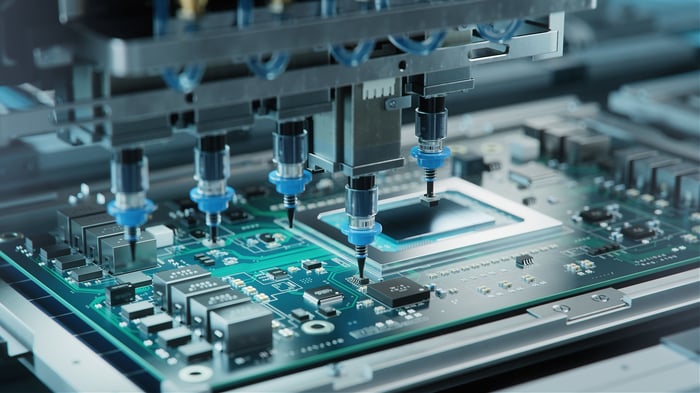
Image source: Getty Images.
The ETF of semiconductor leaders
The VanEck Semiconductor ETF's holdings are essentially the chip industry's "greatest hits" grouped into a single ticker. The bulk of them (about 78%) are based in the United States, while the remaining 22% is dominated by the Netherlands and Taiwan. Its top 10 stock holdings and their allocation in the ETF's portfolio are:
- Nvidia: 17%
- Taiwan Semiconductor Manufacturing: 10.5%
- Broadcom: 7.95%
- Intel: 7%
- Advanced Micro Devices: 6.17%
- Texas Instruments: 5%
- Micron Technology: 4.9%
- Analog Devices: 4.49%
- Qualcomm: 4.31%
- Kla Corp: 4.26%
All these stocks profit in some way from the AI capex plans of the Magnificent Seven and many other companies.
Nvidia is the most dominant AI hardware company in the world, and its graphics processing units (GPUs) are used by just about every AI software company.
Taiwan Semiconductor is the largest chip manufacturer globally, responsible for 72% of the total pure foundry market.
Broadcom is Google's partner in developing the Tensor Processing Unit (TPU), one of the biggest competitors to Nvidia's GPU.
Micron is one of only three companies that dominate the global memory chip market. It produces the HBM4 memory chip for Nvidia's Vera Rubin GPU, and it stands to profit handsomely from the global memory shortage we're in right now.
I could go on, but I think you get the idea.
A hassle-free access to AI leaders
The ETF gives you exposure to all those stocks and 16 more, with an expense ratio of 0.35% and an average lifetime annual return of 26.92% per year. That's more than double the S&P 500's average annual return of about 10%.
It has a three-month average volume of 9.2 million shares as well, so it's very widely traded, and you should have no problem getting into or out of a position in it.
If you want to profit from the AI hardware market's seemingly unstoppable boom, the VanEck Semiconductor ETF is one of the most straightforward ways to do it.
Should you buy stock in VanEck ETF Trust - VanEck Semiconductor ETF right now?
Before you buy stock in VanEck ETF Trust - VanEck Semiconductor ETF, consider this:
The Motley Fool Stock Advisor analyst team just identified what they believe are the 10 best stocks for investors to buy now… and VanEck ETF Trust - VanEck Semiconductor ETF wasn’t one of them. The 10 stocks that made the cut could produce monster returns in the coming years.
Consider when Netflix made this list on December 17, 2004... if you invested $1,000 at the time of our recommendation, you’d have $490,864!* Or when Nvidia made this list on April 15, 2005... if you invested $1,000 at the time of our recommendation, you’d have $1,216,789!*
Now, it’s worth noting Stock Advisor’s total average return is 963% — a market-crushing outperformance compared to 201% for the S&P 500. Don't miss the latest top 10 list, available with Stock Advisor, and join an investing community built by individual investors for individual investors.
*Stock Advisor returns as of May 6, 2026.
James Hires has positions in Alphabet and Micron Technology. The Motley Fool has positions in and recommends Advanced Micro Devices, Alphabet, Amazon, Broadcom, Intel, Meta Platforms, Micron Technology, Nvidia, Qualcomm, Taiwan Semiconductor Manufacturing, and Texas Instruments. The Motley Fool has a disclosure policy.
Recommended Articles









Comments (0)
Click the $ button, enter the symbol, and select to link a stock, ETF, or other ticker.