


Downbeat guidance sank shares; Is Kuaishou at $25bn a buy? ---



$KUAISHOU-W(01024.HK)'s sharp drop was driven by the guidance released at the small-group meeting (1Q26 & 2026), which broadly fell short of buy-side expectations. In short, revenue growth is under pressure while investment is stepping up, leading to a notable YoY decline in profit.
1) Main drag: E‑com growth concerns — ads guided to low-single-digit growth and GMV will no longer disclose specific figures next year
Mgmt. expects ad revenue growth to slow to 8–9% in Q1 and 6–7% for the full year, a clear deceleration vs. 2025. While GMV will not be disclosed, using the 15% growth guide for other revenue, backing out Kling and factoring in commission concessions, we infer GMV growth at 5–10% for Q1 and the full year, whereas the market had still penciled in ~13% for both ads and e‑com.
E‑com monetization for Kuaishou stems from two streams: internal ads (merchant traffic spend) and commissions. Since user growth plateaued and e‑com ads reached roughly half of ad mix, the e‑com business became the core valuation anchor for its legacy operations.
However, the e‑com tax enforcement rolled out since Oct last year hit merchants with previously non-compliant tax practices, especially non-brand SMEs (industry-wide sales impact at ~4–5%, with SMEs potentially >10%). Some top-selling Kuaishou streamers are no longer ‘small’ by GMV, but likely had gray areas in tax treatment, making the clean-up’s impact more pronounced.
As a result, after regularization this year, these large streamers and SMEs will pay more taxes, naturally squeezing their traffic budgets. Meanwhile, to offset merchant ‘losses’, Kuaishou is offering traffic subsidies and commission rebates (ultimately competitive moves), directly pressuring ad revenue and the e‑com commission take rate.
2) Added pressure: higher‑than‑expected investment — 2026 full‑year capex at RMB 26bn vs. buy‑side’s RMB 18bn (RMB 15bn last year), shaving ~3ppt off margins
With top-line under pressure, the company still plans to ramp AI investment this year, with capex guided to RMB 26bn, up 70%+ YoY. The incremental RMB 11bn vs. last year will mainly fund Kling and the OneRec model (smart recommendations), and assuming 5‑yr depreciation, the extra hit to this year’s GPM is ~150bps.
The increased AI spend will flow through COGS (compute depreciation) and R&D (AI-related opex). At the same time, a higher mix from lower‑margin short dramas will dilute GPM, resulting in a 3–4ppt drag on full‑year margins.
On this math, 2026 profit would be RMB 17–18bn, implying a YoY decline of over 15%. Ex‑Kling and AI spend, margins would be flat vs. 2025, suggesting the profit uptick pause is not solely about AI.
3) The lone bright spot: Kling’s near‑term billings look strong, but guidance implies competition still matters
Dolphin Research already flagged Kling’s solid Q1 run‑rate: Jan ARR reached $300mn, Q1 revenue is guided to ~RMB 500mn, and full‑year growth should at least double. This small beat stems from the market focusing on iOS App billings, while Kling is gaining better traction on the enterprise/pro user side.
But if the goal is only to double to ~RMB 2.1bn+, with RMB 500mn already in Q1, does that imply monthly/quarterly sequential growth is merely flat to low single‑digits? That would fall short of the ‘hyper‑growth’ one expects from a top‑tier foundation model, meaning it cannot command the full valuation premium of leading model vendors (it should be discounted).
Mgmt. likely factors in potential competitive pressure on Kling, especially given rapid shifts in AI. The closest rival Seedance, backed by Douyin & Doubao, is expanding aggressively on the consumer side, and video‑gen models have lower technical barriers with nearer‑term ceilings vs. text LLMs, so absolute moats are thinner.
The real moat lies in ecosystem and first‑mover advantages: Kuaishou’s ecosystem fits video‑gen well, providing massive low‑cost video data and natural enterprise access via e‑com and short‑video ad businesses. Its first‑mover edge (years of video data denoising/cleaning) helps sustain top‑tier user experience.
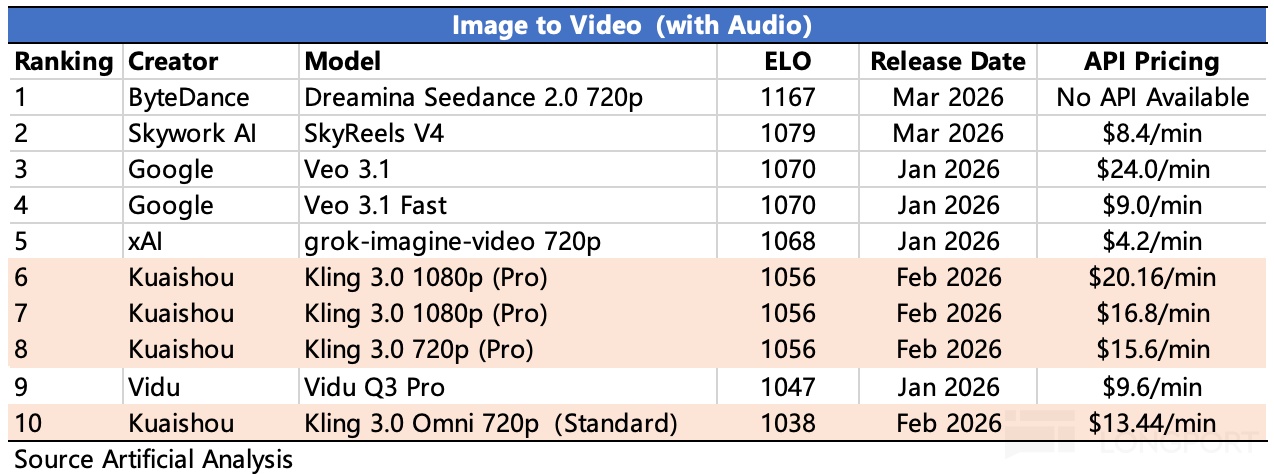
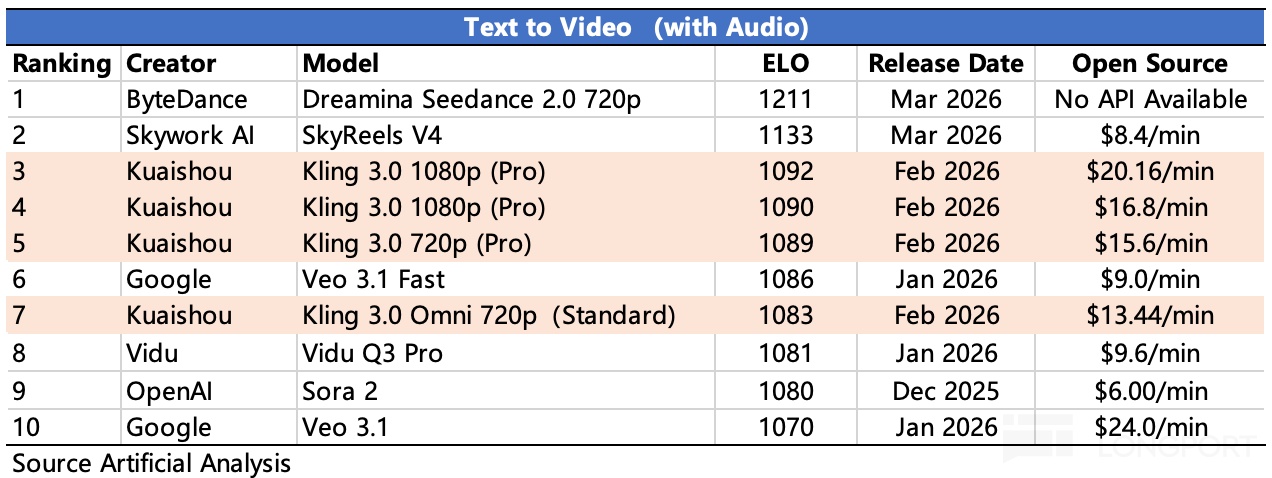
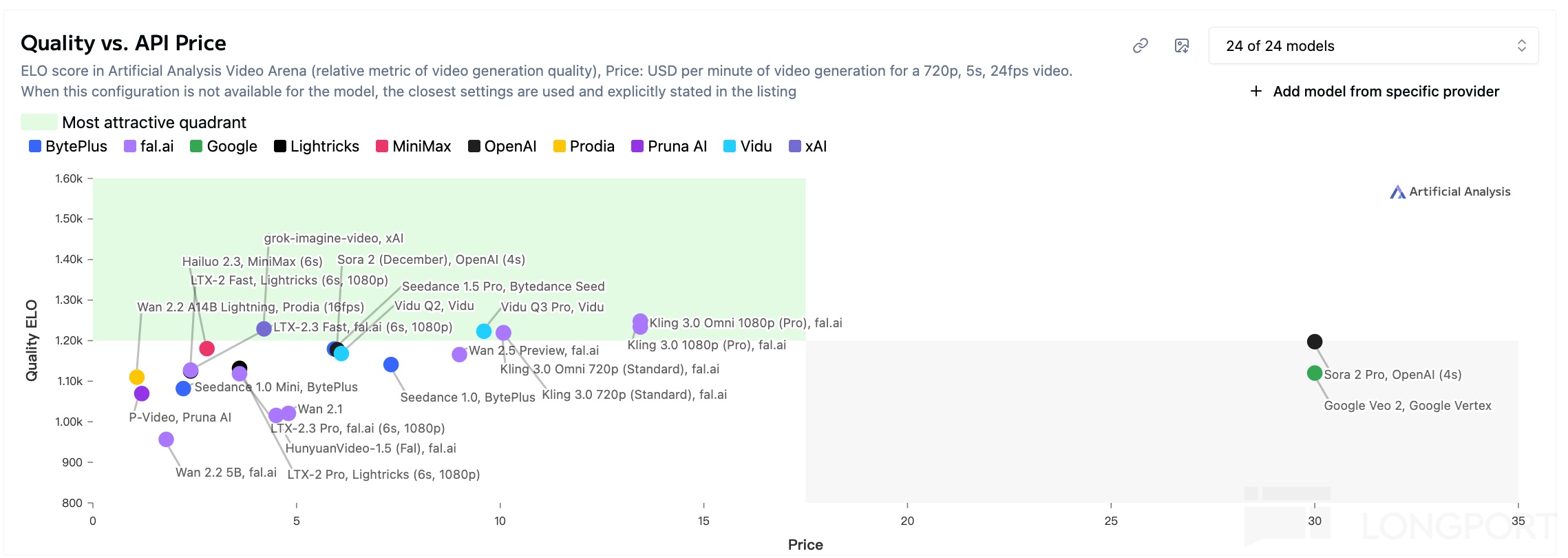
The latest Kling 3.0 pursues a premium, specialized path (more enterprise/pro‑user oriented), offering multimodal I/O and full‑modal instruction control, and can generate 120‑sec, high‑motion, narrative‑strong videos. These strengths are not fully captured by the ELO scores below, marking a differentiated positioning vs. the value‑priced viral versions (e.g., 2.0/2.6).
4) Reading the bottom: relative valuation + shareholder returns
Given heavier investment into Kling and its better‑than‑expected near‑to‑mid‑term traction, we still use SOTP for legacy + Kling. For Kling, we assign a $350–400mn 2026 revenue and 20x P/S, implying $7–8bn valuation.
For legacy, Dolphin Research uses two approaches:
(1) From fundamentals, assign 6–8x P/E to RMB 18bn profit for a $16–20.5bn valuation.
(2) From shareholder returns, 2025 delivered HKD 5.1bn and this year known dividends are HKD 3.0bn; if buybacks reach the 2024–2025 average of HKD 8.0bn, total returns would be HKD 11.0bn, which at a 10% yield implies ~$14bn valuation for legacy.
On these two methods, combined SOTP (legacy + Kling) is $21–28.5bn, averaging just under $25bn. The stock closed today at ~$25.4bn, suggesting the market priced it ‘fast, precise, and tough.’
Mgmt. calls its guidance ‘conservative,’ implying room to beat later on. From a long‑term view, downside looks limited at these levels, and investors can reference the range above against their risk appetite, while near‑term caution is reasonable given low visibility.
To quickly shift sentiment and expectations, the fastest path near term is sustained, faster iteration and tuning for Kling, preserving product competitiveness, accelerating penetration, and driving greater investor recognition and pricing of its R&D capability.
Risk disclosure and disclaimer for this note:海豚投研免责声明及一般披露
Recommended Articles








Comments (0)
Click the $ button, enter the symbol, and select to link a stock, ETF, or other ticker.