


MU: AI-fueled memory boom—can it break the boom-bust cycle? ---



Micron Technology (MU.O) released its FQ2 2026 results (quarter ended Jan 2026) after the U.S. market close, early Mar 19 Beijing time. Key takeaways are below.
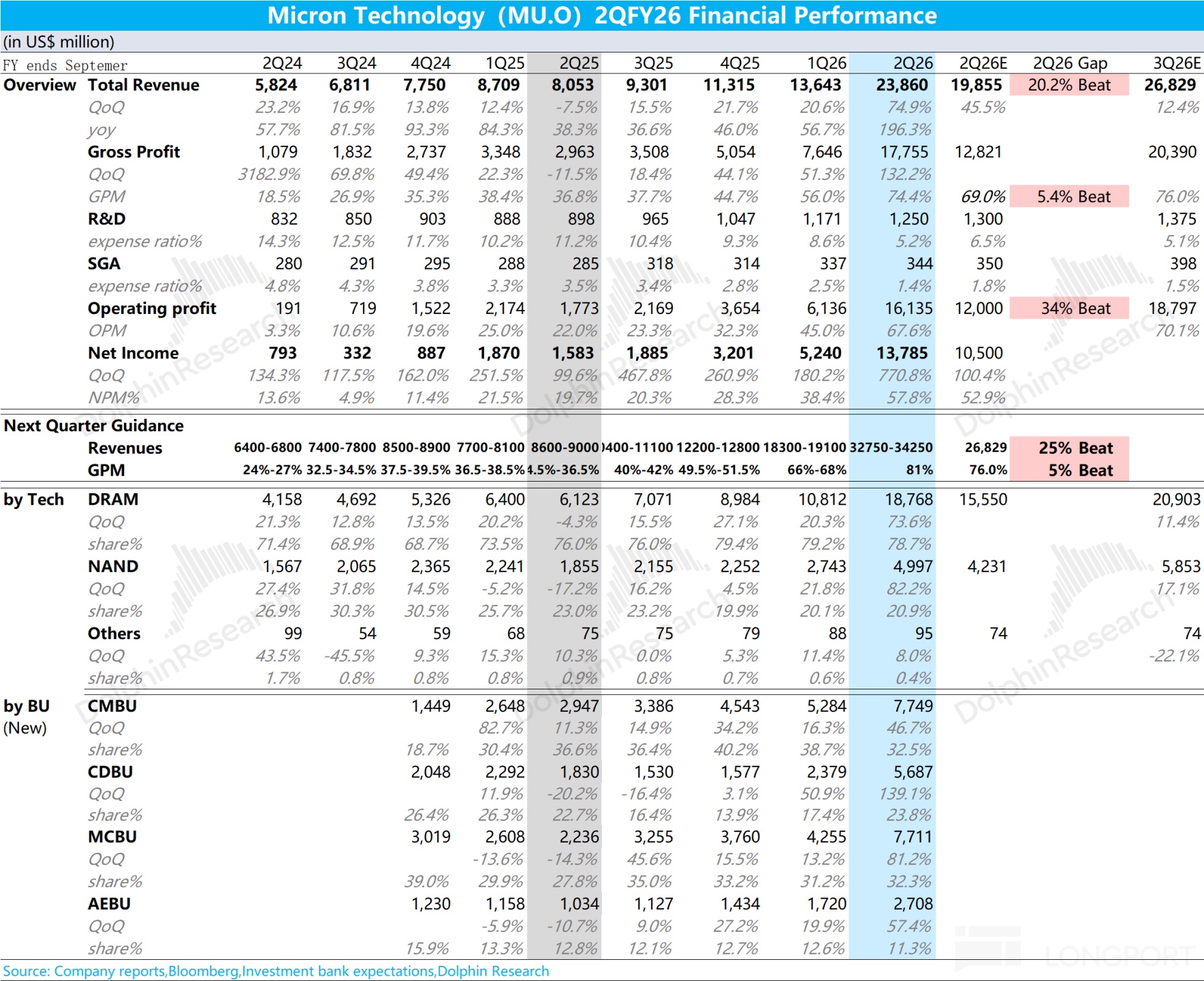
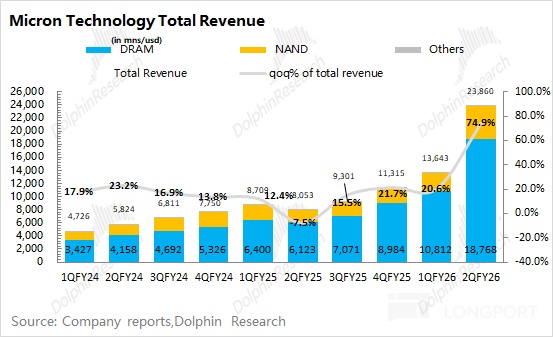
1. Headline results: Revenue came in at $23.86 bn (+75% QoQ), beating the raised buyside bar (~$19.9 bn). Growth was driven by both DRAM and NAND, with each segment up over 70% QoQ.
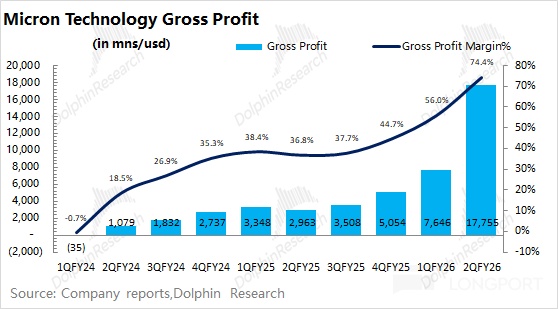
GPM reached 74.4%, beating the raised buyside bar (~69%). Supported by sharp pricing gains, average selling prices (ASPs) for DRAM and NAND were both up more than 60% QoQ.
2. DRAM: Revenue was $18.8 bn, +73.6% QoQ, led primarily by price increases. DRAM ASP rose ~65% QoQ, while shipments were up ~5% QoQ.
By product: ① Legacy DRAM contributed the largest incremental dollar growth, at an estimated ~$16.0 bn this quarter (+80% QoQ or more), as AI demand began to lift DDR products. ② Dolphin Research estimates HBM revenue at roughly $2.7 bn, up about $0.5 bn QoQ, benefiting from HBM3E and HBM4 ramp shipments.
3. NAND: Revenue was $5.0 bn, +82% QoQ. The increase was mainly price-led, with shipments up ~2% QoQ and ASPs up ~78% QoQ.
After a prolonged downturn, industry participants had cut some NAND capacity. As AI demand extends into NAND, tight supply-demand is pushing NAND prices sharply higher.
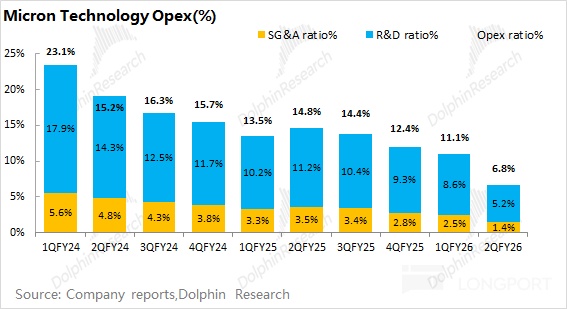
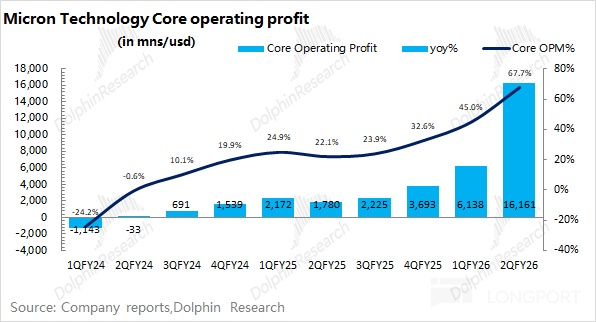
4. Opex: With revenue scaling, R&D and S&M ratios continued to fall. Core OP reached $16.1 bn with OPM at 67.6%. Profit expansion was driven by revenue and GPM, with GPM topping 74% on sharply higher DRAM/NAND ASPs.
5.$Micron Tech(MU.US) Outlook: FQ3 2026 revenue guided to $32.75–34.25 bn, above the Street (~$26.8 bn), and GPM to ~81%, above the Street (~76%). The beat reflects continued price hikes across legacy memory products.
Dolphin Research view: Blowout quarter, but management commentary fell short of expectations
Both revenue and margin materially beat expectations. With only modest shipment growth, upside was primarily price-driven across memory.
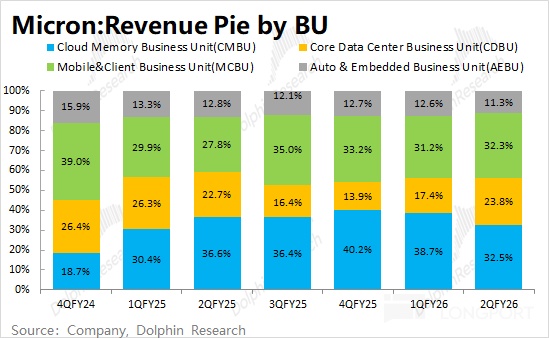
After revising segment disclosures, by end-market: beyond faster growth at the Cloud Memory BU (CMBU), Core Data Center BU (CDBU) and Mobile & Client BU (MCBU) were the main growth engines, powered by sharp price hikes in legacy memory.
Next-quarter guidance is well ahead of consensus. Micron sees revenue at ~$33.5 bn (±$0.75 bn), implying a ~$9.6 bn QoQ increase, beating the Street (~$26.8 bn). GPM is guided to ~81%, well above the buyside (~76%), pointing to another round of sizable price increases next quarter.
Beyond the print, the key watch items for Micron are as follows.
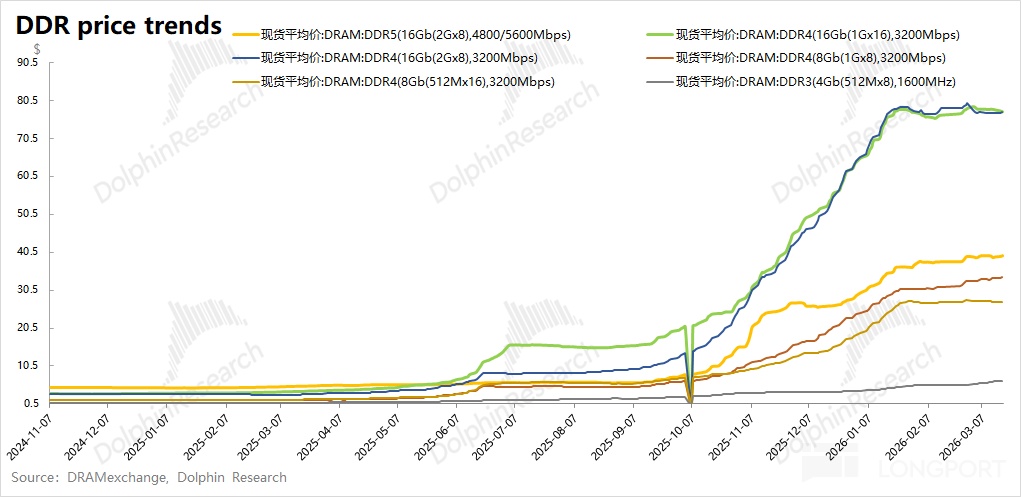
a) Legacy memory super-cycle: Nearly 80% of revenue comes from DRAM, most of it from non-HBM DRAM. The sharp rise in DDR pricing has a larger impact on earnings, and the market remains in a broad upcycle.
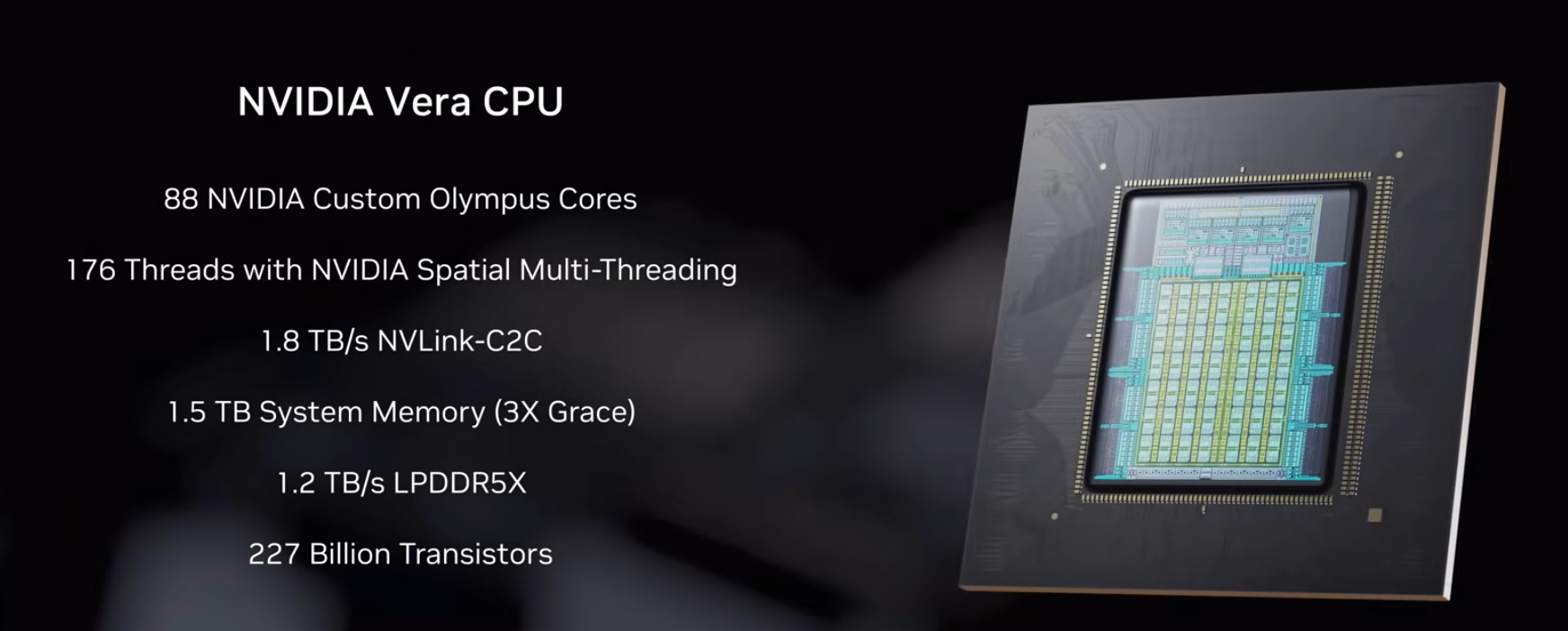
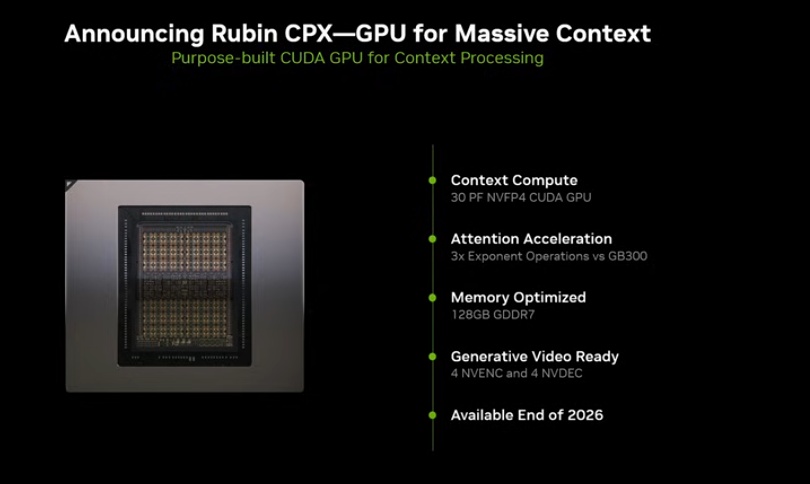
As AI shifts from training to inference, DDR demand rises: ① On the CPU side, vs. Grace, a single Vera CPU will require up to 1.5TB of DDR (3x Grace). ② Rubin CPX opted for GDDR7 rather than HBM.
b) AI-driven memory certainty: This memory cycle is led by incremental AI demand, while PCs and smartphones remain subdued, with hyperscalers as the ultimate buyers. Based on major players' outlooks, 2026–2027 capex should remain elevated.
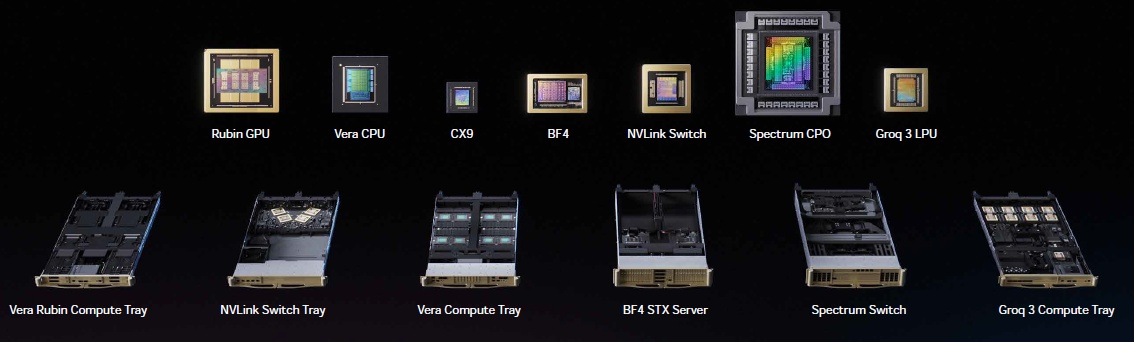
Per NVIDIA's roadmap, the data center bottleneck is shifting from compute to memory. From Blackwell to Rubin, DPU (NAND) and LPU (SRAM) are both memory-focused additions.
Google's TPU already supports FP8, which covers most inference needs, narrowing the compute advantage. Meanwhile, compute scales faster than memory bandwidth, creating a 'memory wall'. As workloads tilt to inference, memory capacity and bandwidth matter more than raw compute.
c) Capex and outlook: FY26 capex raised again to $25.0 bn (vs. $20.0 bn prior), above the Street (~$22.5 bn).
For FY27, management guided to a sizable increase, but noted in a later analyst huddle that capex could normalize lower after FY27.
With a current market cap of ~$519.7 bn, Micron trades at roughly 8x FY26 core net OP on our math (assuming revenue +200% YoY, GPM 78%, tax rate 14.5%). Given the pronounced cyclicality, prior-cycle peak phase (still in price-up phase) multiples mostly sat in the 5–15x PE band, placing the current multiple toward the low end.
① Near term: the industry is in a memory price upcycle, now compounded by Samsung's labor action, suggesting continued earnings beats.
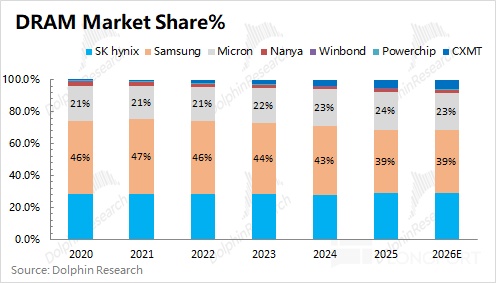
Samsung strike: Samsung holds nearly 40% share in DRAM. Workers, frustrated by the widening pay gap vs. SK Hynix, voted to strike for 18 days from May 21. If production halts, it could take up to two months to restart lines.
② Mid-to-long term: beyond near-term beats, investors focus on earnings durability, including long-term agreements, demand assurance, and the FY27+ outlook. If hyperscalers sign longer-dated contracts to secure supply, that would further de-risk growth.
On key investor concerns, management commented as follows:
1) Long-term agreements: moving from prior 1-year LTAs to 5-year Strategic Customer Agreements (SCAs), with the first signed with a major customer. This resembles deeper collaboration rather than take-or-pay locks.
2) Demand assurance: Micron can meet only 50%–two-thirds of core customers' mid-term needs, unchanged vs. three months ago.
3) FY27 outlook: supply-demand tightness should persist into 2027, but visibility beyond 2027 is limited. Capex will rise significantly again in FY27, but the later analyst huddle also indicated capex could roll over after FY27. (Dolphin Research will publish a detailed transcript.)
Company and industry outlook imply relatively high visibility for 2026–2027 growth. Demand coverage is unchanged, while commentary beyond 2027 remains cautious, including the potential for capex to trend lower after FY27.
Against a 'blowout short-term' print, the market still wants the memory industry to temper cyclicality. Given management's capex outlook, Micron should still be valued as a cyclical, which may cap PE expansion.
Below is Dolphin Research's detailed take on Micron's results.
I. Overall results: revenue and margin well above expectations
1.1 Revenue
FQ2 2026 revenue was $23.86 bn (+75% QoQ), above the Street (~$19.9 bn). The QoQ growth was driven by both DRAM and NAND.
By end-market, data center and networking contributed the largest incremental growth. Smartphones and PCs also rose meaningfully on legacy memory price hikes.
For next quarter, revenue is guided to $32.75–34.25 bn, implying ~+40.4% QoQ and above the Street (~$26.8 bn). Dolphin Research believes the upcycle remains intact, with next-quarter growth still largely price-led for legacy memory.
1.2 Gross profit
Gross profit was $17.8 bn, with GPM at 74.4%, up 1,840 bps QoQ. The expansion was driven by legacy memory price increases.
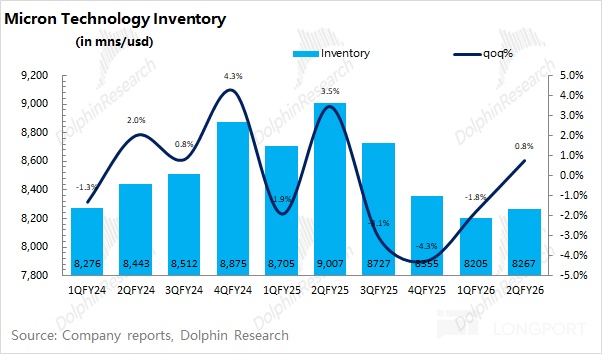
Inventory stood at $8.27 bn, up 0.8% QoQ. Inventory days fell to 121 on stronger data center and related demand, a relatively low level.
GPM is guided to ~81% next quarter, up another ~660 bps QoQ, indicating further price hikes for legacy DRAM and NAND. If Samsung's strike disrupts supply, there could be upside to the margin guide.
1.3 Operating expenses
FQ2 2026 opex was $1.62 bn, +7.3% QoQ. With faster top-line growth, the opex ratio fell to 6.8%.
Core OP was $16.16 bn, with growth driven by higher revenue and GPM. With opex relatively stable, profit upside is primarily a function of revenue and margins.
II. Segment detail: legacy memory price hikes are the main earnings driver
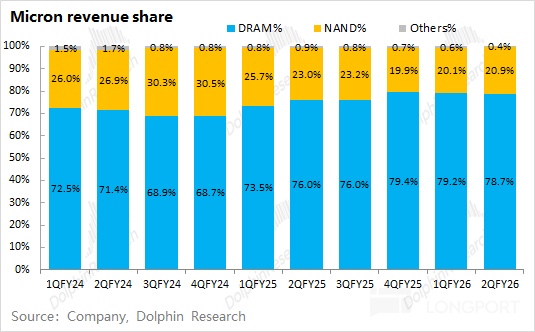
DRAM and NAND remain the key revenue pillars, with DRAM still at roughly 80% mix.
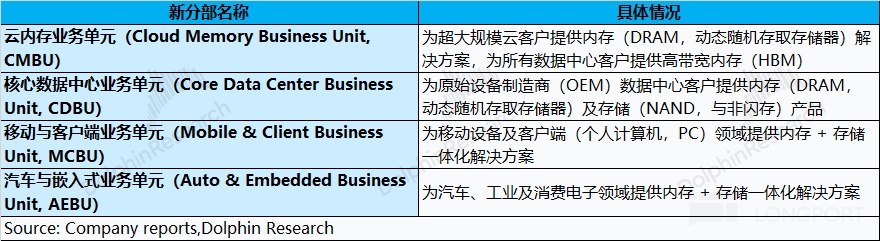
In addition, Micron revised its end-market reporting, replacing CNBU, SBU, MBU and EBU with CMBU, CDBU, MCBU and AEBU. Data center and cloud now represent 50%+ of revenue, underscoring strategic focus on these businesses.
2.1 DRAM
DRAM is the largest revenue stream at nearly 80% mix. FQ2 DRAM revenue rose to $18.77 bn (+74% QoQ). DRAM ASPs were up ~65% QoQ, with shipments up ~5%.
By sub-segment, Dolphin Research estimates HBM revenue at ~$2.7 bn, up ~$0.5 bn QoQ. DDR and other products were roughly $16.0 bn, up more than 80% QoQ.
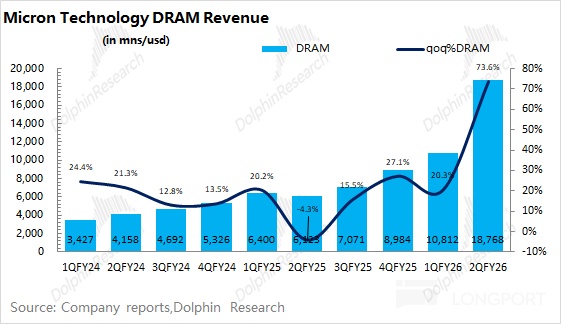
DRAM remains Micron's core, led by HBM and DDR families.
1) HBM:
The company will not break out HBM quarterly. Based on industry and company datapoints, Dolphin Research estimates HBM revenue at about $2.7 bn this quarter, up roughly $0.5 bn QoQ.
Micron serves as a secondary supplier to NVIDIA and trails SK Hynix on execution. With Samsung's HBM3E now certified by NVIDIA, HBM share will be reallocated, putting all three vendors back on a more level playing field.
As NVIDIA Rubin GPUs and AMD MI400 adopt HBM4, shipment progress and product readiness for HBM4 will determine share gains in HBM.

2) DDR and others:
DDR and related product revenue was about $16.0 bn, up 80%+ QoQ. While traditional end-markets like smartphones remain soft, data center and AI have reshaped supply-demand, driving strong DDR price increases.
As AI emphasis shifts from training to inference, DDR demand rises:
① On CPU DDR, vs. Grace, a single Vera CPU will require up to 1.5TB of DDR (3x Grace). ② NVIDIA Rubin CPX selected GDDR7 rather than HBM, which also lifts DDR-related demand.
2.2 NAND
NAND is the second-largest contributor at ~20% mix. FQ2 NAND revenue was $5.0 bn (+82% QoQ), with shipments up ~2% and ASPs up ~78% QoQ.
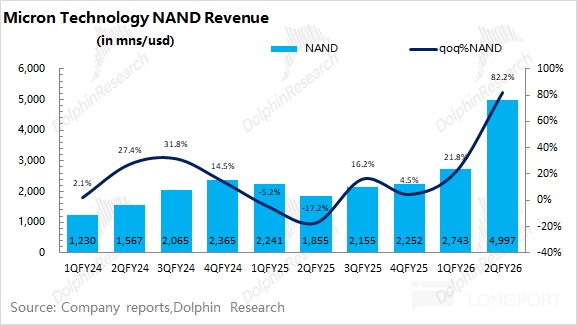
Earlier, AI capex mainly boosted HBM, leaving NAND lagging DRAM. As the mix shifts toward inference, the AI capex impulse is broadening, and NAND is now a beneficiary.
Supply-demand dynamics: on supply, prior NAND weakness led some vendors to cut lines, and the Big 3 have prioritized DRAM over NAND in expansions. On demand, AI is lifting NAND needs, such as the additional NAND layer in NVIDIA Rubin.
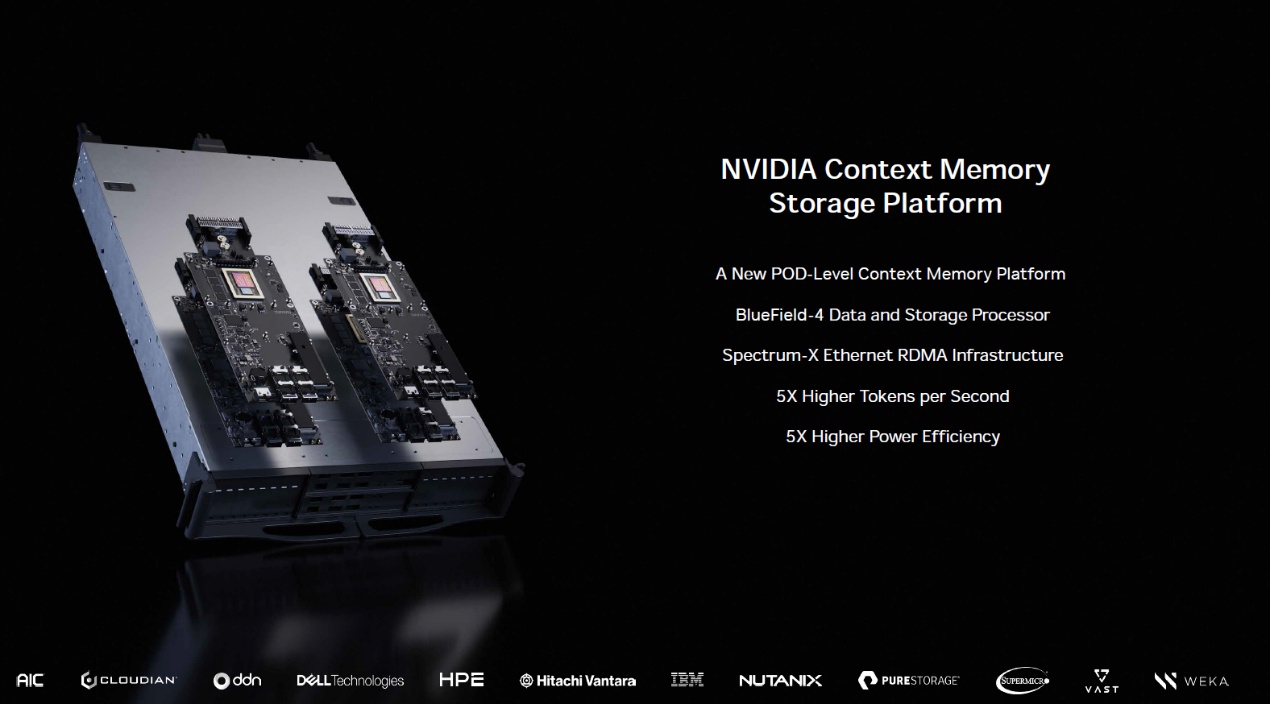
NVIDIA added an 'Inference Context Memory System' (ICMS) to Rubin: ICMS offloads KV Cache from HBM to a more cost-effective medium, freeing HBM bandwidth for compute and lowering inference cost.
Each Rubin GPU can add 16TB of NAND as 'external memory', implying up to 1,152TB of NAND per NVL72.
Dolphin Research's Micron archives:
Memory highlights:
Jan 14, 2026 memory industry '99% idle compute? In the inference era, memory power beats compute power'
Jan 6, 2026 memory industry 'Memory rally: how strong is the AI memory super-cycle?'
Earnings season:
Dec 18, 2025 analyst huddle 'Micron (analyst huddle): cash prioritized for capacity adds; HBM4 yield ramp faster'
Dec 18, 2025 call 'Micron (Trans): GPM to keep rising, with a slower pace'
Dec 18, 2025 earnings take 'Micron MU: AI ignites memory power; is a memory super-cycle starting?'
Sep 24, 2025 call 'Micron (Trans): broad guide raise as AI tailwinds reach legacy semis'
Sep 24, 2025 earnings take 'Micron: unrelenting AI capex, is the memory super-cycle finally here?'
Jun 26, 2025 call 'Micron (Trans): HBM4 sampled; HBM3E 12Hi in smooth mass production'
Jun 26, 2025 earnings take 'HBM ramp ahead: can Micron press the advantage?'
Mar 21, 2025 call 'Micron (Trans): HBM to climb through 2025; higher in 2026'
Mar 21, 2025 earnings take 'Micron: the tailwind is near, but waiting has risks'
Risk disclosure and statements:Dolphin Research disclaimer and general disclosure
Recommended Articles









Comments (0)
Click the $ button, enter the symbol, and select to link a stock, ETF, or other ticker.