


New Zealand Economy Slows More Than Expected Before Iran War Hit



New Zealand’s economic growth slowed sharply in the final three months of 2025, leaving it in a weaker position to absorb fallout from the spiraling conflict in the Middle East.
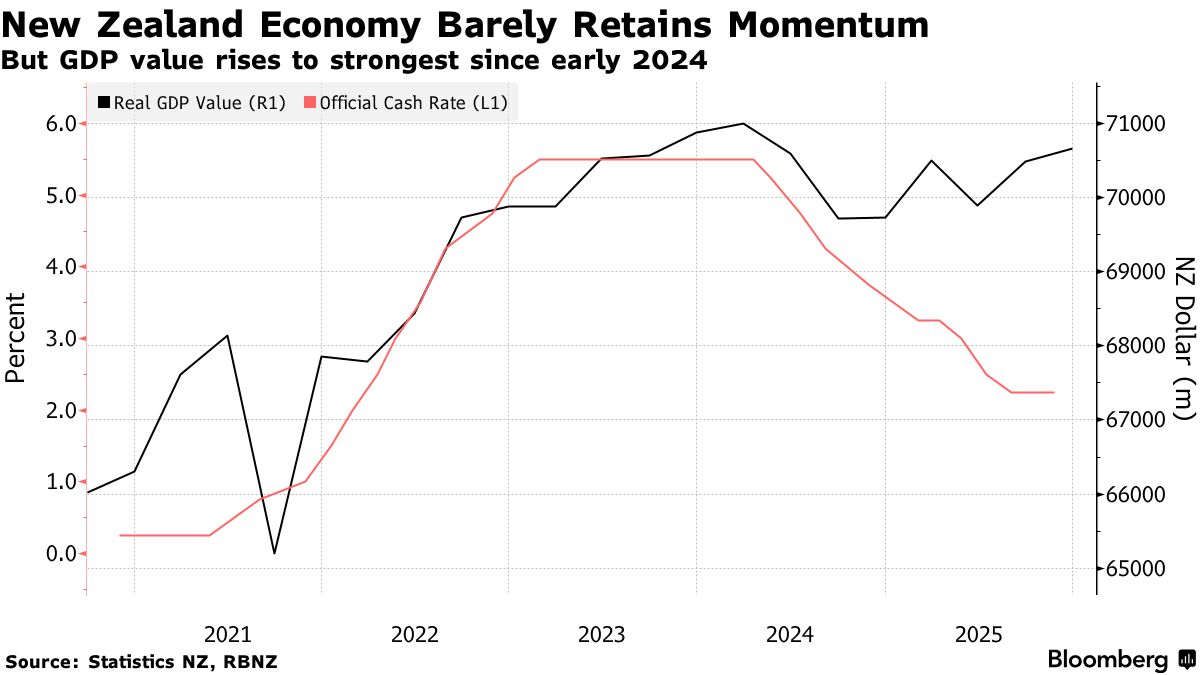
Gross domestic product advanced 0.2% in the fourth quarter after it grew a downwardly revised 0.9% in the preceding three months, Statistics New Zealand said Thursday in Wellington. Economists expected a 0.5% expansion.
New Zealand’s economy has broadly responded to the Reserve Bank’s aggressive interest-rate cuts, with confidence indicators showing an uptick and evidence of expansion in retailing and tourism. However, the outlook is clouded by the war in Iran and rising fuel prices that threaten to erode households’ spending power and deter investment.
“Today’s figures may ultimately prove to be of little more than historical interest, given the pall cast over the global economy in recent weeks by the Iran conflict,” said Michael Gordon, senior economist at Westpac in Auckland. The RBNZ “will note that while the New Zealand economy was regathering some momentum coming into this latest shock, it was still barely at a pace that would have halted the rise in unemployment or added to domestic inflation pressures.”
The New Zealand dollar edged lower after the data, buying 57.86 US cents at 11:30 a.m. in Wellington from 58.09 cents beforehand.
The RBNZ last month held the Official Cash Rate at 2.25% and Governor Anna Breman signaled at the time there was only the possibility of a rate hike in December as inflation was slowing. But with rising gasoline prices now expected to push inflation significantly above the RBNZ’s 1-3% target for much of 2026, money markets are now fully pricing hikes in both September and December.
“With inflation now looking unlikely to move below 3% any time soon and higher prices at the pump an effective tax on consumers, the risks to the growth outlook are clearly skewed to the downside,” said Kim Mundy, senior economist at ASB Bank in Auckland. “This is particularly the case given the weak starting point for private demand.”
Any economic disruption will come at a time when New Zealand’s housing market is struggling for momentum and immigration is running below long-term averages.
That’s unwelcome news for the ruling National Party, which is trailing in opinion polls and plans to contest the November election by arguing it is the superior economic manager. Still, the center-right coalition government can point to some sustained growth after the economy languished for much of its three-year term.
The fourth-quarter expansion was led by a rebound in primary industries such as farming and mining, while accommodation and retailing led growth in services, today’s report showed. Still, manufacturing was flat while construction contracted 1.4%.
GDP per capita was unchanged from the third quarter.
From a year earlier, GDP expanded 1.3%, missing economists’ estimate of 1.7% growth but rising modestly from 1.1% in the 12 months through September. That left the value of GDP the highest since the first quarter of 2024.
Recommended Articles










Comments (0)
Click the $ button, enter the symbol, and select to link a stock, ETF, or other ticker.