


Eli Lilly and Co Stock (LLY) Moved Down by 3.19% on Mar 5: Key Drivers Unveiled



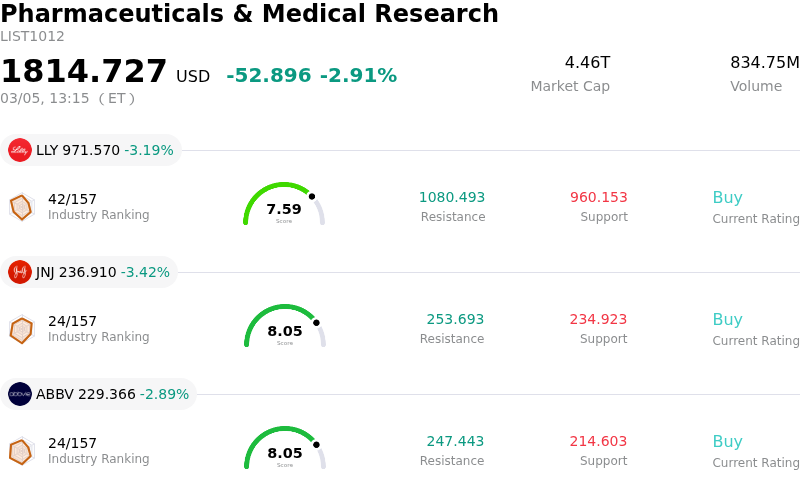
Eli Lilly and Co (LLY) moved down by 3.19%. The Pharmaceuticals & Medical Research sector is down by 2.91%. The company underperformed the industry. Top 3 stocks by trading volume in the sector: Eli Lilly and Co (LLY) down 3.19%; Johnson & Johnson (JNJ) down 3.42%; AbbVie Inc (ABBV) down 2.89%.
What is driving Eli Lilly and Co (LLY)’s stock price down today?
Eli Lilly and Company's stock experienced a downward movement today, largely influenced by emerging competitive pressures in the GLP-1 market and concerns surrounding its high valuation. A significant catalyst for this decline appears to be the recent announcement from a key competitor regarding aggressive price reductions for their GLP-1 medications, anticipated to take effect in the coming year. This development has sparked concerns among investors about a potential "price war" that could compel Eli Lilly to lower the price of its own successful obesity treatment, potentially impacting future profit margins across its core franchise.
Furthermore, the company's valuation remains a point of scrutiny. The stock trades at a premium compared to broader market averages, implying that a substantial portion of its future growth potential may already be factored into its current price. This elevated valuation renders the stock more susceptible to profit-taking and corrections, especially when broader market sentiment shifts or specific industry headwinds emerge. Recent trends indicate some negative short-term momentum for the stock.
Additionally, some analyses point to potential operational risks, including indicators of increasing inventory and rising accounts receivable. These metrics could suggest a risk of inventory write-downs or a future slowdown in sales, which may lead to a deterioration in earnings quality and reduced investor confidence. The concentration of revenue within the tirzepatide franchise also presents a risk, making the company more vulnerable to any negative developments within this critical drug class.
Despite these pressures, the company has released several positive updates. Eli Lilly anticipates regulatory approval and a U.S. launch for its oral obesity drug in the near term. The company also recently launched a new platform aimed at expanding access to obesity treatments through employer-sponsored programs. Analysts largely maintain positive ratings and price targets for the stock, reflecting long-term confidence in its pipeline, including promising clinical trial results for other metabolic assets, and strategic initiatives like an AI drug discovery partnership. However, these positive developments appear to be overshadowed by immediate concerns about market dynamics and valuation.
Technical Analysis of Eli Lilly and Co (LLY)
Technically, Eli Lilly and Co (LLY) shows a MACD (12,26,9) value of [-5.59], indicating a sell signal. The RSI at 44.11 suggests neutral condition and the Williams %R at -86.49 suggests oversold condition. Please monitor closely.
Fundamental Analysis of Eli Lilly and Co (LLY)
Eli Lilly and Co (LLY) is in the Pharmaceuticals & Medical Research industry. Its latest annual revenue is $65.18B, ranking 4 in the industry. The net profit is $20.64B, ranking 2 in the industry. Company Profile
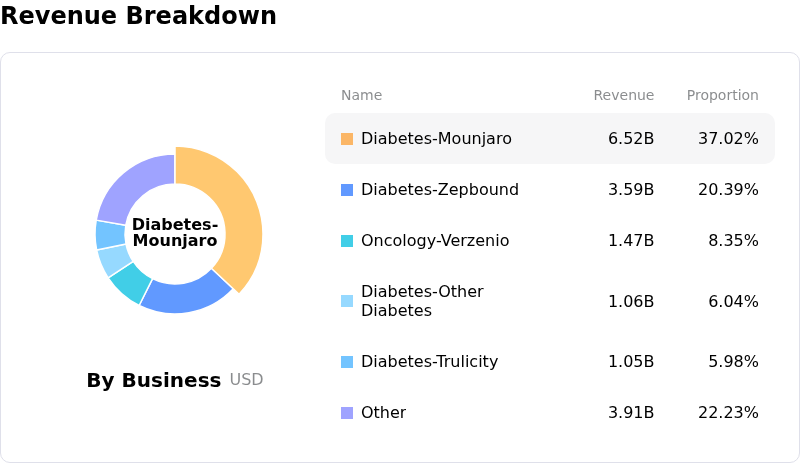
Over the past month, multiple analysts have rated the company as Buy, with an average price target of $1206.10, a high of $1500.00, and a low of $875.00.
More details about Eli Lilly and Co (LLY)
Company Specific Risks:
- Recent double-downgrade by HSBC to 'Reduce' with a significantly lowered price target, citing extreme valuation concerns and the stock being "priced for perfection" with high potential for disappointment.
- Intensified competitive pressure and risk of a price war in the GLP-1 market due to Novo Nordisk's announced price cuts for competing weight-loss medications, potentially eroding Eli Lilly's profit margins for Zepbound.
- Indicators of bloating inventory and potential channel stuffing, evidenced by a significant increase in the average inventory processing period and accounts receivable balance, suggesting future sales slowdowns or inventory write-downs.
This article may include AI-generated content that is human-reviewed, which is for reference and general information purposes only and does not constitute investment advice.
Recommended Articles








Comments (0)
Click the $ button, enter the symbol, and select to link a stock, ETF, or other ticker.