


JD: State subsidies fade; still bleeding on all fronts? ---



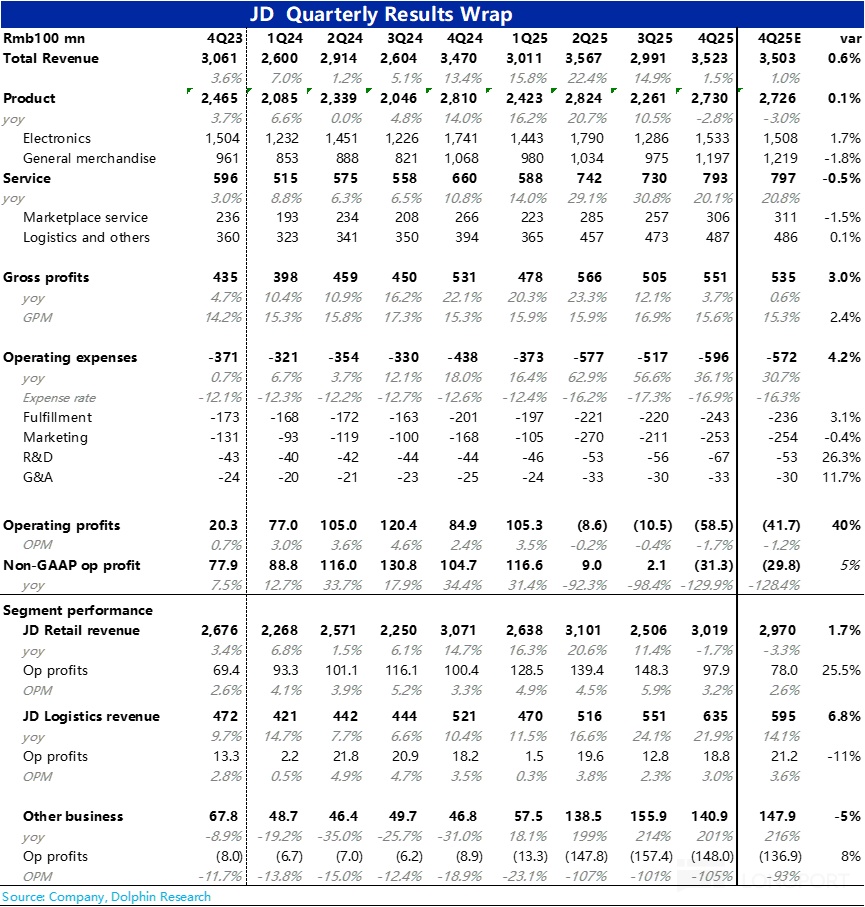
Among China’s three major e-comm players, $JD.com(JD.US) reported Q4 results first. In short, outcomes landed roughly in line against a low bar. The headline read-through: broadly as expected under sufficiently muted expectations.
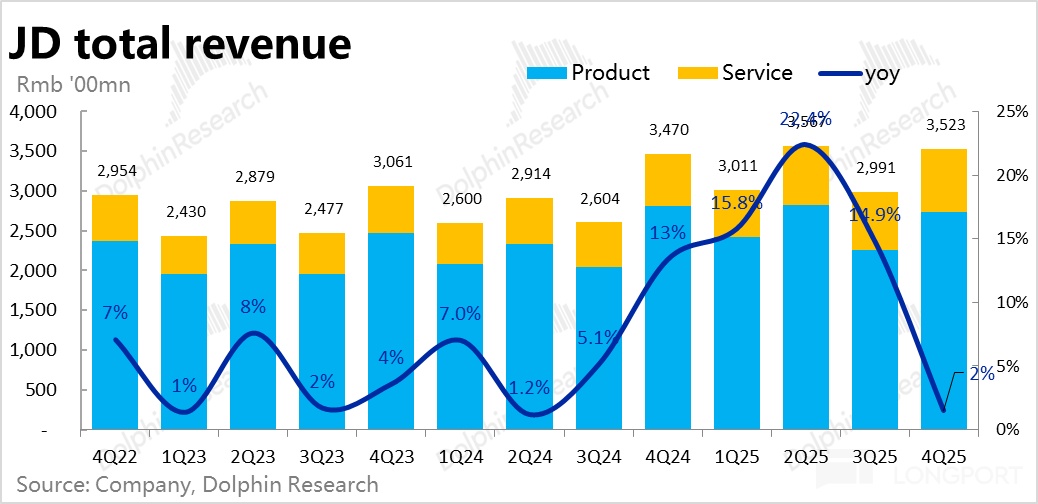
1) State subsidies faded, revenue growth collapsed: At the group level, Q4 revenue growth slowed sharply to +1.5% YoY. The sequential deceleration exceeded 13ppt. The key driver: JD was the largest beneficiary of state subsidies, which set a high base, and the rollback therefore hit it hardest.
That said, the print modestly beat Bloomberg consensus. The weak setup was well telegraphed.
2) Appliance & electronics were the biggest drag, other lines cushioned: Powered/goods (appliances, electronics, phones, etc.) swung to -12% YoY, becoming the main culprit of the top-line slowdown. Other sub-segments also softened due to weaker cross-sell from powered goods but proved more resilient, providing a buffer.
Specifically, general merchandise rose 12% YoY. Marketplace services from 3P merchants and logistics services grew 20% YoY, which was decent and broadly in line with sell-side expectations.
Worth noting, logistics-type revenue growth slowed by nearly 12ppt QoQ, the second largest decline after powered goods. This suggests take-rate/volume in on-demand delivery likely fell vs. the previous two quarters.
3) Larger losses than during the food-delivery war: Adj. operating loss was ~RMB 3.1 bn, marking the first loss since 2017, and it exceeded the losses seen during the peak investment quarters in food delivery (Q2–Q3). The market had anticipated this, and it was broadly in line with Bloomberg consensus. (On a GAAP basis, operating loss was much larger and missed due to ~RMB 1.6 bn one-off intangible amortization in the quarter.)
4) Mall margin fell, new biz cut losses less than hoped: By segment, the widened group loss reflected two factors. First, the core Mall, which hit record profits during the subsidy boom, saw margins fall as subsidies faded. Second, despite expectations for less food-delivery spending, new-biz losses narrowed less than expected.
Specifically, JD Mall operating profit was RMB 9.8 bn, down ~2.5% YoY. That is well below the RMB 13–15 bn per quarter seen in the first three quarters, but better than more bearish sell-side models.
The miss came from new biz, with a loss of RMB 14.8 bn vs. the market at RMB 13.8 bn, failing to show the expected step-down tied to lower food-delivery spend.
Either order volumes in on-demand/food delivery fell but subsidies stayed high to defend scale, or overseas/other new bets overshot plans. Watch for more color on the call.
5) Cost and opex lenses: By segment, despite the subsidy rollback, core-site GPM still improved (+110bps YoY), similar to last quarter’s lift. Margin pressure came from higher opex (self-funded consumer subsidies replacing state subsidies). The group shows a similar pattern: GPM up, but profit dragged by elevated expenses.
By opex line, fulfillment and marketing ratios rose notably, consistent with shipping subsidies from on-demand (and potentially higher traditional shipping costs) and company-funded subsidies replacing state support.
6) Generous shareholder returns, but sustainability in question: In FY25 the company repurchased about $3.0 bn of stock and fully cancelled it, equal to ~6% of shares outstanding at end-2024. It also declared FY25 dividends of about $2.0 bn, taking dividends + buybacks to ~13.8% of pre-earnings market cap, which is notably generous.
However, FY25 FCF was only RMB 17.3 bn, below the sum of buybacks and dividends. With core-site profits likely down YoY in FY26 and if new biz remains deeply loss-making, sustaining repurchases at this pace is uncertain.
Dolphin Research view:
1) On current-quarter performance, both trend and absolute metrics were weak. As subsidies faded, revenue growth collapsed from mid-teens to just 1%, effectively flat.
Profit also fell as the Mall, which had delivered record margins and cash generation, lost its subsidy tailwind. Meanwhile, the company did not pull back, continuing to invest in on-demand, overseas, and lower-tier expansion, which limited new-biz loss reduction.
The result was the first adj. operating loss since 2017, underscoring the severity.
2) Underlying business trends and logic
1) In the core Mall, given subsidy rollback and the high base from Q4-24 to H2-25, powered goods sales will likely keep declining visibly in H1-26 (home appliances led the weakness this quarter; phones could turn into a drag next year).
At the same time, with more self-funded subsidies and de-leverage on lower sales, Mall profit likely peaked in FY25 and could still fall YoY in FY26. Directionally negative.
Potential offsets: a) general merchandise and 3P were less affected by subsidy rollback and could stay solid or even strengthen in 2026, cushioning powered-goods weakness. b) With consumption stimulus as a policy focus, new subsidy rounds could follow quickly and even exceed last year’s, limiting the downside in powered goods.
These are not the base case today, but the surprise risk is there.
2) Another key logic: as core-site profitability normalizes post-boom, how will the company adjust its stance on new-biz spend and losses?
Based on this print, near-term the company seems inclined to keep investing. While it has largely stopped promoting food delivery and order volumes likely fell vs. prior quarters, the loss reduction appears modest so far.
The company also stated in the release a FY26 goal to double its market share in instant retail (covering food, non-food and 7Fresh). That implies continued scale investment, even if below FY25 levels.
Separately, as noted last quarter, JD revived the Jingxi brand to push white-label and lower-tier penetration, and highlighted a '100-Billion Supermarket' channel with a 3-year plan to invest RMB 20 bn.
Overseas moves are even more active. Reports suggest the JoyBuy biz in Europe is entering an investment phase, including user acquisition and logistics buildout.
As a result, while new-biz losses could narrow vs. FY25, the absolute loss may still be several to ten-plus billions per quarter. For reference, JP Morgan previously modeled new-biz losses shrinking from RMB 46 bn in FY25 to RMB 39 bn in FY26.
Whether that reduction is achievable is now less certain. This leaves the company in a narrative of weakening core cash generation while new businesses continue to bleed.
3) On valuation, we look at two lenses: a floor under a bearish case, and a reasonable value under a neutral case.
Conservative case: take group profits including new-biz losses. Assume no major subsidy relay in FY26, leading to negative powered-goods growth, and de-leverage driving lower Mall margin and a small decline in Mall profit (low single-digit %).
For new biz (food delivery, Jingxi + overseas), assume smaller absolute losses in food delivery but larger overseas investment & losses. In total, model RMB 40 bn in new-biz losses in FY26.
Group net profit would be ~RMB 20+ bn (no add-back for SBC or other items). Versus a sub-RMB 250 bn pre-earnings market cap, that implies ~12–13x, not cheap. On this strict basis, there is room to de-rate further toward ~10x.
However, the market rarely values this strictly. Given new-biz spend is discretionary and can be dialed back, a neutral view would anchor on core Mall OP, which implies ~6x PE at the current cap.
Also, shareholder returns are attractive, with buybacks + dividends at ~14% of market cap, which supports the floor. Overall, JD sits in a trough on both trend and valuation, with two potential repair levers: 1) a stronger-than-expected new subsidy wave in FY26 to stabilize powered goods and Mall profit; 2) a pivot away from aggressive new-biz expansion, delivering a sharper loss reduction.
The first depends on policy and is uncertain. The second is within the company’s control and not low probability. If it happens, multiple on core profits could re-rate from ~6x to ~8–10x.
Detailed takeaways this quarter:
I. Subsidy payback arrived as expected, self-run retail turned negative
1) Self-run retail revenue was RMB 226.1 bn, down 2.5% YoY, lagging online physical retail growth of ~+3% in Oct–Nov. The reason: subsidy rollback and a high base drove a notable decline in powered goods, especially home appliances. As a prior top beneficiary, JD is now taking the biggest hit.
The good news: this was well anticipated and digested by the market, and the print largely matched expected growth.
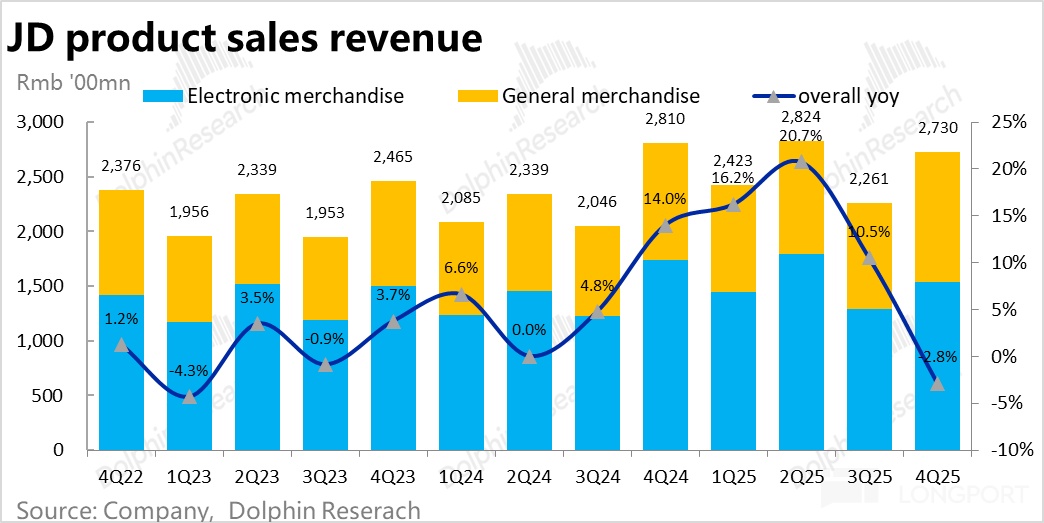
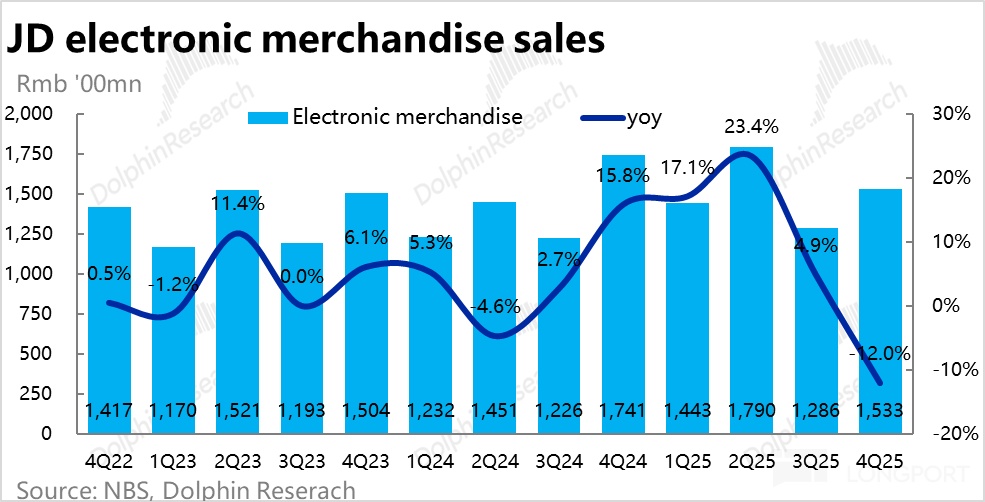
Diving deeper, powered-goods revenue fell 12% YoY, a deep decline but broadly in line with expectations. NBS data show large-scale home-appliance sales down 14–19% YoY in Oct–Nov, while phones and other comms devices stayed in peak season with 20%+ YoY growth, cushioning appliances.
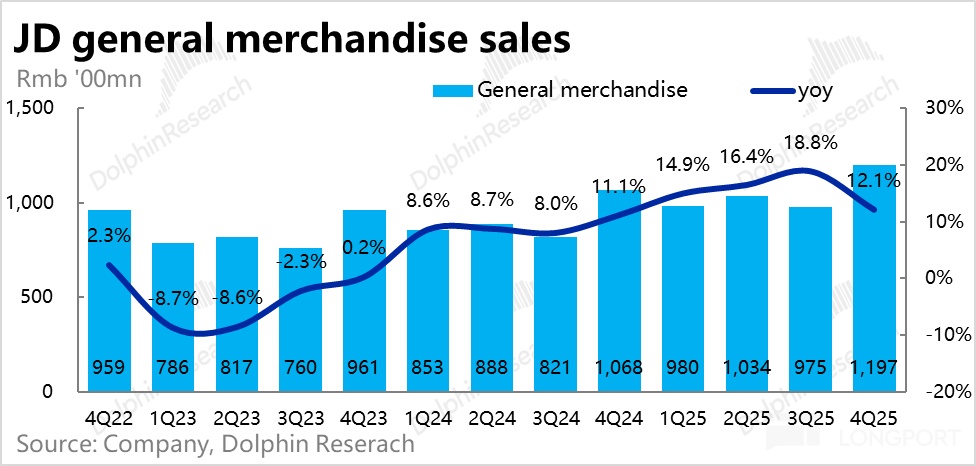
By contrast, supported by supermarkets and apparel (JD Mall opened ~6 more stores QoQ; brands on JD Fashion exceeded 1,000), general merchandise grew nearly 12% YoY. It slowed somewhat (higher base and weaker traffic from powered goods) but still delivered double-digit growth.
2) Services slowed but proved sturdier: Service revenue also cushioned the top line. Commission and ads rose 15% YoY, though growth slowed QoQ due to softer platform traffic (dragged by self-run).
In magnitude, self-run growth decelerated by nearly 14ppt QoQ, while commission & ads slowed by less than 9ppt. This indicates JD’s 3P ecosystem and monetization are still improving at the margin.
Logistics-type revenue, including JD Logistics and on-demand delivery, grew nearly 24% YoY, down meaningfully from ~35% at peak food-delivery investment, implying volumes in on-demand/delivery softened QoQ.
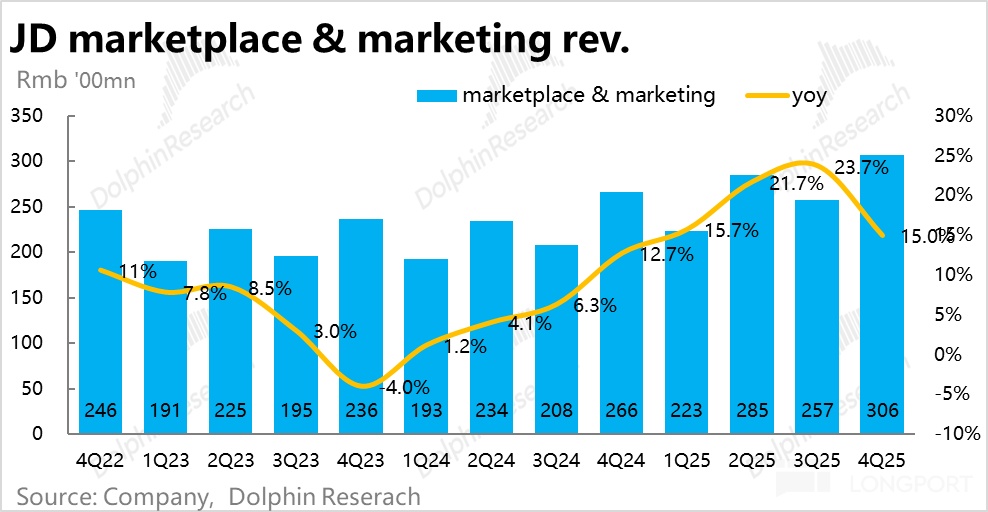
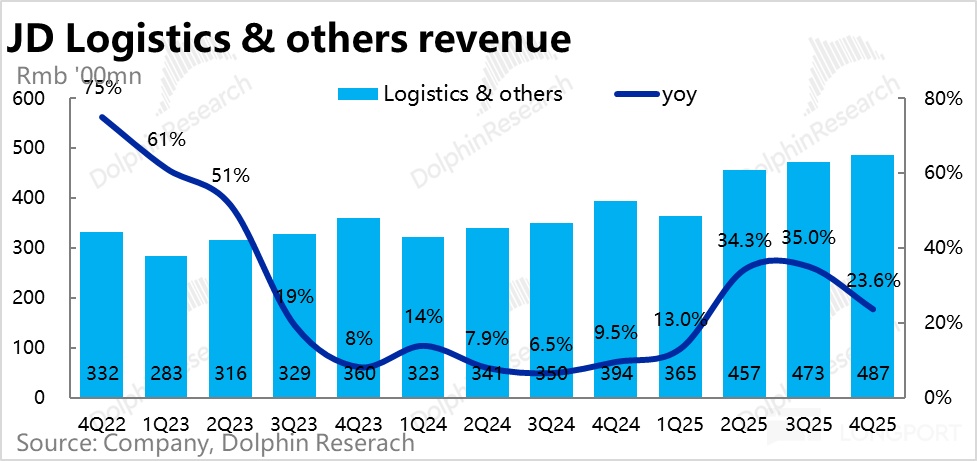
Overall, with both subsidy- and delivery-driven traffic fading, total revenue growth plunged from 15% last quarter to just 1.5%. Mix-wise, general merchandise, 3P, and logistics delivered decent growth to offset the sharp decline in powered goods, keeping the total barely positive and in line with consensus.
II. Mall margin fell as expected, new-biz losses didn’t narrow as hoped
From a segment lens:
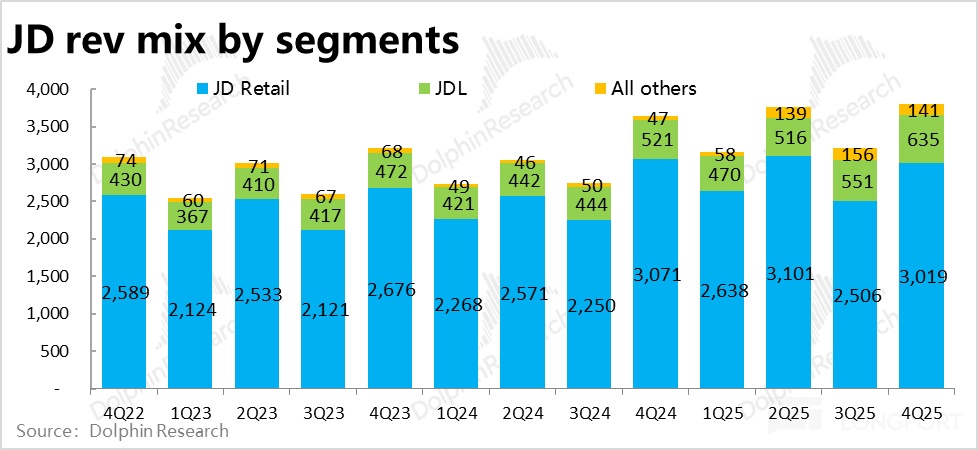
1) The core JD Mall revenue growth turned negative to -1.7% YoY due to powered-goods drag, but it was slightly better than Bloomberg consensus.
2) JD Logistics (JDL) revenue grew 21% YoY, a modest slowdown but still solid. Per JDL’s own release, growth was driven by intra-group on-demand (JDL acquired Dada’s on-demand business in Q4), while revenue from external customers was flattish.
3) New biz, including food delivery, posted RMB 14.1 bn revenue vs. RMB 15.6 bn last quarter, a mild miss. This likely reflects lower scale and revenue contribution from food delivery/on-demand.
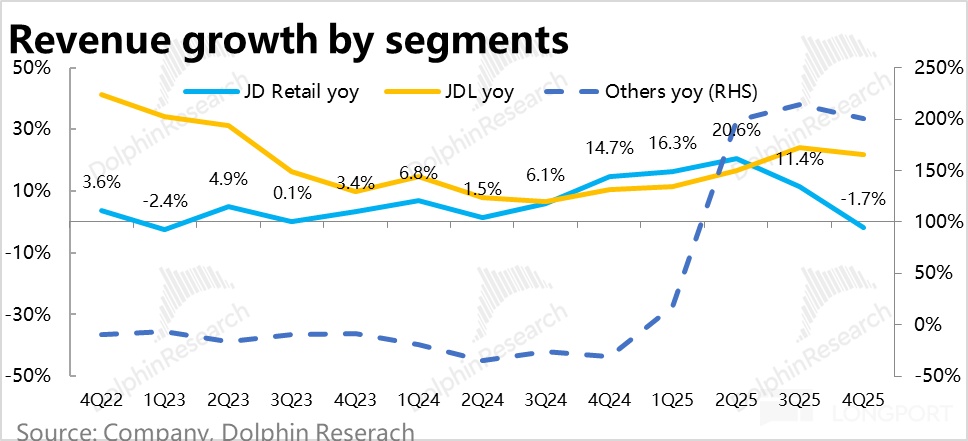
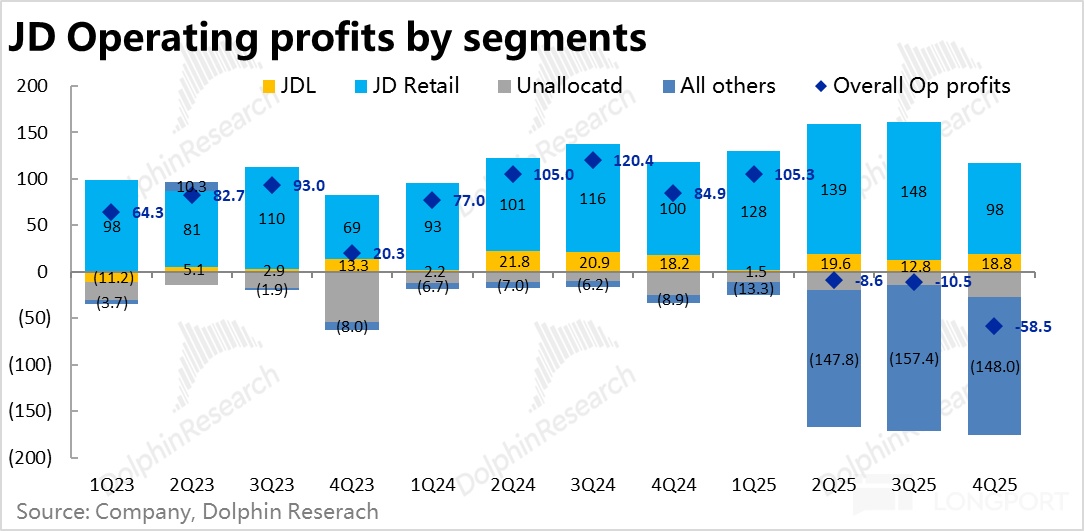
On profit, group GAAP operating loss hit RMB 5.85 bn, worse than the Q2–Q3 peak food-delivery investment period. The core reason: Mall margins fell as subsidy benefits faded from prior record levels, while new-biz losses remained elevated.
By segment:
1) JD Mall OP was RMB 9.8 bn, down ~2.5% YoY and well below the RMB 13–15 bn per quarter seen in 1–3Q, but above Bloomberg’s RMB 7.8 bn. Not as bad as feared.
2) JDL OP also missed slightly, with profit up only 3% YoY despite solid revenue growth, dragged by on-demand/food delivery subsidies and lower margins.
3) The biggest profit miss was new biz, with a RMB 14.8 bn loss vs. RMB 13.8 bn expected. Pre-print, the street looked for a sharper narrowing on lower delivery spend and better UE, but the loss only narrowed by <1 bn QoQ.
Either on-demand kept subsidies high to defend orders, or overseas/other new bets overshot plans. More clarity is needed from management.

III. GPM kept rising, opex ratio worsened — a mix/recognition story
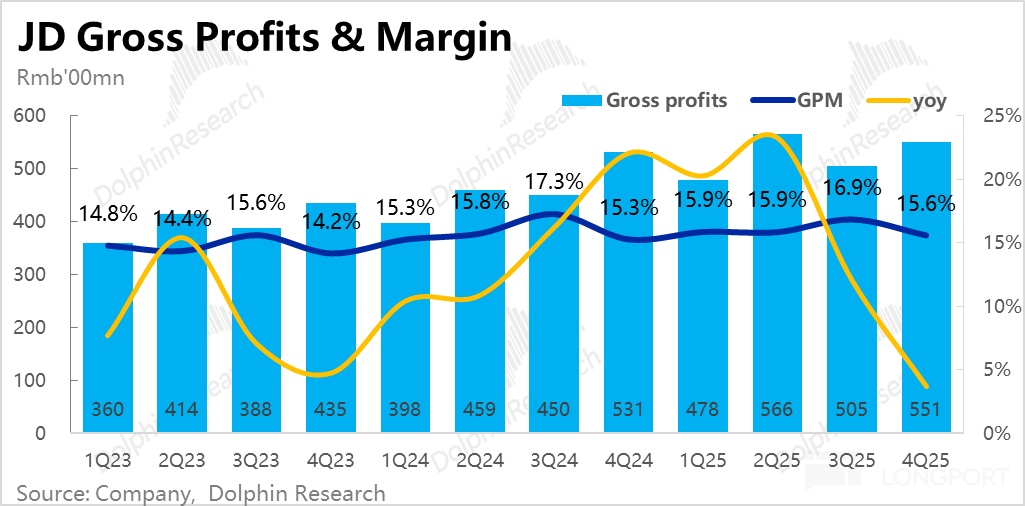
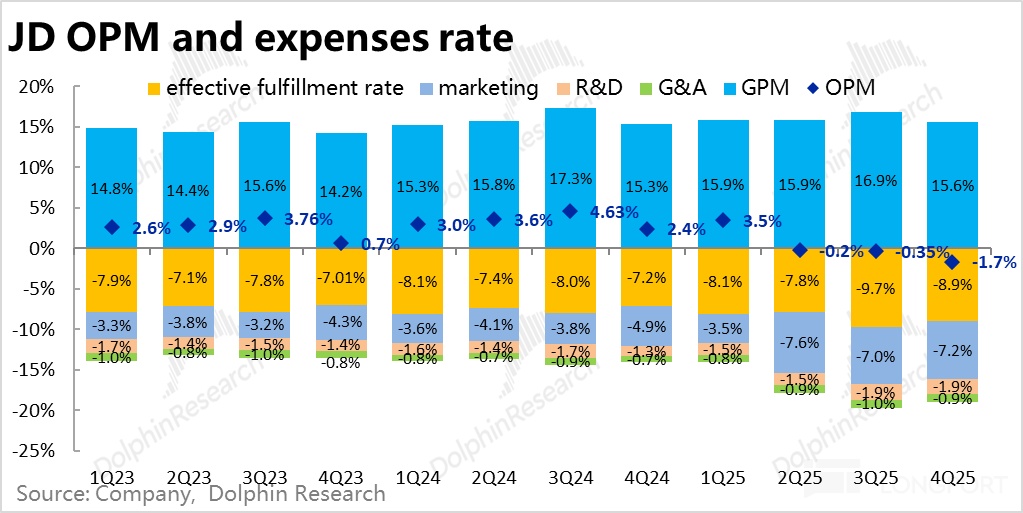
On costs and expenses, group GPM rose to 16.9%, up 30bps YoY, which was a bit surprising. On closer look, more spending was recognized as opex instead.
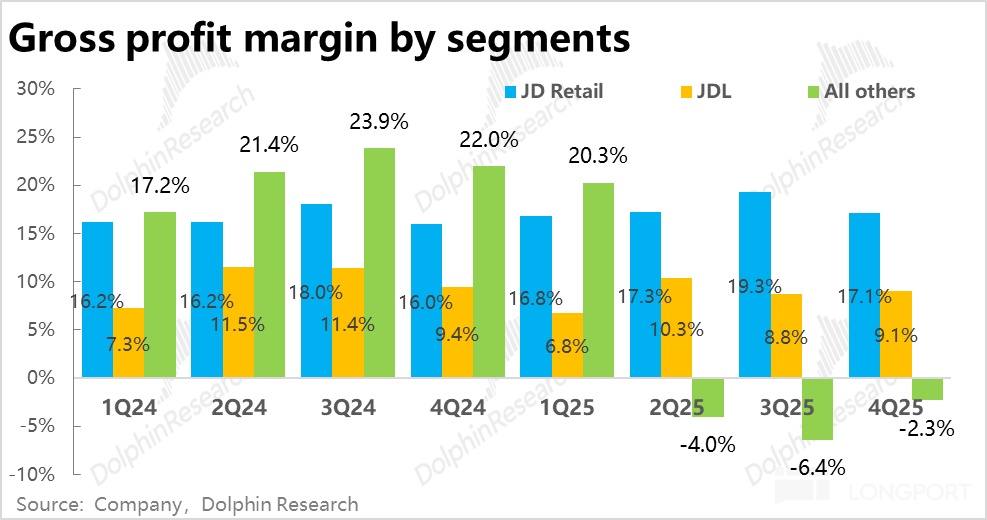
By segment, core-site GPM still rose +110bps YoY despite subsidy rollback, similar to last quarter. The Mall margin decline was driven by higher expenses (self-funded subsidies replacing state subsidies).
Another factor: new-biz GPM improved from -6.4% to 2.3% QoQ. This also reflects shifting more spending into opex, with limited substantive difference in underlying economics.
On opex, by segment first:
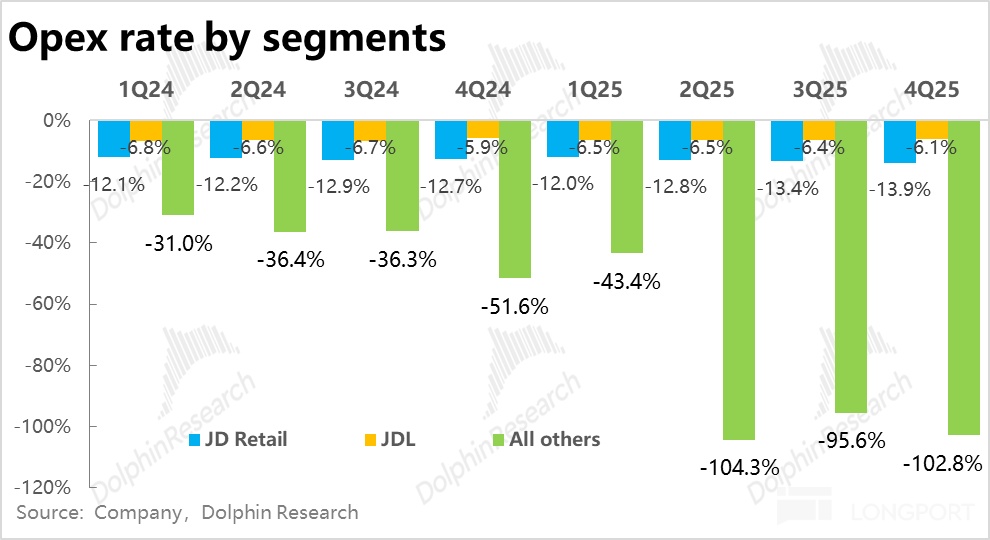
1) JD Mall opex ratio was 13.9%, up 120bps YoY and above the increase in GPM, hence a slight decline in OPM.
2) For new biz, as noted, GPM improved QoQ, but the expense ratio rose from 96% to 103%, so the operating loss margin actually widened QoQ.
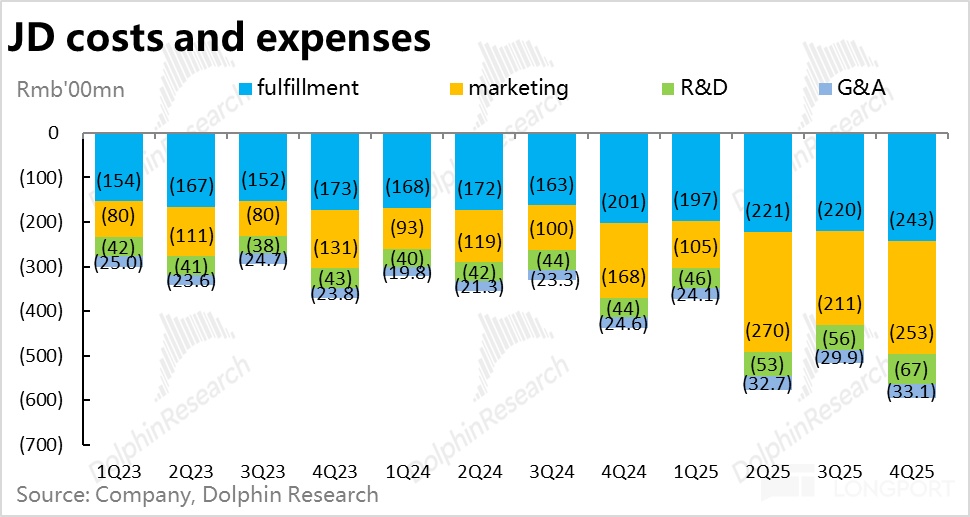
By expense type, group opex totaled RMB 60.9 bn, +36.5% YoY. While growth slowed vs. Q2–Q3, revenue growth slowed even more, lifting the opex ratio by ~10bps QoQ.
Fulfillment and marketing ratios rose notably, consistent with shipping subsidies in on-demand and company-funded subsidies replacing state support.
R&D also spiked abnormally, likely due to ~RMB 1.6 bn intangible amortization recognized this quarter.
For the same reason, adj. operating loss was ~RMB 3.1 bn, roughly in line with market expectations. GAAP operating loss was RMB 5.85 bn, ~RMB 1.7 bn worse than expected, largely due to the one-off amortization.
Prior Dolphin Research on [JD]:
Earnings reviews
Nov 14, 2025 review 'JD: even without state subsidies, still attacking on many fronts'
Nov 14, 2025 transcript 'JD (Trans): food delivery to break even, overseas to invest prudently long term'
Aug 14, 2025 review 'JD: RMB 10 bn profit wiped out in one click — how long can the delivery dream last?'
Aug 14, 2025 transcript 'JD (Trans): food delivery is a 10-year strategy, synergies emerging'
May 13, 2025 review 'State subsidies propped up the show — can JD hold its head high again?'
May 13, 2025 transcript 'JD (Trans): food-delivery UE hard to judge, buyback Avg. price $37'
Mar 6, 2025 review 'Subsidies lifted JD out of the hole'
Mar 6, 2025 transcript 'JD (Trans): powered-goods growth front-half strong then fades; general goods strong all year'
Nov 14, 2024 review 'JD: subsidies likely to extend into next year (3Q24 call notes)'
Nov 14, 2024 transcript 'Back to life on state subsidies — is JD being revived?'
Aug 16, 2024 review 'JD’s comeback? Not so fast'
Aug 16, 2024 transcript 'JD: can the profit beat sustain and how is competition shifting?'
Deep dives
Jun 18, 2025 'JD’s big bet on delivery: desperate move or well-crafted plan?'
Jun 19, 2025 'JD, Alibaba and Meituan all-in — is food delivery the endgame for e-comm?'
Apr 14, 2023 'On the operating table — does JD still have value?'
Apr 22, 2022 'Meituan and JD — why do they outperform amid share wars?'
Risk disclosure and disclaimer: Dolphin Research disclaimer and general disclosure
Recommended Articles








Comments (0)
Click the $ button, enter the symbol, and select to link a stock, ETF, or other ticker.