US STOCKS-Wall St set for lower open as investors weigh Middle East war risks

By Johann M Cherian and Ragini Mathur
March 5 (Reuters) - Wall Street's main indexes were on track to open lower on Thursday as the Middle East conflict entered its sixth day, raising concerns of fresh inflation pressures that could complicate the Federal Reserve's monetary policy decisions.
Helping limit the losses was a strong forecast from Broadcom
Despite the U.S.-Israeli air war against Iran showing no signs of cooling off, Wall Street's main indexes have fared better than their European and Asian counterparts this week, aided primarily by a rebound in technology stocks that bore the brunt of February's selloff.
The tech-led recovery in the prior session helped the Nasdaq recover all weekly losses, putting it on track to close the week in positive territory if those gains hold through Friday.
Still, a prolonged disruption in shipping through the strategic Strait of Hormuz is likely to further fuel inflation pressures through energy and shipping costs, at a time when U.S. tariffs have already complicated the Fed's monetary policy outlook.
Any signs that crude prices could hit $100 a barrel would be worrisome for markets and investors were on the lookout for reports that the conflict could be nearing its end.
Policymakers have broadly acknowledged the need to wait and gauge the impact on the economy, although investors are anticipating price pressures to delay a 25-basis-point interest rate cut by the Federal Reserve to September from July, according to LSEG-compiled data.
"For the past couple of years, bringing inflation down has been the Fed's entire focus, and they were finally making progress. But if energy stays expensive, inflation could start climbing again and that would force the Fed to rethink its plans," said Adam Sarhan, chief executive of 50 Park Investments.
At 08:43 a.m. ET, Dow E-minis YMcv1 were down 283 points, or 0.58%, S&P 500 E-minis EScv1 were down 22.25 points, or 0.32%, and Nasdaq 100 E-minis NQcv1 were down 103.25 points, or 0.41%.
The CBOE volatility index .VIX was up 0.95 points at 22.1, reflecting broader investor caution, while futures tied to the rate-sensitive Russell 2000 index RTYcv1 were down 0.9%.
Travel stocks that are the most sensitive to energy prices were down. Delta Airlines AAL.O slipped 1.1%, while Norwegian Cruise NCLH.N dipped 0.6%.
A prolonged conflict could also disrupt supplies of key semiconductor manufacturing materials and impede data center deployment by AI leaders in the Middle East. Chip stocks were mixed, with Nvidia NVDA.O down 0.7%, while Marvell Technology MRVL.O rose 1.4%.
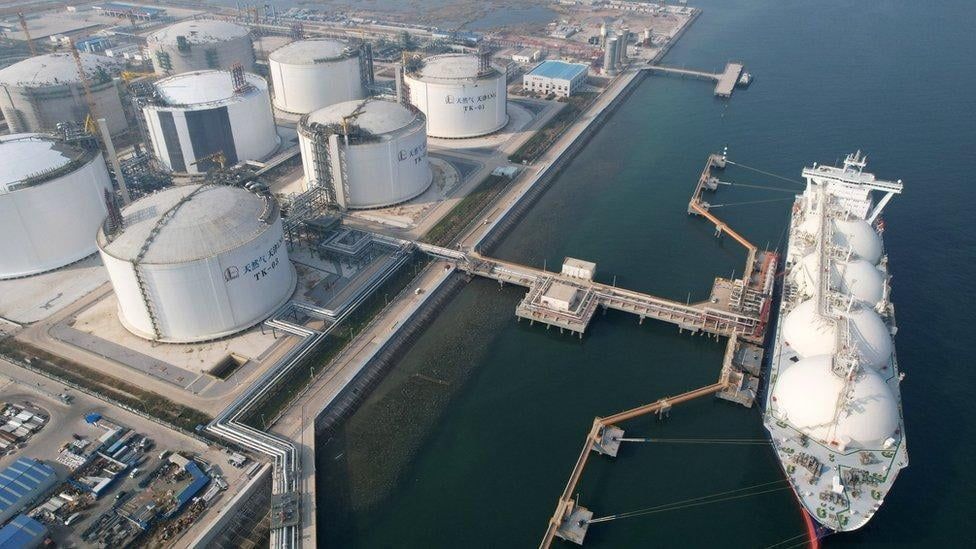
Energy companies such as Cheniere Energy LNG.N and Valero Energy VLO.N were up about 1%, while defense stocks such as RTX RTX.N and Aerovironment AVAV.O added 0.6% and 1.8%, respectively.
Among others, Trade Desk TTD.O jumped 21% after a report that OpenAI held early talks with the advertising technology firm to sell ads.
Supermarket chain operator Kroger KR.N fell 2.7% after forecasting annual sales and profit largely below estimates.
Meanwhile, data showed the number of Americans filing new applications for unemployment benefits was unchanged last week. Fresh Fed remarks from U.S. Fed Vice Chair Michelle Bowman are due later in the day, ahead of the crucial non-farm payrolls report on Friday.