


Banco Bilbao Vizcaya Argentaria SA Stock Moved Down by 6.21% on Mar 3: Drivers Behind the Movement



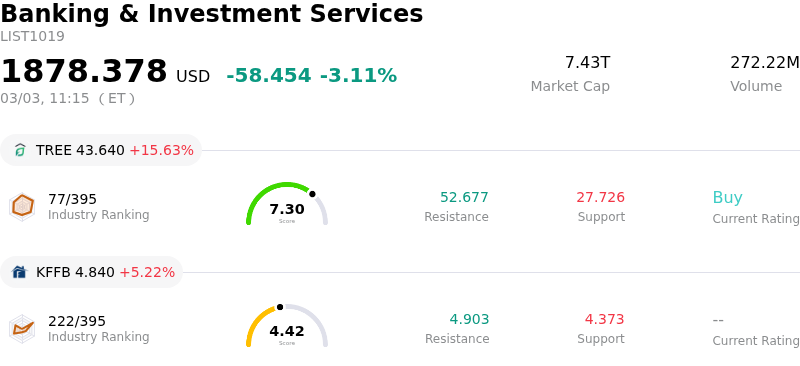
Banco Bilbao Vizcaya Argentaria SA (BBVA) moved down by 6.21%. The Banking & Investment Services industry is down by 3.11%. The company underperformed the industry. Top 3 gainers of the industry: Lendingtree Inc (TREE) up 15.63%; Kentucky First Federal Bancorp (KFFB) up 5.22%; Lion Group Holding Ltd (LGHL) up 5.08%.
BBVA's stock experienced a significant intraday decline, influenced by a combination of macroeconomic concerns, geopolitical tensions, and company-specific factors that have recently led to increased investor caution.
Global market sentiment on the current date, March 3, 2026, is under pressure from geopolitical tensions, specifically a reported operation involving the US and Israel against Iran. This has resulted in a risk-off environment across global stock markets, including major indices like the S&P500 and DAX, contributing to downward pressure on individual stocks such as BBVA. Additionally, broader macroeconomic concerns, including persistent inflation and weaker-than-expected US GDP growth, have further amplified market unease.
While BBVA announced nearing completion of the first tranche of a €1.25 billion share buyback program, typically a positive signal for shareholder returns and capital optimization, this news appears to have been overshadowed by the broader market anxieties and other specific concerns. Analyst reports have previously suggested that BBVA's shares were trading at a "full-ish" valuation compared to European peers, leading some analysts to downgrade their ratings and favor rivals due to limited upside potential.
Concerns over BBVA's financial health also stem from its fourth-quarter 2025 results, released earlier in February. Despite reporting record profits for 2025, the stock previously declined due to lower-than-expected capital levels, higher operating costs, and a cautious outlook provided by management for 2026. Specifically, the common equity Tier 1 ratio dropped below market expectations, and operating expenses increased sharply, driven by variable employee compensation and technology spending. The outlook for 2026 was described as "conservative" by analysts, particularly regarding revenue growth, costs, and cost of risk in its key markets of Spain and Mexico.
Furthermore, there has been a notable increase in short interest in BBVA during February, suggesting that a growing number of investors are betting against the stock. This increase in short selling can exert additional downward pressure on the stock price. The European banking sector overall is navigating a complex regulatory landscape in 2026, with a focus on implementing and simplifying existing rules rather than developing significant new initiatives, particularly in Europe which is pursuing a competitiveness-driven strategy. However, divergence in regulatory approaches between Europe and the US, and ongoing discussions around capital requirements, also contribute to market uncertainty in the banking sector.
Technically, Banco Bilbao Vizcaya Argentaria SA (BBVA) shows a MACD (12,26,9) value of [-0.18], indicating a sell signal. The RSI at 36.70 suggests neutral condition and the Williams %R at -91.42 suggests oversold condition. Please monitor closely.
Banco Bilbao Vizcaya Argentaria SA (BBVA) is in the Banking & Investment Services industry. Its latest annual revenue is 44.16B, ranking 11 in the industry. The net profit is 11.40B, ranking 9 in the industry. Company Profile
Over the past month, multiple analysts have rated the company as STRONG BUY, with an average price target of 28.56, a high of 28.56, and a low of 28.56.
Company Specific Risks:
- Recent analyst downgrades and "full-ish" valuation concerns are impacting investor sentiment, shifting preference towards rival banks and limiting perceived upside potential.
- Fourth-quarter results, despite record profits, revealed lower-than-expected capital levels and higher operating costs, leading to investor unease and a significant stock price decline.
- Management's notably cautious outlook provided for 2026 is contributing to investor uncertainty regarding future growth and profitability.
- Disappointing performance from BBVA's Turkish unit, characterized by weakening credit quality, sharply increased provisioning charges, and rising non-performing loans, negatively impacted consolidated earnings.
This article may include AI-generated content that is human-reviewed, which is for reference and general information purposes only and does not constitute investment advice.
Recommended Articles









Comments (0)
Click the $ button, enter the symbol, and select to link a stock, ETF, or other ticker.