Will Micron Technology Stock Split?

Key Points
Micron Technology stock has outperformed Nvidia, AMD, Broadcom, and Taiwan Semi over the past 12 months.
Its sales have soared as hyperscale infrastructure budgets become more inclusive of memory and storage chips.
Given Micron's elevated share price -- up over 600% -- some investors may perceive the stock as expensive now.
What if I told you there is an artificial intelligence (AI) semiconductor stock that has handily outperformed Nvidia, Advanced Micro Devices, Broadcom, and Taiwan Semiconductor Manufacturing over the last year?
Shares of memory and storage chip specialist Micron Technology (NASDAQ: MU) have blasted 290% in just the past 12 months -- making it one of the premier technology stocks in the Nasdaq-100 index. Zooming out even further, Micron stock has soared more than 600% throughout the entire AI revolution.
Will AI create the world's first trillionaire? Our team just released a report on the one little-known company, called an "Indispensable Monopoly" providing the critical technology Nvidia and Intel both need. Continue »
With so much momentum behind it, could Micron stock be set up for a split? Let's dig into the mechanics of how stock splits work and assess why Micron could be a good candidate right now.

Image source: Micron Technology.
How do stock splits work?
"Stock split" is a financial term that sounds complicated, but in reality understanding this concept is quite easy. The first component of a stock split that investors need to understand is the underlying ratio. For example, a company may announce that it's going to complete a 10-for-1 split.
From there, it's important to understand how this ratio impacts a company's stock price and outstanding share count. Let's assume that a stock is trading for $1,000 per share and has 1 million shares outstanding. Under these conditions, the company's market value is $1 billion.
In a 10-for-1 split, the stock price would be reduced by a factor of 10 while the share count would rise by that same multiple. In this case, the split-adjusted share price would fall to $100 while the number of outstanding shares would increase to 10 million.
Do you see what happened here? The market value of the company remains the same. The big takeaway to understand is that stock splits do not change the underlying valuation of a company.

Image source: Getty Images.
Why do companies engage in stock splits?
If stock splits do not change the value of the company, then why do businesses even bother with them? Usually, it boils down to investor psychology. While this way of thinking is not entirely correct, many investors perceive a company's worth purely through the lens of its stock price. In other words, if a stock trades for $1,000 per share it's generally seen as "expensive" while a $10 stock is viewed as "cheap."
If a company has experienced an abnormally high return in an otherwise short time frame, like Micron has, investors may start to think they've missed their chance as the stock has gotten pricey. Again, from a valuation perspective, this is not always the case.
Nevertheless, management understands these psychological dynamics. And if a stock's trading volume is thinning or retail investor ownership is decelerating, a company may choose to split its stock in hopes of broadening its investor profile by making shares more accessible.
Will Micron split its stock in 2026?
So far in the AI revolution, two of Micron's chip peers, Nvidia and Broadcom, have engaged in stock splits. In the graph below, these respective splits are annotated by the colored circles with the letter "S" in the middle. Per the trends illustrated, both Nvidia and Broadcom stocks have witnessed meaningful gains since their stock splits.
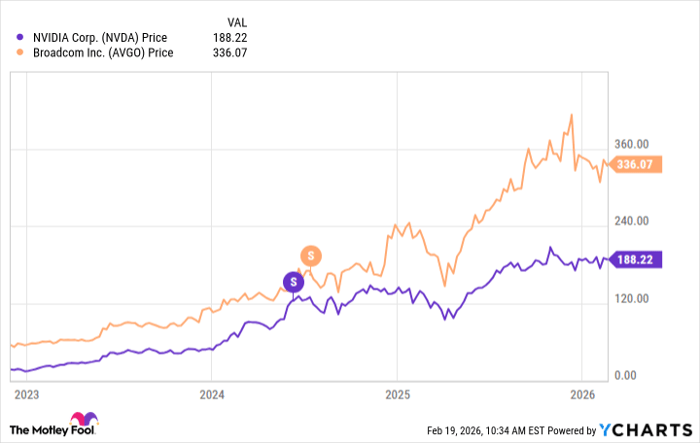
With that said, investors should keep in mind one point above all else: Stock splits don't do much to change a company's underlying operation. In other words, Micron doesn't gain much should it choose to split its stock. Moreover, given stock splits do not change the valuation profile of a company, investors shouldn't worry about buying Micron stock at $400 today or a perceived "lower" price in the future.
Given accelerating AI infrastructure investment from major hyperscalers, Micron's growth prospects should remain robust over the next several years. For these reasons, I see Micron as a compelling stock to buy and hold throughout the AI infrastructure boom -- regardless of whether a split is on the horizon or not.
Should you buy stock in Micron Technology right now?
Before you buy stock in Micron Technology, consider this:
The Motley Fool Stock Advisor analyst team just identified what they believe are the 10 best stocks for investors to buy now… and Micron Technology wasn’t one of them. The 10 stocks that made the cut could produce monster returns in the coming years.
Consider when Netflix made this list on December 17, 2004... if you invested $1,000 at the time of our recommendation, you’d have $409,970!* Or when Nvidia made this list on April 15, 2005... if you invested $1,000 at the time of our recommendation, you’d have $1,174,241!*
Now, it’s worth noting Stock Advisor’s total average return is 889% — a market-crushing outperformance compared to 192% for the S&P 500. Don't miss the latest top 10 list, available with Stock Advisor, and join an investing community built by individual investors for individual investors.
*Stock Advisor returns as of February 24, 2026.
Adam Spatacco has positions in Nvidia. The Motley Fool has positions in and recommends Advanced Micro Devices, Micron Technology, Nvidia, and Taiwan Semiconductor Manufacturing. The Motley Fool recommends Broadcom. The Motley Fool has a disclosure policy.
Related Articles
Nvidia Q4 Earnings Preview: AI-Driven Growth Versus Market Expectations
TradingKey - NVIDIA (NVDA) is set to release its fourth quarter fiscal year 2026 earnings report after the market close on February 25, ET. As the world undergoes a period of rapid AI technological advancement, market debates over a capital expenditure bubble have intensified. In this context, NVIDIA’s results serve not only as a test of its business performance but also as a core bellwether for the sustainability of the global AI boom.
Tesla Stock Outlook: Why 2026 Could Be the Year of the Tesla Robotaxi
TradingKey - The concept of autonomous mobility for Tesla(TSLA) has gone from a projection of the far away future to a vital part of its overall long-term growth strategy.
International Copper Prices Rise for 7 Straight Months; Will Bull Market Continue in 2026?
TradingKey - As the "king of industrial metals," every fluctuation in international copper prices impacts the nerves of global investors. In early 2026, international copper prices continued to rise, extending the upward trend from 2025 and reaching a new high above $14,500, marking seven consecutive months of gains. Meanwhile, London Metal Exchange (LME) copper prices have climbed from $7,800 per tonne in July 2025 to over $9,000 per tonne today.
Is SaaS Dead? The Truth Behind the Software Meltdown, the Missing Floor, and the Peak That’s Not Coming Back
TradingKey - A trillion dollars just vanished from software stocks—this piece breaks down who AI is really killing, who quietly benefits, and why cheap SaaS may be the biggest value trap of this cycle.