This AI Stock Is a Money-Making Machine

Key Points
Advances in artificial intelligence are moving at light speed.
Without the semiconductor chips to make high-performance computing equipment capable of running AI models, many well-known players in the industry would be stuck.
The leverage that this maker of semiconductor manufacturing equipment has is an essential part of how it has been so successful.
There's always a story behind the story. For every successful entrepreneur, there were countless rank-and-file employees who were critical in realizing a company's full potential. And for every business at the forefront of a hot new trend, there are many other businesses that are content to remain largely behind the scenes, doing their job and contributing their part toward an industry's success.
Taiwan Semiconductor Manufacturing (NYSE: TSM) hasn't gotten quite the same amount of attention that other players in the AI stock world have received. Nevertheless, without Taiwan Semi's chip manufacturing equipment, a host of better-known tech giants would be stuck with greatly inferior processes for making the semiconductors they need. In this second article in the three-part series on Taiwan Semi for the Voyager Portfolio, you'll see just how much the tech company's vital machinery has allowed it to turn its work into cold, hard cash.
Will AI create the world's first trillionaire? Our team just released a report on the one little-known company, called an "Indispensable Monopoly" providing the critical technology Nvidia and Intel both need. Continue »
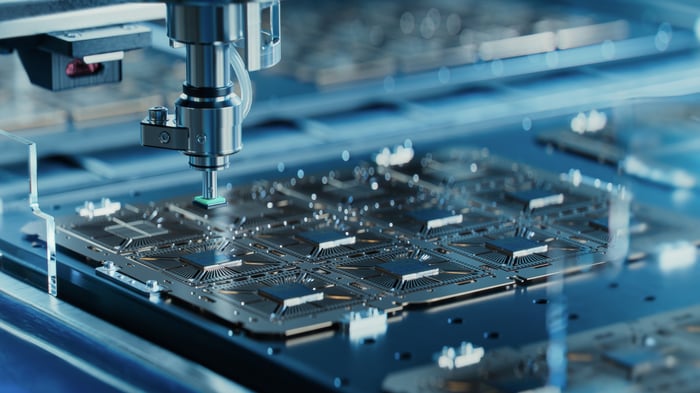
Image source: Getty Images.
What Taiwan Semi has accomplished
The past decade has been a strong one for technology companies. Because of its relationships with both giants of the field and up-and-coming chip design businesses, Taiwan Semi has been able to reap the financial rewards from rising interest in semiconductors.
Since 2015, Taiwan Semi has grown its revenue by more than 350%. In particular, large gains in sales at the beginning of the COVID-19 pandemic in 2020 got things rolling for the company, and AI demand powered further top-line increases for the semiconductor equipment maker.
But the more important story for shareholders has come from Taiwan Semi's discipline in controlling costs. Efficient manufacturing processes minimize Taiwan Semi's expenses related to production, which has resulted in gross profit jumping over 460%. Gross margin has expanded from less than 49% 10 years ago to nearly 60% today.
Also, keeping operating expenses in check has helped Taiwan Semi thrive. The company hasn't skimped on research and development activities, but it's been careful with its overhead. As a result, operating income has climbed more than seven times, and operating margin has climbed almost 13 percentage points to 50.8%. Earnings have followed a similar trajectory, as a greater than nine percentage point increase in net margin has helped net income climb almost 475% over the decade.
All of these factors have contributed to Taiwan Semi's impressive performance. Return on equity jumped more than five percentage points during 2025 to 35.4%. The company paid out 29% more in dividend distributions to shareholders than it did in 2024. Yet it also strengthened its balance sheet, increasing its cash and marketable securities position by 27%.
Where has Taiwan Semi's growth come from?
A look at Taiwan Semi's fourth-quarter financial report reveals that the company is enjoying favorable trends beyond just artificial intelligence. To be clear, AI drives much of the demand for high-performance computing chips, and that area was the biggest contributor to Taiwan Semi's growth, rising 48% and constituting 58% of total revenue for the company.
However, other areas were also strong. Growth in chips for the automotive sector jumped 34%. Internet of things applications saw a 15% rise. And the important smartphone market, which represents almost 30% of Taiwan Semi's total sales, enjoyed a more modest but still significant gain of 11% year over year.
What Taiwan Semi needs to keep soaring
The net result of Taiwan Semi's prowess in providing foundry services to chip design companies has been a soaring share price that has set new all-time highs countless times over the past year. Investors are extremely optimistic about Taiwan Semi stock's ability to keep up its momentum. To determine whether that optimism is justified, the third and final article on Taiwan Semi for the Voyager Portfolio will focus on the semiconductor equipment maker's prospects to keep expanding its business in 2026 and beyond.
Should you buy stock in Taiwan Semiconductor Manufacturing right now?
Before you buy stock in Taiwan Semiconductor Manufacturing, consider this:
The Motley Fool Stock Advisor analyst team just identified what they believe are the 10 best stocks for investors to buy now… and Taiwan Semiconductor Manufacturing wasn’t one of them. The 10 stocks that made the cut could produce monster returns in the coming years.
Consider when Netflix made this list on December 17, 2004... if you invested $1,000 at the time of our recommendation, you’d have $409,970!* Or when Nvidia made this list on April 15, 2005... if you invested $1,000 at the time of our recommendation, you’d have $1,174,241!*
Now, it’s worth noting Stock Advisor’s total average return is 889% — a market-crushing outperformance compared to 192% for the S&P 500. Don't miss the latest top 10 list, available with Stock Advisor, and join an investing community built by individual investors for individual investors.
*Stock Advisor returns as of February 24, 2026.
Dan Caplinger has no position in any of the stocks mentioned. The Motley Fool has positions in and recommends Taiwan Semiconductor Manufacturing. The Motley Fool has a disclosure policy.
Related Articles
Nvidia Q4 Earnings Preview: AI-Driven Growth Versus Market Expectations
TradingKey - NVIDIA (NVDA) is set to release its fourth quarter fiscal year 2026 earnings report after the market close on February 25, ET. As the world undergoes a period of rapid AI technological advancement, market debates over a capital expenditure bubble have intensified. In this context, NVIDIA’s results serve not only as a test of its business performance but also as a core bellwether for the sustainability of the global AI boom.
Tesla Stock Outlook: Why 2026 Could Be the Year of the Tesla Robotaxi
TradingKey - The concept of autonomous mobility for Tesla(TSLA) has gone from a projection of the far away future to a vital part of its overall long-term growth strategy.
International Copper Prices Rise for 7 Straight Months; Will Bull Market Continue in 2026?
TradingKey - As the "king of industrial metals," every fluctuation in international copper prices impacts the nerves of global investors. In early 2026, international copper prices continued to rise, extending the upward trend from 2025 and reaching a new high above $14,500, marking seven consecutive months of gains. Meanwhile, London Metal Exchange (LME) copper prices have climbed from $7,800 per tonne in July 2025 to over $9,000 per tonne today.
Is SaaS Dead? The Truth Behind the Software Meltdown, the Missing Floor, and the Peak That’s Not Coming Back
TradingKey - A trillion dollars just vanished from software stocks—this piece breaks down who AI is really killing, who quietly benefits, and why cheap SaaS may be the biggest value trap of this cycle.