Consumer Staples Just Got Expensive in a Way Not Seen in 25 Years. History Sends a Warning.

Key Points
Consumer staples stocks have gotten off to their best start to a calendar year this century in 2026.
But that means the sector is trading at a price-to-earnings multiple higher than it's been in nearly 30 years.
History says investors will want to prepare for an extended stretch of underperformance ahead.
Year to date (as of Feb. 18, 2026), the State Street Consumer Staples Select Sector SPDR ETF (NYSEMKT: XLP) is up just over 13%. That's the best start to a year this sector has had by far since it launched in late 1998.
Investors who have maintained diversification in their portfolio over the past three years are finally getting rewarded for their patience. But there's a growing concern from the sector having risen this far, this fast.
Will AI create the world's first trillionaire? Our team just released a report on the one little-known company, called an "Indispensable Monopoly" providing the critical technology Nvidia and Intel both need. Continue »

Source: Getty Images.
When the talk turns to market valuations, most people are talking about the tech sector or artificial intelligence (AI) stocks. And justifiably so. The State Street Technology Select Sector SPDR ETF is trading at about 27 times the next 12 month's earnings expectations, much above its long-term average.
But the rally seen in non-tech sectors is starting to raise valuation concerns there as well. After the recent rally in the consumer staples sector, it has a forward price-to-earnings (P/E) ratio of more than 23. That's the highest this sector has seen going back to just before the tech bubble burst.
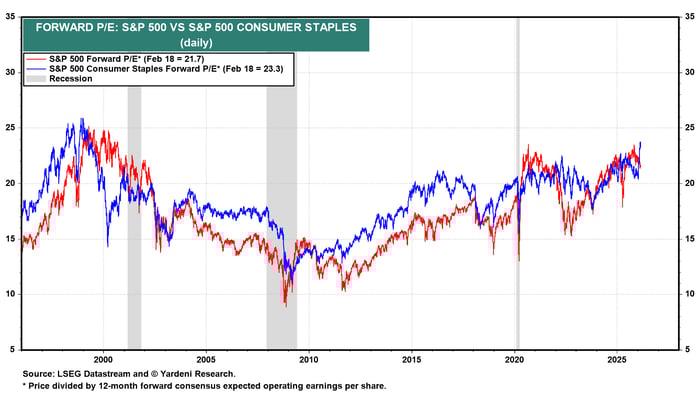
Source: Yardeni Research.
Valuations could contract
A high valuation is probably more concerning for this sector than it is for tech. Stocks with high growth rates, like those seen with the Magnificent 7 stocks, can justify higher valuations. Consumer staples, on the other hand, constitute a traditionally low growth sector. It's steady and more defensive but usually doesn't do much to warrant a premium valuation. To get back in line with historical norms, valuations almost certainly need to contract. Stock prices usually need to fall for that to happen.
But let's flash back to nearly 30 years ago when staples last traded at these levels.
It turns out that peak valuations happened to coincide almost directly with peak stock prices. From late 1998 to early 2000, consumer staples stocks fell by nearly 40% from peak to valley. They also underperformed the S&P 500 for nearly two years.

^SP15CNSSTR data by YCharts.
The big difference between then and now might be that the staples sector was actually outperforming the S&P 500 in the years leading up to its downturn. In more recent times, staples had their last good year relative to the broader market in 2022. During the tech & AI boom of the past few years, they lagged badly.
So perhaps there's some more "catch-up" to be done by this sector today. But I don't want to discount the downside of investing in a sector that's at its most expensive level in nearly three decades. Earnings growth for consumer staples in 2025 was relatively flat, and 2026 isn't expected to be much better.
That suggests these stocks might be priced for perfection at the moment. That should serve as a warning to anyone considering chasing recent winners here.
Should you buy stock in Select Sector SPDR Trust - State Street Consumer Staples Select Sector SPDR ETF right now?
Before you buy stock in Select Sector SPDR Trust - State Street Consumer Staples Select Sector SPDR ETF, consider this:
The Motley Fool Stock Advisor analyst team just identified what they believe are the 10 best stocks for investors to buy now… and Select Sector SPDR Trust - State Street Consumer Staples Select Sector SPDR ETF wasn’t one of them. The 10 stocks that made the cut could produce monster returns in the coming years.
Consider when Netflix made this list on December 17, 2004... if you invested $1,000 at the time of our recommendation, you’d have $409,970!* Or when Nvidia made this list on April 15, 2005... if you invested $1,000 at the time of our recommendation, you’d have $1,174,241!*
Now, it’s worth noting Stock Advisor’s total average return is 889% — a market-crushing outperformance compared to 192% for the S&P 500. Don't miss the latest top 10 list, available with Stock Advisor, and join an investing community built by individual investors for individual investors.
*Stock Advisor returns as of February 24, 2026.
David Dierking has no position in any of the stocks mentioned. The Motley Fool has no position in any of the stocks mentioned. The Motley Fool has a disclosure policy.
Related Articles
Nvidia Q4 Earnings Preview: AI-Driven Growth Versus Market Expectations
TradingKey - NVIDIA (NVDA) is set to release its fourth quarter fiscal year 2026 earnings report after the market close on February 25, ET. As the world undergoes a period of rapid AI technological advancement, market debates over a capital expenditure bubble have intensified. In this context, NVIDIA’s results serve not only as a test of its business performance but also as a core bellwether for the sustainability of the global AI boom.
Tesla Stock Outlook: Why 2026 Could Be the Year of the Tesla Robotaxi
TradingKey - The concept of autonomous mobility for Tesla(TSLA) has gone from a projection of the far away future to a vital part of its overall long-term growth strategy.
International Copper Prices Rise for 7 Straight Months; Will Bull Market Continue in 2026?
TradingKey - As the "king of industrial metals," every fluctuation in international copper prices impacts the nerves of global investors. In early 2026, international copper prices continued to rise, extending the upward trend from 2025 and reaching a new high above $14,500, marking seven consecutive months of gains. Meanwhile, London Metal Exchange (LME) copper prices have climbed from $7,800 per tonne in July 2025 to over $9,000 per tonne today.
Is SaaS Dead? The Truth Behind the Software Meltdown, the Missing Floor, and the Peak That’s Not Coming Back
TradingKey - A trillion dollars just vanished from software stocks—this piece breaks down who AI is really killing, who quietly benefits, and why cheap SaaS may be the biggest value trap of this cycle.